
Scrape verified decision-maker emails from Google with GPT-4.1 and Apify

Workflow preview
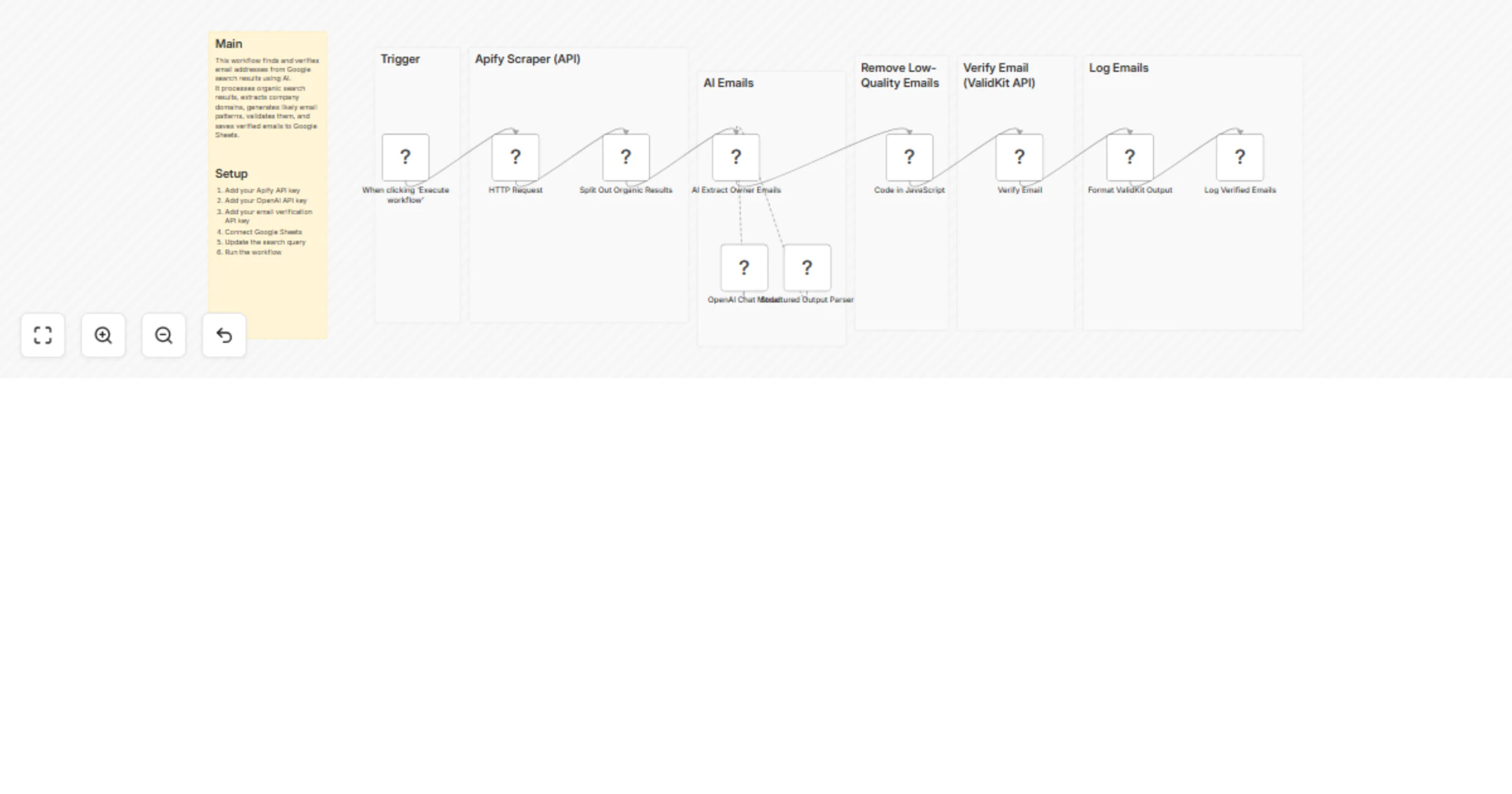
Workflow preview
100%
Scrape verified decision-maker emails from Google with GPT-4.1 and Apify preview
Open on n8n.io

1. Workflow Overview

Description This workflow automatically discovers decision maker email addresses from Google search results using AI. Starting from a search query, it scrapes organic Google results, extracts compa...

Best for

  • Lead Generation automation workflows
  • AI Summarization automation workflows
  • advanced n8n builders looking for reusable templates

Tools used

n8n-nodes-base.manualtrigger, n8n-nodes-base.httprequest, n8n-nodes-base.splitout, @n8n/n8n-nodes-langchain.agent, @n8n/n8n-nodes-langchain.lmchatopenai, @n8n/n8n-nodes-langchain.outputparserstructured, n8n-nodes-base.code, n8n-nodes-base.set

Source and attribution

This workflow is cataloged by N8N Workflows and links back to its original n8n.io source page by Hyrum Hurst.

Original n8n.io source

1.1 Workflow description

Title
Scrape verified decision-maker emails from Google with GPT-4.1 and Apify
Workflow name
Scrape verified decision-maker emails from Google with GPT-4.1 and Apify

Description

This workflow automatically discovers decision-maker email addresses from Google search results using AI.

Starting from a search query, it scrapes organic Google results, extracts company domains, infers likely decision-makers, generates realistic executive email patterns, validates deliverability, and stores only verified emails in Google Sheets.

The workflow is designed to reduce manual research while producing structured, outbound-ready contact data that can be reused across sales, partnerships, recruiting, and research workflows.


How it works

  1. Trigger The workflow starts manually or via a webhook with a Google search query.

  2. Google Search Scraping An Apify node collects organic Google search results for the query.

  3. Result Processing Each result is processed individually to extract the company name and website domain.

  4. Decision-Maker Inference An AI model analyzes the company context and identifies likely decision-makers (for example founders, executives, partners, or directors).

  5. Email Pattern Generation AI generates realistic executive email address candidates based on the company domain.

  6. Inbox Filtering Generic role-based inboxes (such as info@, support@, or sales@) are removed.

  7. Email Validation An email validation API checks deliverability and filters out invalid addresses.

  8. Data Structuring Results are normalized into structured fields for consistent storage.

  9. Storage Verified emails and company details are logged in Google Sheets.


Set up steps

  1. Apify
  • Create an Apify account
  • Generate an API token
  • Select a Google Search scraping actor
  1. OpenAI
  • Create an OpenAI account
  • Generate an API key
  1. Email validation service
  • Create an account with your preferred email validation provider
  • Generate an API key
  1. Google Sheets
  • Create a spreadsheet for storing results
  • Configure Google Sheets credentials in n8n
  1. Configure the workflow
  • Update the search query input
  • Add API keys to the relevant nodes
  • Select the target Google Sheet
  1. Run the workflow
  • Execute the workflow manually or via webhook

Output

Each processed result produces:

  • Company name
  • Website domain
  • Decision-maker email address
  • Email validation status
  • Source search query

Requirements

  • Apify account
  • OpenAI API key
  • Email validation API key
  • Google Sheets credentials

Author

Hyrum Hurst AI Automation Engineer at QuarterSmart 📧 [email protected]

1.2 Logical Blocks

This catalog entry is organized from the workflow JSON. The node-level section below shows the executable blocks available for review before importing the template.

2. Block-by-Block Analysis

Block 1 - When clicking ‘Execute workflow’

Type / Role
n8n-nodes-base.manualTrigger - manualTrigger
Config choices
Version 1

Block 2 - HTTP Request

Type / Role
n8n-nodes-base.httpRequest - httpRequest
Config choices
Version 4.3

Block 3 - Split Out Organic Results

Type / Role
n8n-nodes-base.splitOut - splitOut
Config choices
Version 1

Block 4 - AI Extract Owner Emails

Type / Role
@n8n/n8n-nodes-langchain.agent - agent
Config choices
Version 3

Block 5 - OpenAI Chat Model

Type / Role
@n8n/n8n-nodes-langchain.lmChatOpenAi - lmChatOpenAi
Config choices
Version 1.3

Block 6 - Structured Output Parser

Type / Role
@n8n/n8n-nodes-langchain.outputParserStructured - outputParserStructured
Config choices
Version 1.3

Block 7 - Code in JavaScript

Type / Role
n8n-nodes-base.code - code
Config choices
Version 2

Block 8 - Verify Email

Type / Role
n8n-nodes-base.httpRequest - httpRequest
Config choices
Version 4.3

Block 9 - Format ValidKit Output

Type / Role
n8n-nodes-base.set - set
Config choices
Version 3.4

Block 10 - Log Verified Emails

Type / Role
n8n-nodes-base.googleSheets - googleSheets
Config choices
Version 4.7

Block 11 - Sticky Note

Type / Role
n8n-nodes-base.stickyNote - stickyNote
Config choices
Version 1

Block 12 - Sticky Note1

Type / Role
n8n-nodes-base.stickyNote - stickyNote
Config choices
Version 1

Block 13 - Sticky Note2

Type / Role
n8n-nodes-base.stickyNote - stickyNote
Config choices
Version 1

Block 14 - Sticky Note3

Type / Role
n8n-nodes-base.stickyNote - stickyNote
Config choices
Version 1

Block 15 - Sticky Note4

Type / Role
n8n-nodes-base.stickyNote - stickyNote
Config choices
Version 1

Block 16 - Sticky Note5

Type / Role
n8n-nodes-base.stickyNote - stickyNote
Config choices
Version 1

Block 17 - Sticky Note6

Type / Role
n8n-nodes-base.stickyNote - stickyNote
Config choices
Version 1

3. Summary Table

Workflow Scrape verified decision-maker emails from Google with GPT-4.1 and Apify
Complexity advanced
Nodes 17
Categories Lead Generation, AI Summarization
Author Hyrum Hurst
Published 21 Jan 2026

4. Reproducing the Workflow from Scratch

  1. 1. Download the workflow JSON

    Use the JSON export at /data/workflows/12877/12877.json as the source template for this automation.

  2. 2. Import the template into n8n

    Open n8n, import the downloaded JSON, and review each node before activating the workflow.

  3. 3. Configure credentials and variables

    Replace placeholder credentials, API keys, webhook URLs, account IDs, and environment-specific values with your own settings.

  4. 4. Test with sample data

    Run the workflow manually or in a staging workspace, inspect node output, and confirm downstream systems receive the expected data.

  5. 5. Activate and monitor

    Enable the workflow only after testing, then monitor executions, errors, and rate limits during the first production runs.

5. General Notes & Resources

Review imported nodes carefully before activation. This catalog entry is intended to help you inspect the workflow structure, understand required services, and find related templates faster.

Node names, credentials, schedules, webhook paths, and external service limits may need adjustment for your workspace.

Frequently asked questions

What does Scrape verified decision-maker emails from Google with GPT-4.1 and Apify do?

Description This workflow automatically discovers decision maker email addresses from Google search results using AI. Starting from a search query, it scrapes organic Google results, extracts compa...

What do I need before importing this workflow?

Review the workflow JSON, configure any required credentials in n8n, and test the automation in a safe workspace before using it in production.

Can I customize this workflow?

Yes. Use the block-by-block analysis and the downloadable JSON to inspect each node, then adjust credentials, prompts, schedules, filters, or destinations for your Lead Generation, AI Summarization use case.



