Extract Meta Ads detailed targeting across all endpoints using Google Sheets
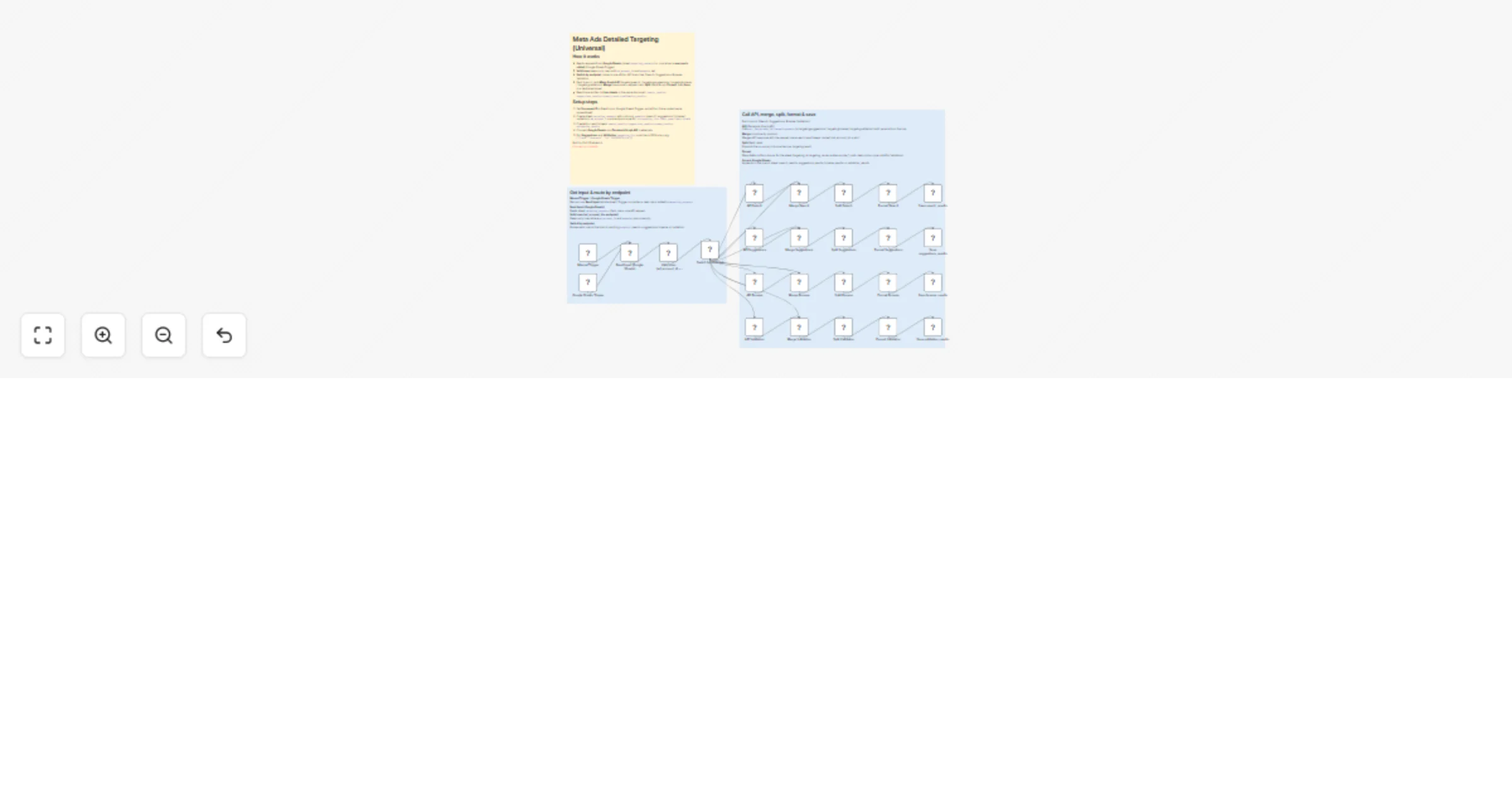
Workflow preview


 Early Deal
DISCOUNT 20%

Overview
Meta Ads Detailed Targeting Extractor (Universal, Switch by Endpoint)
This workflow is a universal automation for all four Meta Detailed Targeting API endpoints: Search, Suggestions, Browse, and Validation. You use a single Google Sheets tab with an endpoint column; a Switch node routes each row to the correct branch; results are written to four separate sheets in the same spreadsheet. It is designed for media buyers, performance marketers, and analysts who manage targeting research, audience suggestions, browse trees, and validation in bulk and want one workflow instead of four.
Use Case
Working with Meta’s Detailed Targeting API usually means separate flows for search, suggestions, browse, and validation. This workflow is ideal if you want to:
- Centralize targeting operations in one place: one input sheet, one workflow, four result sheets.
- Drive everything from Google Sheets: add rows with
endpoint(search | suggestions | browse | validation),ad_account_id, and endpoint-specific parameters; run manually or on new rows. - Keep results organized by endpoint:
search_results,suggestions_results,browse_results,validation_resultsin the same document. - Run on demand or on row add: use Manual Trigger for full-sheet runs or Google Sheets Trigger to process only new rows.
How it Works
The workflow is organized into clear blocks:
1. Trigger & input
- Manual Trigger → Read Input (Google Sheets) — reads the entire
targeting_requestssheet for ad-hoc or test runs. - Google Sheets Trigger — runs when a new row is added to
targeting_requests; only new rows are processed (no re-processing of existing data). - Read Input (Google Sheets) always reads from the same sheet:
targeting_requests.
2. Validation & routing
- Valid rows (ad_account_id + endpoint) — Filter node keeps only rows where both
ad_account_idandendpointare non-empty. - Switch by endpoint — routes each row to one of four branches based on
endpoint:search,suggestions,browse, orvalidation(values must match exactly, including case).
3. Each branch (Search, Suggestions, Browse, Validation)
- API (Facebook Graph API) — calls the corresponding edge:
targetingsearch,targetingsuggestions,targetingbrowse, ortargetingvalidationwith parameters from the row (act_{ad_account_id}/...). - Merge (combine by position) — merges the API response with the original request row so each result keeps context (e.g.
ad_account_id,q,targeting_list). - Split (field:
data) — expands the APIdataarray into one item per targeting result. - Format — maps fields to flat columns for the sheet:
endpoint,ad_account_id,query,limit_type,targeting_id,targeting_name,audience_size_lower_bound,audience_size_upper_bound,path,description,type; for Validation branch,validis also included. - Save to Google Sheets — appends to the branch-specific sheet:
search_results,suggestions_results,browse_results, orvalidation_results.
4. Output
- All four Save nodes write to the same spreadsheet (same Document ID), each to its own sheet. The
validcolumn is populated only invalidation_results; other sheets leave it empty.
Input sheet: targeting_requests
Required columns for every row:
| Column | Description |
|---|---|
endpoint |
One of: search, suggestions, browse, validation (lowercase). |
ad_account_id |
Meta ad account ID (without the act_ prefix). |
Endpoint-specific columns:
| Endpoint | Required | Optional |
|---|---|---|
| search | q — search query |
limit (default 25), limit_type, locale |
| suggestions | targeting_list — JSON array, e.g. [{"type":"interests","id":"6003263791114"}] |
limit (up to 45), limit_type, locale |
| browse | — | limit_type, locale |
| validation | One of: targeting_list, id_list, or name_list (string/JSON per Meta API docs) |
locale |
If search has no q, or suggestions / validation lack the required targeting input, the API call will fail.
Output sheets (same document)
Use the same Document ID in Read Input, Google Sheets Trigger, and all four Save nodes. Create (or let n8n create) these sheet names:
| Sheet | Branch | Notes |
|---|---|---|
search_results |
Search | endpoint, ad_account_id, query, limit_type, targeting_id, targeting_name, audience_size_*, path, description, type |
suggestions_results |
Suggestions | Same columns; query holds the targeting_list from the request |
browse_results |
Browse | Same columns; query empty |
validation_results |
Validation | Same columns + valid (true/false from API) |
Setup Instructions
1. Credentials
- Connect Google Sheets OAuth2 in: Read Input (Google Sheets), Google Sheets Trigger (if used), and all four Save nodes.
- Connect Facebook Graph API credentials in each of the four API nodes (e.g. same “Facebook Graph” credential set).
2. Spreadsheet & sheets
- Set the Document ID in:
- Read Input (Google Sheets) — Document = your spreadsheet, Sheet =
targeting_requests. - Google Sheets Trigger — same Document ID and sheet
targeting_requests(if you use the trigger). - All four Save ..._results nodes — same Document ID; each node uses its own Sheet name:
search_results,suggestions_results,browse_results,validation_results. - Create the input sheet
targeting_requestswith the columns described above and the four result sheets (or allow n8n to create them on first append).
3. Switch by endpoint
- Ensure the
endpointcolumn intargeting_requestscontains exactly:search,suggestions,browse, orvalidation(lowercase, as in the Switch conditions).
4. Triggers
- Keep Manual Trigger for full-sheet runs; use Google Sheets Trigger for row-added automation. When using the trigger, run the workflow only when new rows are added so existing rows are not processed again.
5. Activate
- Save and activate the workflow. Test with a few rows per endpoint before processing large sheets.
The workflow reuses the same patterns as other Meta Detailed Targeting templates: read from Sheets, call Facebook Graph API, Merge by position, Split Out on data, then append to Sheets. The difference is the single input sheet with an endpoint column, Switch-based routing, and four dedicated branches writing to four sheets in one spreadsheet.