Block 1 - Extract Application Data
- Type / Role
- n8n-nodes-base.set - set
- Config choices
- Version 3.4


 Early Deal
This workflow is provided as-is. Please review and test before using in production.
Revolutionize university admissions with intelligent AI driven application evaluation that analyzes student profiles, calculates eligibility scores, and automatically routes decisions saving 2.5 ho...
n8n-nodes-base.set, n8n-nodes-base.code, n8n-nodes-base.if, n8n-nodes-base.gmail, n8n-nodes-base.googlesheets, n8n-nodes-base.stickynote, @n8n/n8n-nodes-langchain.agent, @n8n/n8n-nodes-langchain.lmchatopenai
This workflow is cataloged by N8N Workflows and links back to its original n8n.io source page by Jitesh Dugar.
Original n8n.io sourceRevolutionize university admissions with intelligent AI-driven application evaluation that analyzes student profiles, calculates eligibility scores, and automatically routes decisions - saving 2.5 hours per application and reducing decision time from weeks to hours.
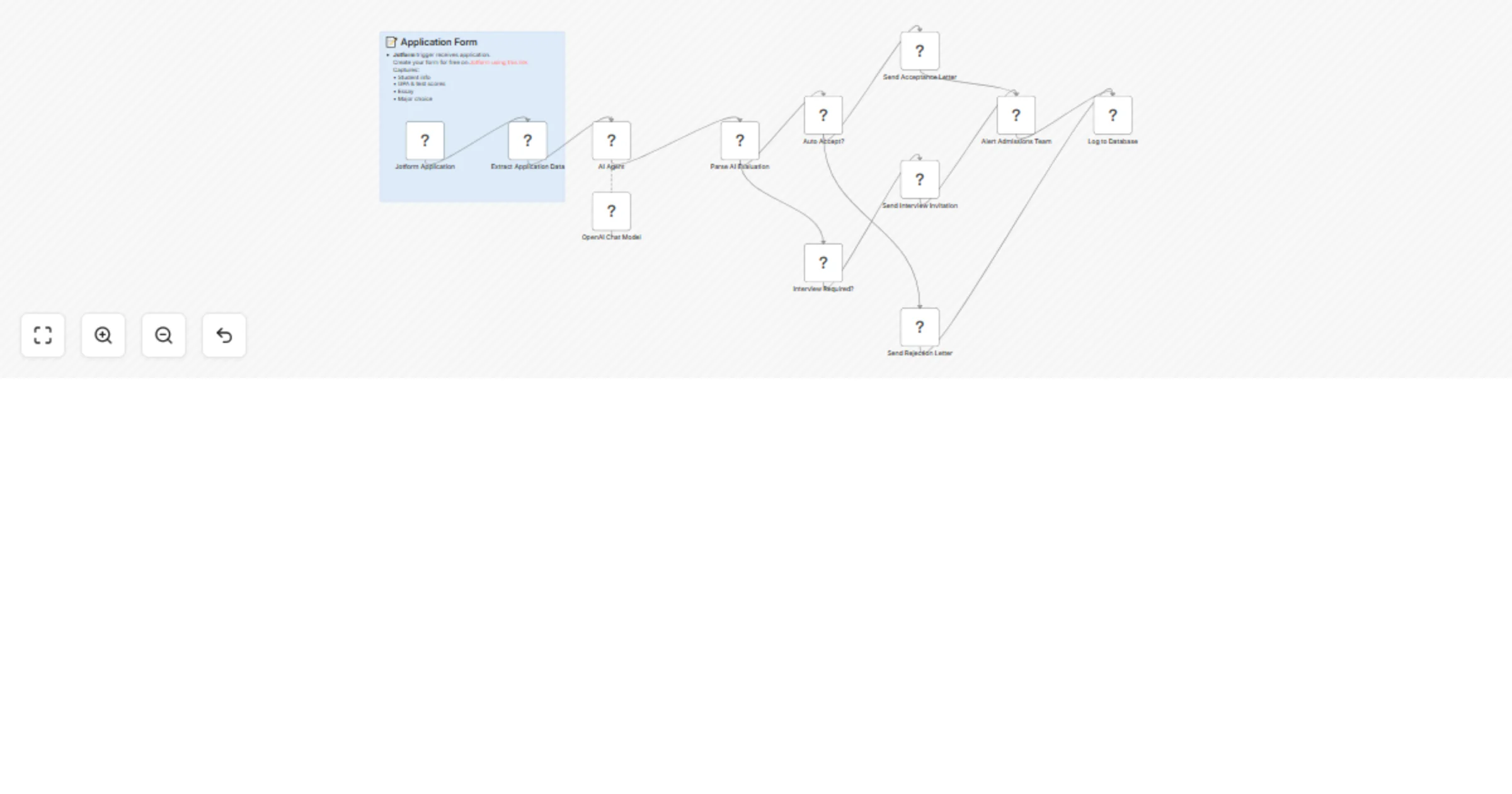
Transforms your admissions process from manual application review to intelligent automation:
📝 Captures Applications - Jotform intake with student info, GPA, test scores, essay, extracurriculars
🤖 AI Holistic Evaluation - OpenAI analyzes academic strength, essay quality, extracurriculars, and fit
🎯 Intelligent Scoring - Evaluates students using 40% academics, 25% extracurriculars, 20% essay, 15% fit (0-100 scale)
🚦 Smart Routing - Automatically routes based on AI evaluation:
💰 Scholarship Automation - Calculates merit scholarships ($5k-$20k+) based on eligibility score
📊 Analytics Tracking - All applications logged to Google Sheets for admissions insights
AI Holistic Evaluation: Comprehensive analysis weighing academics, extracurriculars, essays, and institutional fit
Intelligent Scoring System: 0-100 eligibility score with automated categorization and scholarship determination
Structured Output: Consistent JSON schema with academic strength, admission likelihood, and decision reasoning
Automated Communication: Personalized acceptance, interview, and rejection letters for every applicant
Fallback Scoring: Manual GPA/SAT scoring if AI fails - ensures zero downtime
Admin Alerts: Instant email notifications for exceptional high-scoring applicants (95+)
Comprehensive Analytics: Track acceptance rates, average scores, scholarship distribution, and applicant demographics
Customizable Criteria: Easy prompt editing to match your institution's values and requirements
Universities & Colleges: Processing 500+ undergraduate applications per semester
Graduate Programs: Screening master's and PhD applications with consistent evaluation
Private Institutions: Scaling admissions without expanding admissions staff
Community Colleges: Handling high-volume transfer and new student applications
International Offices: Evaluating global applicants 24/7 across all timezones
Scholarship Committees: Identifying merit scholarship candidates automatically
Jotform - Application form with student data collection (free tier works) Create your form for free on Jotform using this link Create your application form with fields: Name, Email, Phone, GPA, SAT Score, Major, Essay, Extracurriculars
OpenAI API - GPT-4o-mini for cost-effective AI evaluation (~$0.01-0.05 per application)
Gmail - Automated applicant communication (acceptance, interview, rejection letters)
Google Sheets - Application database and admissions analytics
Slack - Real-time alerts for exceptional applicants
Calendar APIs - Automated interview scheduling
Student Information System (SIS) - Push accepted students to enrollment system
Document Analysis Tools - OCR for transcript verification
Adjust Evaluation Weights: Change academics (40%), extracurriculars (25%), essay (20%), fit (15%) percentages
Multiple Programs: Clone workflow for different majors with unique evaluation criteria
Add Document Analysis: Integrate OCR for transcript and recommendation letter verification
Interview Scheduling: Connect Google Calendar or Calendly for automated booking
SIS Integration: Push accepted students directly to Banner, Ellucian, or PeopleSoft
Waitlist Management: Add conditional routing for borderline scores (65-69)
Diversity Tracking: Include demographic fields and bias detection in AI evaluation
Financial Aid Integration: Automatically calculate need-based aid eligibility alongside merit scholarships
90% reduction in manual application review time (from 2.5 hours to 15 minutes per application)
24-48 hour decision turnaround time vs 4-6 weeks traditional process
40% higher yield rate - faster responses increase enrollment commitment
100% consistency - every applicant evaluated with identical criteria
Zero missed applications - automated tracking ensures no application falls through cracks
Data-driven admissions - comprehensive analytics on applicant pools and acceptance patterns
Better applicant experience - professional, timely communication regardless of decision
Defensible decisions - documented scoring criteria for accreditation and compliance
Screen 5,000+ applications per semester, identify top 20% for auto-admit, route borderline to committee review.
Evaluate 500+ highly competitive applications, calculate merit scholarships automatically, schedule interviews with top candidates.
Process master's and PhD applications with research experience weighting, flag candidates for faculty review, automate fellowship awards.
Handle high-volume open enrollment while identifying honors program candidates and scholarship recipients instantly.
Evaluate global applicants 24/7, account for different GPA scales and testing systems, respond same-day regardless of timezone.
Provide instant decisions for early applicants, fill classes strategically, optimize scholarship budget allocation.
Calibrate Your AI: After 100+ applications, refine evaluation criteria based on enrolled student success
A/B Test Thresholds: Experiment with score cutoffs (e.g., 93 vs 95 for auto-admit) to optimize yield
Build Waitlist Pipeline: Keep 70-84 score candidates engaged for spring enrollment or next year
Track Source Effectiveness: Add UTM parameters to measure which recruiting channels deliver best students
Committee Review: Route 85-94 scores to human admissions committee for final review
Bias Audits: Quarterly review of AI decisions by demographic groups to ensure fairness
Parent Communication: Add parent/guardian emails for admitted students under 18
Financial Aid Coordination: Sync scholarship awards with financial aid office for packaging
This workflow demonstrates:
Perfect for learning advanced n8n automation patterns in educational technology!
FERPA Compliance: Protects student data with secure credential handling
Fair Admissions: Documented criteria eliminate unconscious bias
Human Oversight: Committee review option for borderline cases
Transparency: Applicants can request evaluation criteria
Appeals Process: Structured workflow for decision reconsideration
Data Retention: Configurable Google Sheets retention policies
Ready to transform your admissions process? Import this template and start evaluating applications intelligently in under 1 hour.
Questions or customization needs? The workflow includes detailed sticky notes explaining each section and comprehensive fallback logic for reliability.
This catalog entry is organized from the workflow JSON. The node-level section below shows the executable blocks available for review before importing the template.
| Workflow | University application evaluation & scholarship automation with GPT-4 & Jotform |
|---|---|
| Complexity | intermediate |
| Nodes | 13 |
| Categories | HR, AI Summarization |
| Author | Jitesh Dugar |
| Published | 13 Oct 2025 |
Use the JSON export at /data/workflows/9574/9574.json as the source template for this automation.
Open n8n, import the downloaded JSON, and review each node before activating the workflow.
Replace placeholder credentials, API keys, webhook URLs, account IDs, and environment-specific values with your own settings.
Run the workflow manually or in a staging workspace, inspect node output, and confirm downstream systems receive the expected data.
Enable the workflow only after testing, then monitor executions, errors, and rate limits during the first production runs.
Review imported nodes carefully before activation. This catalog entry is intended to help you inspect the workflow structure, understand required services, and find related templates faster.
Node names, credentials, schedules, webhook paths, and external service limits may need adjustment for your workspace.
Revolutionize university admissions with intelligent AI driven application evaluation that analyzes student profiles, calculates eligibility scores, and automatically routes decisions saving 2.5 ho...
Review the workflow JSON, configure any required credentials in n8n, and test the automation in a safe workspace before using it in production.
Yes. Use the block-by-block analysis and the downloadable JSON to inspect each node, then adjust credentials, prompts, schedules, filters, or destinations for your HR, AI Summarization use case.