
Triage customer support emails with Groq AI, ClickUp and Google Sheets

Workflow preview
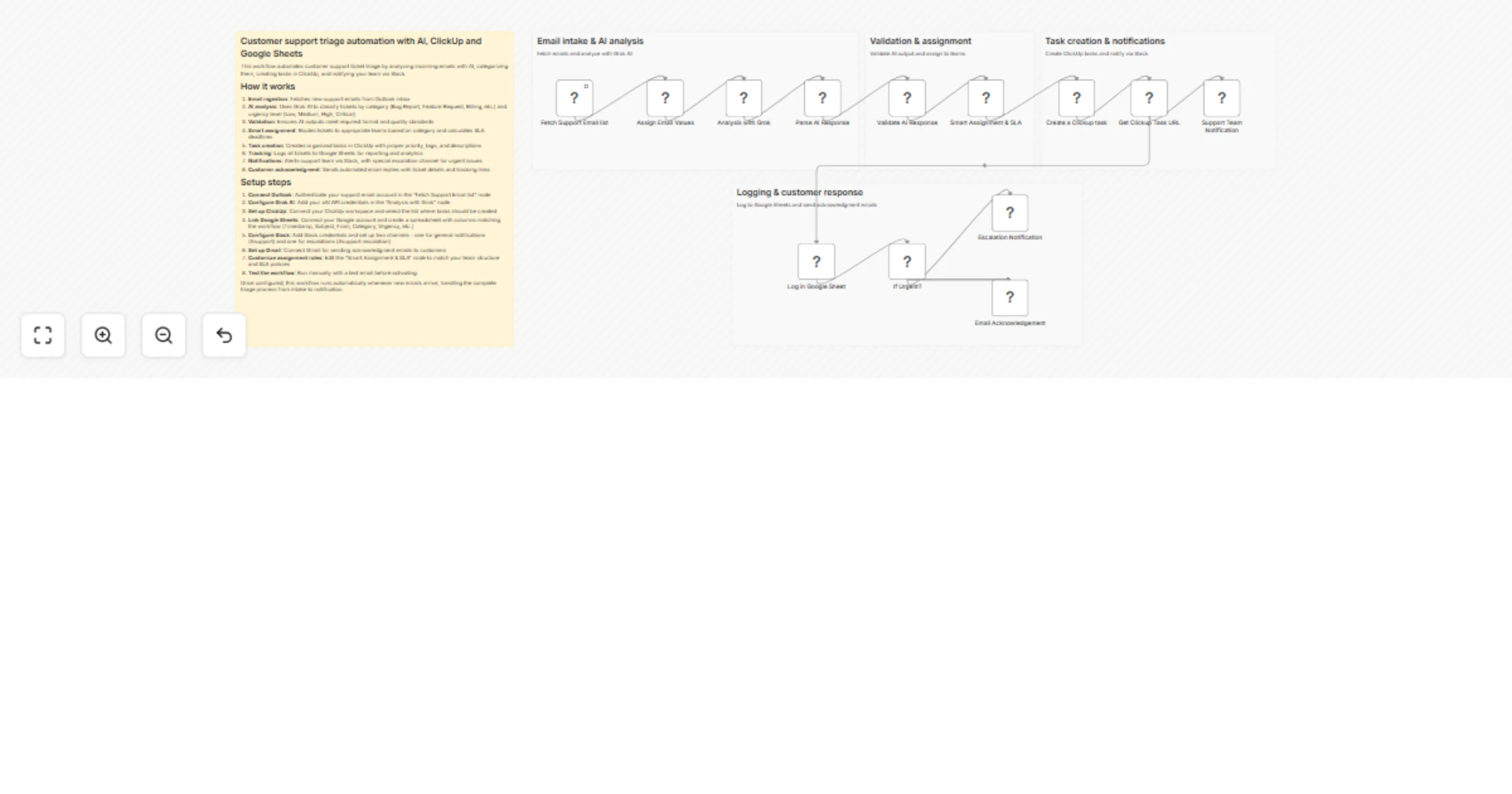
Workflow preview
100%
Triage customer support emails with Groq AI, ClickUp and Google Sheets preview
Open on n8n.io

1. Workflow Overview

Customer Support Triage Automation with AI, ClickUp and Google Sheets Description This workflow automates the complete customer support email triage process by intelligently classifying incoming...

Best for

  • Ticket Management automation workflows
  • AI Summarization automation workflows
  • advanced n8n builders looking for reusable templates

Tools used

n8n-nodes-base.code, n8n-nodes-base.httprequest, n8n-nodes-base.set, n8n-nodes-base.gmailtrigger, n8n-nodes-base.clickup, n8n-nodes-base.slack, n8n-nodes-base.if, n8n-nodes-base.gmail

Source and attribution

This workflow is cataloged by N8N Workflows and links back to its original n8n.io source page by Vivekanand M.

Original n8n.io source

1.1 Workflow description

Title
Triage customer support emails with Groq AI, ClickUp and Google Sheets
Workflow name
Triage customer support emails with Groq AI, ClickUp and Google Sheets

Customer Support Triage Automation with AI, ClickUp and Google Sheets

πŸ“˜ Description

This workflow automates the complete customer support email triage process by intelligently classifying incoming support emails, validating AI outputs, assigning tickets to appropriate teams, and orchestrating all downstream actions in a consistent, trackable manner. It is designed for support teams that need to instantly categorise and route high volumes of customer inquiries while maintaining quality, accountability, and fast response times.

The workflow is triggered automatically when new emails arrive in your support inbox. Incoming emails are analysed by Grok AI to determine ticket category (Bug Report, Feature Request, Billing Question, Technical Support, General Inquiry, or Marketing Email) and urgency level (Low, Medium, High, Critical). A validation layer ensures AI outputs meet quality standards with automatic corrections for invalid responses.

Based on the categorisation, the workflow applies intelligent routing rules to assign tickets to the right team (Engineering, Billing, Product, or Support), calculates SLA deadlines based on urgency, and detects escalation triggers like negative sentiment or churn risk keywords. For every ticket, the workflow runs parallel actions: it creates a detailed ClickUp task for team tracking, logs complete ticket information to Google Sheets for analytics, sends real-time Slack notifications to appropriate channels, and delivers a professional acknowledgement email to the customer with ticket details and tracking links.

βš™οΈ What This Workflow Does (Step-by-Step)

πŸ“§ Email Intake - Fetches new support emails from the Outlook inbox automatically.

πŸ“ Assign Email Values - Normalises email data into a consistent structure for processing.

🧠 AI Analysis with Grok - Classifies tickets by category and urgency using AI reasoning.

πŸ” Parse AI Response - Extracts structured data from AI output and adds metadata.

βœ… Validate AI Response - Ensures outputs meet quality standards with automatic fixes for invalid categories or missing summaries.

🎯 Smart Assignment & SLA - Routes tickets to appropriate teams, calculates SLA deadlines (1 hour for Critical, 4 hours for High, 24 hours for Medium, 48 hours for Low), and flags escalation cases based on sentiment or urgency.

πŸ“‹ Create ClickUp Task - Generates organised tasks with priority levels, tags, and complete ticket context.

πŸ”— Get ClickUp Task URL - Captures task links for tracking and reference.

πŸ“Š Log to Google Sheets - Records all ticket details in a centralised tracking spreadsheet.

πŸ’¬ Team Notification (Slack) - Alerts the support team with ticket summary and ClickUp link.

🚨 Escalation Notification (Slack) - Sends urgent alerts to the escalation channel for critical or high-risk tickets.

βœ‰οΈ Customer Acknowledgement (Email) - Delivers professional auto-reply with ticket details, SLA timeline, and tracking link.

🧩 Prerequisites

β€’ Microsoft Outlook or Gmail account for support inbox β€’ Grok API credentials (x.ai) - can be replaced with OpenAI or Claude β€’ Google Sheets OAuth2 for ticket tracking β€’ ClickUp API access for task management β€’ Slack API access for team notifications β€’ Gmail OAuth2 for customer acknowledgement emails

πŸ’‘ Key Benefits

βœ” Instant categorisation of all incoming support emails βœ” Intelligent team routing based on ticket type and urgency βœ” Automatic SLA deadline calculation and tracking βœ” Built-in validation prevents AI errors from reaching customers βœ” Escalation detection for negative sentiment and churn risk βœ” Complete audit trail in Google Sheets βœ” Real-time team awareness via Slack βœ” Professional customer communication with zero delay βœ” Seamless ClickUp integration for task management

πŸ‘₯ Perfect For

  • Customer support teams handling high email volumes
  • SaaS companies managing technical support requests
  • Operations teams needing instant triage and routing
  • Businesses requiring strict SLA compliance
  • Support organisations using ClickUp for task management
  • Teams wanting complete visibility and accountability

1.2 Logical Blocks

This catalog entry is organized from the workflow JSON. The node-level section below shows the executable blocks available for review before importing the template.

2. Block-by-Block Analysis

Block 1 - Validate AI Response

Type / Role
n8n-nodes-base.code - code
Config choices
Version 2

Block 2 - Smart Assignment & SLA

Type / Role
n8n-nodes-base.code - code
Config choices
Version 2

Block 3 - Parse AI Response

Type / Role
n8n-nodes-base.code - code
Config choices
Version 2

Block 4 - Analysis with Grok

Type / Role
n8n-nodes-base.httpRequest - httpRequest
Config choices
Version 4.3

Block 5 - Assign Email Values

Type / Role
n8n-nodes-base.set - set
Config choices
Version 3.4

Block 6 - Get Clickup Task URL

Type / Role
n8n-nodes-base.code - code
Config choices
Version 2

Block 7 - Fetch Support Email list

Type / Role
n8n-nodes-base.gmailTrigger - gmailTrigger
Config choices
Version 1.3

Block 8 - Create a Clickup task

Type / Role
n8n-nodes-base.clickUp - clickUp
Config choices
Version 1

Block 9 - Escalation Notification

Type / Role
n8n-nodes-base.slack - slack
Config choices
Version 2.4

Block 10 - Support Team Notification

Type / Role
n8n-nodes-base.slack - slack
Config choices
Version 2.4

Block 11 - If Urgent?

Type / Role
n8n-nodes-base.if - if
Config choices
Version 2.3

Block 12 - Email Acknowledgement

Type / Role
n8n-nodes-base.gmail - gmail
Config choices
Version 2.2

Block 13 - Sticky Note

Type / Role
n8n-nodes-base.stickyNote - stickyNote
Config choices
Version 1

Block 14 - Sticky Note1

Type / Role
n8n-nodes-base.stickyNote - stickyNote
Config choices
Version 1

Block 15 - Sticky Note2

Type / Role
n8n-nodes-base.stickyNote - stickyNote
Config choices
Version 1

Block 16 - Sticky Note3

Type / Role
n8n-nodes-base.stickyNote - stickyNote
Config choices
Version 1

Block 17 - Sticky Note4

Type / Role
n8n-nodes-base.stickyNote - stickyNote
Config choices
Version 1

Block 18 - Log in Google Sheet

Type / Role
n8n-nodes-base.googleSheets - googleSheets
Config choices
Version 4.7

3. Summary Table

Workflow Triage customer support emails with Groq AI, ClickUp and Google Sheets
Complexity advanced
Nodes 18
Categories Ticket Management, AI Summarization
Author Vivekanand M
Published 10 Feb 2026

4. Reproducing the Workflow from Scratch

  1. 1. Download the workflow JSON

    Use the JSON export at /data/workflows/13289/13289.json as the source template for this automation.

  2. 2. Import the template into n8n

    Open n8n, import the downloaded JSON, and review each node before activating the workflow.

  3. 3. Configure credentials and variables

    Replace placeholder credentials, API keys, webhook URLs, account IDs, and environment-specific values with your own settings.

  4. 4. Test with sample data

    Run the workflow manually or in a staging workspace, inspect node output, and confirm downstream systems receive the expected data.

  5. 5. Activate and monitor

    Enable the workflow only after testing, then monitor executions, errors, and rate limits during the first production runs.

5. General Notes & Resources

Review imported nodes carefully before activation. This catalog entry is intended to help you inspect the workflow structure, understand required services, and find related templates faster.

Node names, credentials, schedules, webhook paths, and external service limits may need adjustment for your workspace.

Frequently asked questions

What does Triage customer support emails with Groq AI, ClickUp and Google Sheets do?

Customer Support Triage Automation with AI, ClickUp and Google Sheets Description This workflow automates the complete customer support email triage process by intelligently classifying incoming...

What do I need before importing this workflow?

Review the workflow JSON, configure any required credentials in n8n, and test the automation in a safe workspace before using it in production.

Can I customize this workflow?

Yes. Use the block-by-block analysis and the downloadable JSON to inspect each node, then adjust credentials, prompts, schedules, filters, or destinations for your Ticket Management, AI Summarization use case.



