Test WAF security interactively with an AI agent and WAFtester MCP
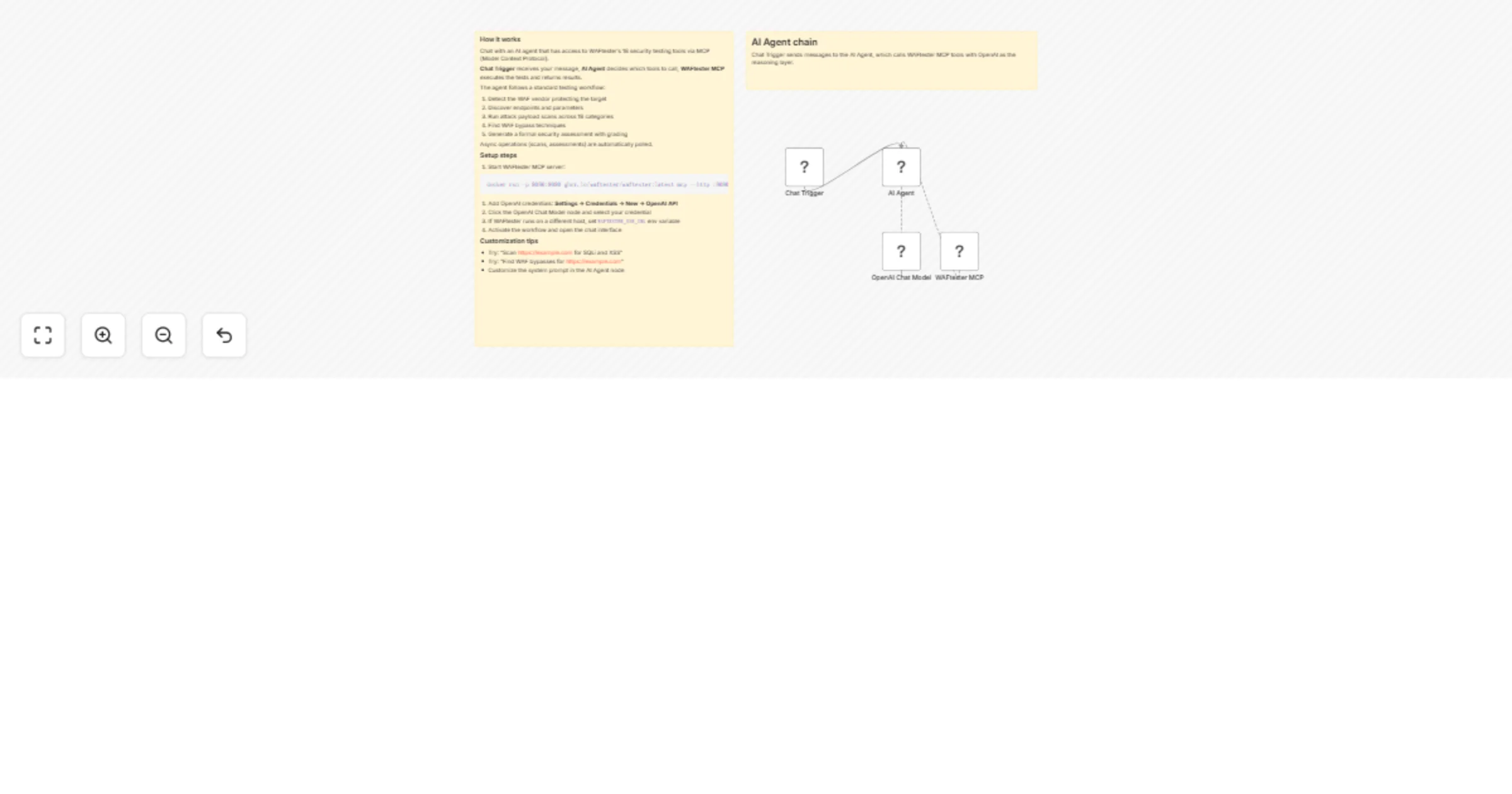
Workflow preview


 Early Deal
DISCOUNT 20%

Overview
What it does
A conversational AI agent that connects to WAFtester via MCP (Model Context Protocol) for interactive Web Application Firewall security testing. Type natural language requests — the agent picks the right tools, runs the tests, and explains the results.
About WAFtester
WAFtester is an open-source CLI for testing Web Application Firewalls. It ships 27 MCP tools, 2,800+ attack payloads across 18 categories (SQLi, XSS, SSRF, SSTI, command injection, XXE, and more), detection signatures for 26 WAF vendors and 9 CDNs, and enterprise-grade assessment with F1/MCC scoring and letter grades (A+ through F).
- GitHub: github.com/waftester/waftester
- Docs: Installation | Examples | Commands
Who it's for
- Security engineers running ad-hoc WAF assessments
- Penetration testers who want AI-assisted reconnaissance and bypass discovery
- DevSecOps teams validating WAF coverage before and after deployments
- API security teams testing OpenAPI/Swagger specs against WAF rules
How it works
The workflow has four nodes:
- Chat Trigger — Opens an n8n chat interface where you type requests in plain English
- AI Agent — Receives your message, reasons about which tools to call, and orchestrates the testing workflow
- OpenAI Chat Model — Provides the LLM reasoning layer (GPT-4o recommended; swappable for Anthropic, Ollama, etc.)
- WAFtester MCP — Connects to the WAFtester server via SSE and exposes all 27 tools to the agent
The agent follows a standard WAF testing workflow:
- detect_waf — Fingerprint the WAF vendor and CDN protecting the target
- discover — Map the attack surface (endpoints, parameters, technologies) from robots.txt, sitemaps, JavaScript, and Wayback Machine
- learn — Generate a prioritized test plan based on discovery results
- scan — Fire 2,800+ attack payloads and measure detection vs. bypass rates
- bypass — Systematic mutation matrix testing to find WAF evasion techniques
- assess — Generate a formal security grade with F1, precision, MCC, and false positive rate
Long-running operations (scan, assess, bypass, discover, discover_bypasses, event_crawl, scan_spec) run asynchronously — the agent polls for results automatically.
Key capabilities
| Capability | Details |
|---|---|
| WAF detection | Fingerprint 26 WAF vendors and 9 CDNs from response headers, cookies, and error pages |
| Payload scanning | 2,800+ payloads across 18 attack categories |
| Bypass discovery | Mutation matrix with 40+ tamper techniques to find WAF evasions |
| Enterprise assessment | F1 score, precision, MCC, false positive rate, and A+ through F grading |
| API spec testing | Validate, plan, and scan OpenAPI/Swagger/Postman specs |
| Headless crawling | Click-driven DOM crawling via headless browser for JS-rendered endpoints |
| Knowledge resources | 12 built-in resources covering WAF signatures, evasion techniques, OWASP mappings, and config defaults |
Example prompts
- "What WAF is protecting https://example.com?"
- "Scan https://example.com for SQLi and XSS"
- "Find WAF bypasses for https://example.com"
- "Run a full security assessment of https://example.com"
- "Validate my API spec at https://example.com/openapi.json"
- "Discover the attack surface of https://example.com"
How to set up
- Start WAFtester MCP server:
docker run -p 8080:8080 ghcr.io/waftester/waftester:latest mcp --http :8080 - Add OpenAI credentials in n8n: Settings → Credentials → New → OpenAI API
- Select the credential in the OpenAI Chat Model node
- Activate the workflow and open the chat interface
Alternatively, use the included docker-compose.yml to run both n8n and WAFtester together with docker compose up -d.
Requirements
| Requirement | Details |
|---|---|
| WAFtester MCP server | Docker image (ghcr.io/waftester/waftester:latest) or binary install for macOS, Linux, Windows |
| LLM API key | OpenAI (default), or swap the model node for Anthropic, Ollama, Azure OpenAI, or any LangChain-compatible provider |
| Authorization | Only test targets you have explicit written permission to test |