Route user requests to specialized agents with GPT-4o Mini
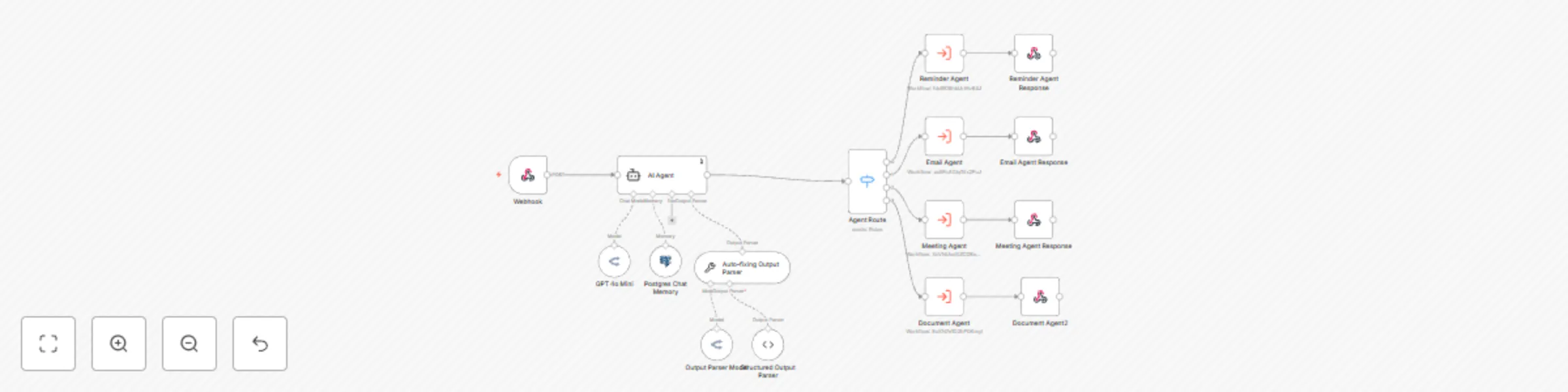
Workflow preview


 Early Deal
DISCOUNT 20%

Important notice
This workflow is provided as-is. Please review and test before using in production.
Overview
This n8n workflow template is designed to route user input to specialized agents (like a Reminder Agent, Email Agent, etc.) using a structured output from a language model. Here's a complete description of what it does and how each part works:
🔁 Workflow Purpose:
This template receives a user's request via Webhook, processes it using an LLM, extracts structured data like the agent name and user query, and routes the input to the appropriate sub-workflow (agent) based on the specified agent type.
🧩 Workflow Breakdown:
1. Webhook (Trigger)
- Node:
Webhook - Purpose: Accepts a POST request from any frontend or API source. It contains the raw user input.
2. GPT Model (LLM Inference)
Node:
GPT 4o MiniPurpose: Interprets the user input and determines:
- Which agent should handle it (e.g., "Reminder Agent", "Email Agent", etc.)
- The actual user request (in structured format)
3. Auto-Fixing Output Parser
- Node:
Auto-fixing Output Parser - Purpose: Ensures that the output from the LLM matches the expected structure. If there's a mismatch, it automatically corrects it using a re-prompt.
4. Structured Output Parser
Node:
Structured Output ParserPurpose: Converts the language model's response into a strict JSON structure with keys like:
"Agent Name""user input""sessionID"
5. Agent Router
Node:
Switch ("Agent Route")Purpose: Based on
"Agent Name", it routes the input to one of the following sub-workflows:- 📅
Reminder Agent - 📧
Email Agent - 🧾
Document Agent - 🤝
Meeting Agent
- 📅
6. Sub-Workflow Call (Execute Workflow)
Each agent is implemented as a separate n8n workflow:
- The input is forwarded to the selected agent.
- For example, if
"Agent Name"is"Reminder Agent", the workflow"Reminder Agent"is called with"user input".
7. Webhook Response
- After the sub-agent workflow finishes, a
Respond to Webhooknode sends the output back as an HTTP response.
✅ Key Features:
- Fully modular and extensible
- LLM-driven routing using OpenRouter GPT-4o
- Auto-corrects structured output errors
- Clean separation of concerns (agent logic is decoupled in sub-workflows)
- Easily add more agents by updating the switch logic
📦 Use Case Examples:
User says: “Remind me to call my mom tomorrow.” → Routed to Reminder Agent
User says: “Send an email to the HR team.” → Routed to Email Agent
User says: “Schedule a meeting with John next week.” → Routed to Meeting Agent