
Match medical symptoms to products with OpenAI, Qdrant & Google Sheets RAG

Workflow preview
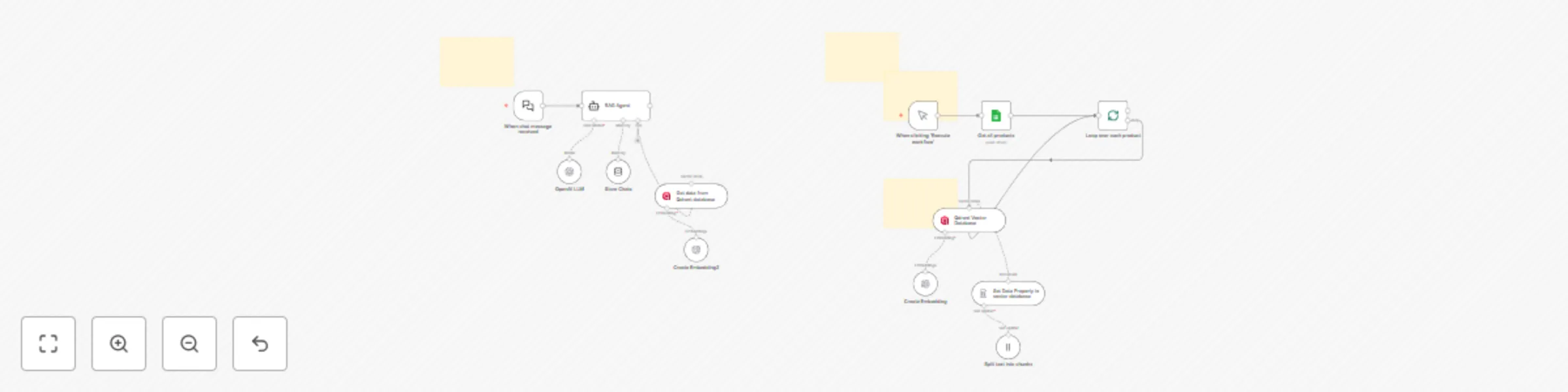
Workflow preview
100%
Match medical symptoms to products with OpenAI, Qdrant & Google Sheets RAG preview
Open on n8n.io

Important notice

This workflow is provided as-is. Please review and test before using in production.

1. Workflow Overview

RAG AI Medical Agent – n8n Workflow Who’s it for This workflow is perfect for: Healthcare ecommerce businesses that want to automate product recommendations. Founders or developers building a...

Best for

  • Lead Nurturing automation workflows
  • AI RAG automation workflows
  • advanced n8n builders looking for reusable templates

Tools used

n8n-nodes-base.stickynote, @n8n/n8n-nodes-langchain.agent, n8n-nodes-base.manualtrigger, @n8n/n8n-nodes-langchain.vectorstoreqdrant, @n8n/n8n-nodes-langchain.embeddingsopenai, @n8n/n8n-nodes-langchain.documentdefaultdataloader, @n8n/n8n-nodes-langchain.textsplittercharactertextsplitter, n8n-nodes-base.splitinbatches

Source and attribution

This workflow is cataloged by N8N Workflows and links back to its original n8n.io source page by Zain Ali.

Original n8n.io source

1.1 Workflow description

Title
Match medical symptoms to products with OpenAI, Qdrant & Google Sheets RAG
Workflow name
Match medical symptoms to products with OpenAI, Qdrant & Google Sheets RAG

🧠 RAG AI Medical Agent – n8n Workflow

👥 Who’s it for

This workflow is perfect for:

  • Healthcare ecommerce businesses that want to automate product recommendations.
  • Founders or developers building an AI assistant using retrieval-augmented generation (RAG) with product data.
  • Anyone wanting to combine OpenAI, Qdrant vector search, and Google Sheets to power intelligent medical queries.

⚙️ How it works / What it does

This RAG-based workflow allows users to ask medical questions related to hair or scalp issues (e.g., hair loss, thinning). It:

  1. Retrieves product info from a Google Sheet.
  2. Converts product data into text embeddings using OpenAI.
  3. Stores those embeddings in a Qdrant vector database.
  4. On chat message trigger, performs a vector similarity search to match user symptoms with relevant products.
  5. Uses an AI agent to respond with top 3 matching products from your catalog.

🛠️ How to set up

Step 1: 🗂 Get your data

  • Make sure your Google Sheet contains the following columns:
    • Product Name
    • Symptoms Involved
    • Product Description
    • ForeverBetty Product Page Link
    • Category (optional but recommended)

Step 2: 🔐 Connect your accounts

  • Add your Google Sheets OAuth2 credentials in the "Get all products" node.
  • Add your OpenAI API key in the embedding nodes.
  • Add your Qdrant credentials in the vector store nodes.

Step 3: 🧠 Populate the Vector DB

  1. Click “Execute workflow” manually.
  2. This pulls data from the Google Sheet.
  3. Each row is:
    • Formatted properly into a vector-friendly string.
    • Converted into an embedding using OpenAI.
    • Stored into Qdrant.

Step 4: 💬 Enable Chat Interface

  • Use the ChatTrigger to receive user queries.
  • The agent searches Qdrant for relevant vectors.
  • Replies with product suggestions via LangChain's LLM agent.

📋 Requirements

  • 🧠 n8n
  • 📄 A Google Sheet with product data.
  • 🔐 Google Sheets OAuth2 credentials.
  • 🧠 OpenAI API key (for embeddings + chat LLM).
  • 🗃️ Qdrant Vector DB instance (Cloud or self-hosted).

🧩 How to customize it

🔄 Change the data structure

  • Update the "Set Data Properly in vector database" node to modify what fields are embedded.
  • Example:
    --- 
    Product: {{ $json['Product Name '] }}
    Use-case: {{ $json['Symptoms Involved'] }}
    Link: {{ $json['ForeverBetty Product Page Link '] }}
    

1.2 Logical Blocks

This catalog entry is organized from the workflow JSON. The node-level section below shows the executable blocks available for review before importing the template.

2. Block-by-Block Analysis

Block 1 - Sticky Note

Type / Role
n8n-nodes-base.stickyNote - stickyNote
Config choices
Version 1

Block 2 - RAG Agent

Type / Role
@n8n/n8n-nodes-langchain.agent - agent
Config choices
Version 1.7

Block 3 - When clicking ‘Execute workflow’

Type / Role
n8n-nodes-base.manualTrigger - manualTrigger
Config choices
Version 1

Block 4 - Sticky Note1

Type / Role
n8n-nodes-base.stickyNote - stickyNote
Config choices
Version 1

Block 5 - Qdrant Vector Database

Type / Role
@n8n/n8n-nodes-langchain.vectorStoreQdrant - vectorStoreQdrant
Config choices
Version 1.3

Block 6 - Create Embedding

Type / Role
@n8n/n8n-nodes-langchain.embeddingsOpenAi - embeddingsOpenAi
Config choices
Version 1.2

Block 7 - Set Data Properly in vector database

Type / Role
@n8n/n8n-nodes-langchain.documentDefaultDataLoader - documentDefaultDataLoader
Config choices
Version 1

Block 8 - Split text into chunks

Type / Role
@n8n/n8n-nodes-langchain.textSplitterCharacterTextSplitter - textSplitterCharacterTextSplitter
Config choices
Version 1

Block 9 - Create Embedding2

Type / Role
@n8n/n8n-nodes-langchain.embeddingsOpenAi - embeddingsOpenAi
Config choices
Version 1.1

Block 10 - Loop over each product

Type / Role
n8n-nodes-base.splitInBatches - splitInBatches
Config choices
Version 3

Block 11 - Get data from Qdrant database

Type / Role
@n8n/n8n-nodes-langchain.vectorStoreQdrant - vectorStoreQdrant
Config choices
Version 1.1

Block 12 - When chat message received

Type / Role
@n8n/n8n-nodes-langchain.chatTrigger - chatTrigger
Config choices
Version 1.1

Block 13 - OpenAI LLM

Type / Role
@n8n/n8n-nodes-langchain.lmChatOpenAi - lmChatOpenAi
Config choices
Version 1

Block 14 - Sticky Note2

Type / Role
n8n-nodes-base.stickyNote - stickyNote
Config choices
Version 1

Block 15 - Sticky Note3

Type / Role
n8n-nodes-base.stickyNote - stickyNote
Config choices
Version 1

Block 16 - Store Chats

Type / Role
@n8n/n8n-nodes-langchain.memoryBufferWindow - memoryBufferWindow
Config choices
Version 1.3

Block 17 - Get all products

Type / Role
n8n-nodes-base.googleSheets - googleSheets
Config choices
Version 4.6

3. Summary Table

Workflow Match medical symptoms to products with OpenAI, Qdrant & Google Sheets RAG
Complexity advanced
Nodes 17
Categories Lead Nurturing, AI RAG
Author Zain Ali
Published 30 Jul 2025

4. Reproducing the Workflow from Scratch

  1. 1. Download the workflow JSON

    Use the JSON export at /data/workflows/6699/6699.json as the source template for this automation.

  2. 2. Import the template into n8n

    Open n8n, import the downloaded JSON, and review each node before activating the workflow.

  3. 3. Configure credentials and variables

    Replace placeholder credentials, API keys, webhook URLs, account IDs, and environment-specific values with your own settings.

  4. 4. Test with sample data

    Run the workflow manually or in a staging workspace, inspect node output, and confirm downstream systems receive the expected data.

  5. 5. Activate and monitor

    Enable the workflow only after testing, then monitor executions, errors, and rate limits during the first production runs.

5. General Notes & Resources

Review imported nodes carefully before activation. This catalog entry is intended to help you inspect the workflow structure, understand required services, and find related templates faster.

Node names, credentials, schedules, webhook paths, and external service limits may need adjustment for your workspace.

Frequently asked questions

What does Match medical symptoms to products with OpenAI, Qdrant & Google Sheets RAG do?

RAG AI Medical Agent – n8n Workflow Who’s it for This workflow is perfect for: Healthcare ecommerce businesses that want to automate product recommendations. Founders or developers building a...

What do I need before importing this workflow?

Review the workflow JSON, configure any required credentials in n8n, and test the automation in a safe workspace before using it in production.

Can I customize this workflow?

Yes. Use the block-by-block analysis and the downloadable JSON to inspect each node, then adjust credentials, prompts, schedules, filters, or destinations for your Lead Nurturing, AI RAG use case.



