
Extract employee emails from company domains with BrowserAct and Google Sheets

Workflow preview
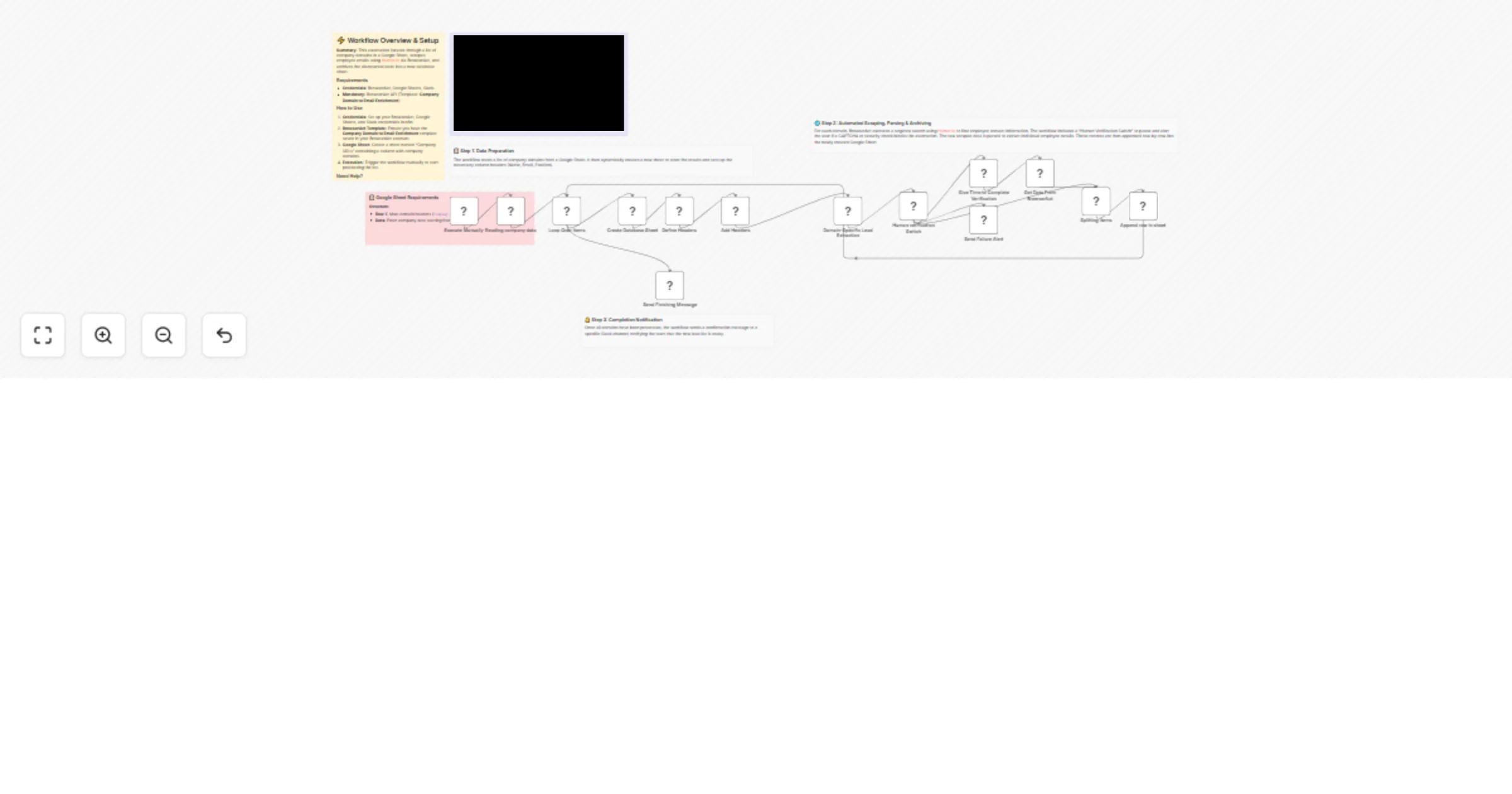
Workflow preview
100%
Extract employee emails from company domains with BrowserAct and Google Sheets preview
Open on n8n.io

1. Workflow Overview

Extract employee emails from company domains using Human in the Loop scraping using BrowserAct This workflow automates the process of enriching company data by scraping employee emails and position...

Best for

  • Lead Generation automation workflows
  • advanced n8n builders looking for reusable templates

Tools used

n8n-nodes-base.splitinbatches, n8n-nodes-base.code, n8n-nodes-base.googlesheets, n8n-nodes-base.set, n8n-nodes-base.wait, n8n-nodes-base.httprequest, n8n-nodes-base.telegram, n8n-nodes-base.switch

Source and attribution

This workflow is cataloged by N8N Workflows and links back to its original n8n.io source page by Madame AI Team | Kai.

Original n8n.io source

1.1 Workflow description

Title
Extract employee emails from company domains with BrowserAct and Google Sheets
Workflow name
Extract employee emails from company domains with BrowserAct and Google Sheets

Extract employee emails from company domains using Human-in-the-Loop scraping using BrowserAct

This workflow automates the process of enriching company data by scraping employee emails and positions from company websites. It processes a list of URLs from a Google Sheet, handles anti-bot measures (CAPTCHAs) by alerting you via Telegram to solve them manually before resuming, and saves the verified data back to your sheet.

Target Audience

Sales development representatives (SDRs), lead generation agencies, and recruiters needing verified contact info.

How it works

  1. Read List: The workflow reads a list of company URLs from a Google Sheet.
  2. Scrape Data: It loops through each URL and triggers BrowserAct to scrape the site for team pages or contact info.
  3. Check Status:
  • Finished: If scraping is successful, it parses the data (Name, Email, Position).
  • Paused: If a CAPTCHA is detected, the workflow sends a Telegram alert. It pauses execution until you verify the CAPTCHA in the browser, then resumes automatically.
  • Failed: If scraping fails, it logs an error.
  1. Save Data: Extracted emails and names are appended to a new tab in the Google Sheet specific to that company.
  2. Notify: Once a company is processed, a Slack notification is sent.

How to set up

  1. Configure Credentials: Connect your Google Sheets, BrowserAct, Telegram, and Slack accounts in n8n.
  2. Prepare BrowserAct: Ensure the Company Domain to Email Enrichment template is saved in your BrowserAct account.
  3. Setup Google Sheet: Create a Google Sheet with a column named Company url and populate it with target domains.
  4. Configure Notifications:
  • Open the Send a message node (Slack) and select your target channel.
  • Open the Alert User and Remind user nodes (Telegram) and ensure your Chat ID is correct.
  1. Activate: Run the workflow manually to start processing the list.

Requirements

  • BrowserAct account with the Company Domain to Email Enrichment template.
  • Google Sheets account.
  • Telegram account (Bot Token).
  • Slack account.

How to customize the workflow

  1. Change Data Source: Replace the Google Sheet input with an Airtable or HubSpot node to pull domains from your CRM.
  2. Enrich Data: Add a Clearbit or Hunter.io node after scraping to cross-reference found emails.
  3. Modify Alerts: Change the Telegram alerts to Email or SMS (via Twilio) if preferred.

Need Help?


Workflow Guidance and Showcase Video

1.2 Logical Blocks

This catalog entry is organized from the workflow JSON. The node-level section below shows the executable blocks available for review before importing the template.

2. Block-by-Block Analysis

Block 1 - Loop Over Items

Type / Role
n8n-nodes-base.splitInBatches - splitInBatches
Config choices
Version 3

Block 2 - Splitting Items

Type / Role
n8n-nodes-base.code - code
Config choices
Version 2

Block 3 - Append row in sheet

Type / Role
n8n-nodes-base.googleSheets - googleSheets
Config choices
Version 4.7

Block 4 - Add Headers

Type / Role
n8n-nodes-base.googleSheets - googleSheets
Config choices
Version 4.7

Block 5 - Reading company data

Type / Role
n8n-nodes-base.googleSheets - googleSheets
Config choices
Version 4.7

Block 6 - Create Database Sheet

Type / Role
n8n-nodes-base.googleSheets - googleSheets
Config choices
Version 4.7

Block 7 - Define Headers

Type / Role
n8n-nodes-base.set - set
Config choices
Version 3.4

Block 8 - Give Time to Complete Verification

Type / Role
n8n-nodes-base.wait - wait
Config choices
Version 1.1

Block 9 - Get Data From BrowserAct

Type / Role
n8n-nodes-base.httpRequest - httpRequest
Config choices
Version 4.3

Block 10 - Send Failure Alert

Type / Role
n8n-nodes-base.telegram - telegram
Config choices
Version 1.2

Block 11 - Human verification Switch

Type / Role
n8n-nodes-base.switch - switch
Config choices
Version 3.4

Block 12 - Execute Manually

Type / Role
n8n-nodes-base.manualTrigger - manualTrigger
Config choices
Version 1

Block 13 - Send Finishing Message

Type / Role
n8n-nodes-base.slack - slack
Config choices
Version 2.4

Block 14 - Domain-Specific Lead Extraction

Type / Role
n8n-nodes-browseract.browserAct - browserAct
Config choices
Version 1

Block 15 - Documentation

Type / Role
n8n-nodes-base.stickyNote - stickyNote
Config choices
Version 1

Block 16 - Step 1 Explanation

Type / Role
n8n-nodes-base.stickyNote - stickyNote
Config choices
Version 1

Block 17 - Step 2 Explanation

Type / Role
n8n-nodes-base.stickyNote - stickyNote
Config choices
Version 1

Block 18 - Step 4 Explanation

Type / Role
n8n-nodes-base.stickyNote - stickyNote
Config choices
Version 1

Block 19 - Sticky Note

Type / Role
n8n-nodes-base.stickyNote - stickyNote
Config choices
Version 1

Block 20 - Sticky Note1

Type / Role
n8n-nodes-base.stickyNote - stickyNote
Config choices
Version 1

3. Summary Table

Workflow Extract employee emails from company domains with BrowserAct and Google Sheets
Complexity advanced
Nodes 20
Categories Lead Generation
Author Madame AI Team | Kai
Published 01 Jan 2026

4. Reproducing the Workflow from Scratch

  1. 1. Download the workflow JSON

    Use the JSON export at /data/workflows/12362/12362.json as the source template for this automation.

  2. 2. Import the template into n8n

    Open n8n, import the downloaded JSON, and review each node before activating the workflow.

  3. 3. Configure credentials and variables

    Replace placeholder credentials, API keys, webhook URLs, account IDs, and environment-specific values with your own settings.

  4. 4. Test with sample data

    Run the workflow manually or in a staging workspace, inspect node output, and confirm downstream systems receive the expected data.

  5. 5. Activate and monitor

    Enable the workflow only after testing, then monitor executions, errors, and rate limits during the first production runs.

5. General Notes & Resources

Review imported nodes carefully before activation. This catalog entry is intended to help you inspect the workflow structure, understand required services, and find related templates faster.

Node names, credentials, schedules, webhook paths, and external service limits may need adjustment for your workspace.

Frequently asked questions

What does Extract employee emails from company domains with BrowserAct and Google Sheets do?

Extract employee emails from company domains using Human in the Loop scraping using BrowserAct This workflow automates the process of enriching company data by scraping employee emails and position...

What do I need before importing this workflow?

Review the workflow JSON, configure any required credentials in n8n, and test the automation in a safe workspace before using it in production.

Can I customize this workflow?

Yes. Use the block-by-block analysis and the downloadable JSON to inspect each node, then adjust credentials, prompts, schedules, filters, or destinations for your Lead Generation use case.



