Block 1 - Google Gemini Chat Model
- Type / Role
- @n8n/n8n-nodes-langchain.lmChatGoogleGemini - lmChatGoogleGemini
- Config choices
- Version 1
This workflow is provided as-is. Please review and test before using in production.
Automatically classify incoming leads based on the sentiment of their message using Google Gemini, store them in Supabase by category, and send tailored WhatsApp messages via the official WhatsApp ...
@n8n/n8n-nodes-langchain.lmchatgooglegemini, n8n-nodes-base.webhook, n8n-nodes-base.set, @n8n/n8n-nodes-langchain.sentimentanalysis, n8n-nodes-base.supabase, n8n-nodes-base.merge, n8n-nodes-base.whatsapp, n8n-nodes-base.stickynote
This workflow is cataloged by N8N Workflows and links back to its original n8n.io source page by Danielle Gomes.
Original n8n.io sourceAutomatically classify incoming leads based on the sentiment of their message using Google Gemini, store them in Supabase by category, and send tailored WhatsApp messages via the official WhatsApp Cloud API.
✅ Use Case: This workflow is ideal for sales, onboarding, and customer support teams who want to:
Understand the tone and urgency of each lead
Prioritize hot leads instantly
Send smart, automatic WhatsApp replies based on user sentiment
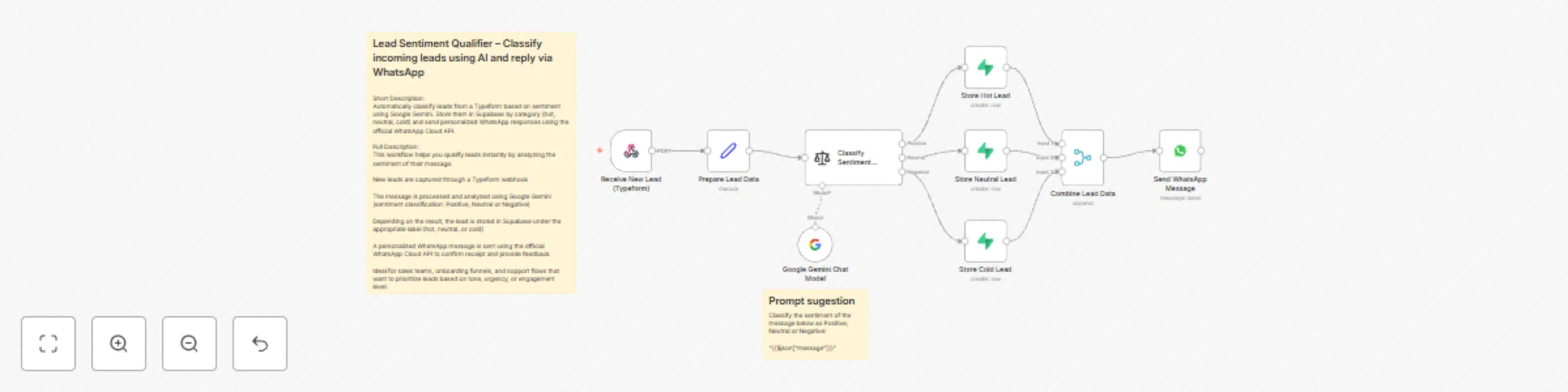
🧠 How it works: Capture lead via a Typeform webhook
Clean and structure the data (name, email, message, etc.)
Run sentiment analysis using Google Gemini to classify the message as:
Positive → Hot Lead
Neutral → Warm Lead
Negative → Cold Lead
Store lead data in Supabase under the corresponding category
Merge data to unify flow paths
Send WhatsApp message using the official WhatsApp Cloud API, with a custom reply for each sentiment result
🔧 Tools used: Typeform (incoming data)
Google Gemini (AI-based sentiment classification)
Supabase (database)
WhatsApp Cloud API (response automation)
🏷 Tags: AI, Sentiment Analysis, Lead Qualification, Supabase, WhatsApp, Gemini, Typeform, CRM, Automation, Customer Engagement
This catalog entry is organized from the workflow JSON. The node-level section below shows the executable blocks available for review before importing the template.
| Workflow | Classify lead sentiment with Google Gemini and send WhatsApp responses via Typeform & Supabase |
|---|---|
| Complexity | intermediate |
| Nodes | 11 |
| Categories | Lead Generation, AI Summarization |
| Author | Danielle Gomes |
| Published | 22 May 2025 |
Use the JSON export at /data/workflows/4322/4322.json as the source template for this automation.
Open n8n, import the downloaded JSON, and review each node before activating the workflow.
Replace placeholder credentials, API keys, webhook URLs, account IDs, and environment-specific values with your own settings.
Run the workflow manually or in a staging workspace, inspect node output, and confirm downstream systems receive the expected data.
Enable the workflow only after testing, then monitor executions, errors, and rate limits during the first production runs.
Review imported nodes carefully before activation. This catalog entry is intended to help you inspect the workflow structure, understand required services, and find related templates faster.
Node names, credentials, schedules, webhook paths, and external service limits may need adjustment for your workspace.
Automatically classify incoming leads based on the sentiment of their message using Google Gemini, store them in Supabase by category, and send tailored WhatsApp messages via the official WhatsApp ...
Review the workflow JSON, configure any required credentials in n8n, and test the automation in a safe workspace before using it in production.
Yes. Use the block-by-block analysis and the downloadable JSON to inspect each node, then adjust credentials, prompts, schedules, filters, or destinations for your Lead Generation, AI Summarization use case.