
Turn any website into an AI support chatbot with OpenAI and Pinecone

Workflow preview
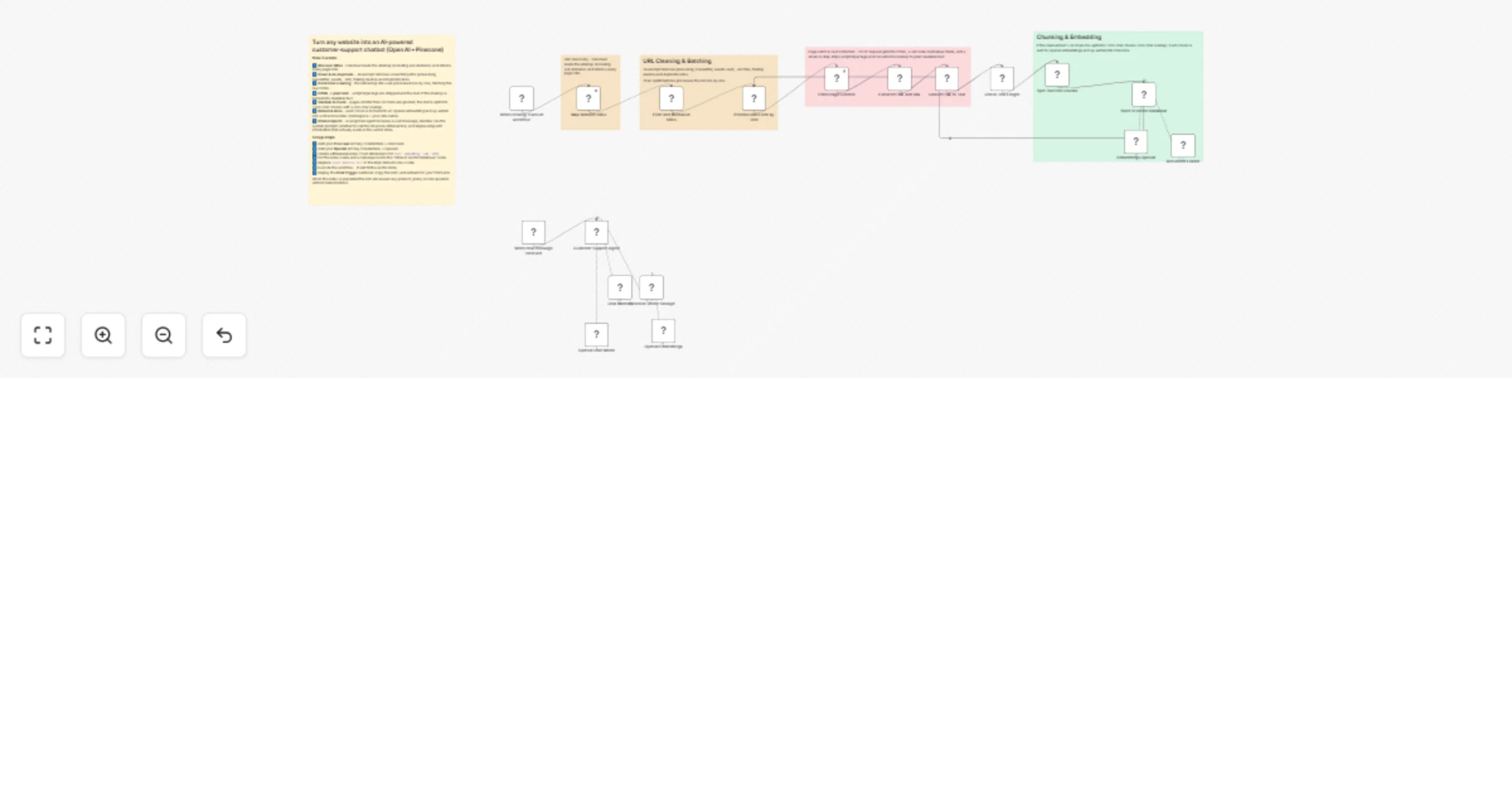
Workflow preview
100%
Turn any website into an AI support chatbot with OpenAI and Pinecone preview
Open on n8n.io

1. Workflow Overview

Complete AI support system using website data (RAG pipeline) This template provides a full end to end Retrieval Augmented Generation (RAG) system using n8n. It includes two connected workflows: 1. ...

Best for

  • Support Chatbot automation workflows
  • AI RAG automation workflows
  • advanced n8n builders looking for reusable templates

Tools used

n8n-nodes-base.manualtrigger, @n8n/n8n-nodes-langchain.embeddingsopenai, @mendable/n8n-nodes-firecrawl.firecrawl, n8n-nodes-base.code, n8n-nodes-base.splitinbatches, n8n-nodes-base.httprequest, n8n-nodes-base.set, n8n-nodes-base.if

Source and attribution

This workflow is cataloged by N8N Workflows and links back to its original n8n.io source page by Dinakar Selvakumar.

Original n8n.io source

1.1 Workflow description

Title
Turn any website into an AI support chatbot with OpenAI and Pinecone
Workflow name
Turn any website into an AI support chatbot with OpenAI and Pinecone

Complete AI support system using website data (RAG pipeline)

This template provides a full end-to-end Retrieval-Augmented Generation (RAG) system using n8n. It includes two connected workflows:

  1. A data ingestion pipeline that crawls a website and stores its content in a vector database.
  2. A customer support chatbot that retrieves this knowledge and answers user queries in real time.

Together, these workflows allow you to turn any public website into an intelligent AI-powered support assistant grounded in real business data.


Use cases

  • AI customer support chatbot for your website
  • Internal company knowledge assistant
  • Product FAQ automation
  • Helpdesk or IT support bot
  • AI receptionist for services
  • Semantic search over company content

How it works

Ingestion workflow

  1. Discover all URLs from a website sitemap.
  2. Filter and normalize the URLs.
  3. Fetch each page and extract readable text.
  4. Clean HTML into plain text.
  5. Split text into overlapping chunks.
  6. Generate embeddings using OpenAI.
  7. Store vectors in Pinecone with metadata.

Chatbot workflow

  1. A user sends a message via chat webhook.
  2. The agent queries Pinecone for relevant knowledge.
  3. Retrieved content is passed to OpenAI.
  4. OpenAI generates a grounded response.
  5. Short-term memory maintains conversation context.

How to use

Step 1 – Run ingestion

  1. Set your target website URL.
  2. Add Firecrawl, OpenAI, and Pinecone credentials.
  3. Create a Pinecone index.
  4. Execute the ingestion workflow.
  5. Wait until all pages are indexed.

Step 2 – Run chatbot

  1. Deploy the chatbot workflow.
  2. Set the same Pinecone index and namespace.
  3. Copy the chat webhook URL.
  4. Connect it to a website, chat widget, or WhatsApp bot.
  5. Start chatting with your AI assistant.

Requirements

  • Firecrawl account
  • OpenAI API key
  • Pinecone account and index
  • Public website to crawl
  • Optional: frontend chat interface

Good to know

  • The chatbot never answers from memory for business data.
  • All company knowledge comes from Pinecone.
  • If Pinecone returns nothing, the bot fails safely.
  • HTML cleaning is basic and can be replaced with:
  • Mozilla Readability
  • Jina Reader
  • Unstructured
  • Chunk size and overlap affect retrieval quality.
  • Pinecone can be replaced with:
  • Qdrant
  • Weaviate
  • Supabase Vector
  • Chroma

Customising this workflow

You can extend this system by:

  • Adding PDF or document loaders
  • Scheduling ingestion daily or weekly
  • Connecting CRM or ticketing systems
  • Adding appointment booking tools
  • Switching to local or open-source models
  • Adding multilingual support
  • Storing raw content in a database
  • Adding feedback or logging

What this n8n template demonstrates

  • Real-world RAG architecture
  • Web crawling pipelines
  • Text chunking strategies
  • Vector database integration
  • AI agent orchestration
  • Memory-controlled conversations
  • Production-grade AI support systems
  • End-to-end AI infrastructure with n8n

Architecture overview

This template follows a modern AI system design:

Website → Ingestion → Embeddings → Pinecone → Retrieval → OpenAI → User

It separates:

  • Data preparation (offline)
  • Knowledge storage
  • Runtime inference

This makes the system scalable, maintainable, and safe for production use.


Need a custom setup?

If you want a similar AI system built for your business (custom data sources, CRM integration, WhatsApp bots, booking systems, dashboards, or private deployments), feel free to reach out at [email protected].

I help companies design and deploy production-ready AI workflows.

1.2 Logical Blocks

This catalog entry is organized from the workflow JSON. The node-level section below shows the executable blocks available for review before importing the template.

2. Block-by-Block Analysis

Block 1 - When clicking ‘Execute workflow’

Type / Role
n8n-nodes-base.manualTrigger - manualTrigger
Config choices
Version 1

Block 2 - Embeddings OpenAI

Type / Role
@n8n/n8n-nodes-langchain.embeddingsOpenAi - embeddingsOpenAi
Config choices
Version 1.2

Block 3 - Map Website URLs

Type / Role
@mendable/n8n-nodes-firecrawl.firecrawl - firecrawl
Config choices
Version 1

Block 4 - Filter and Normalize URLs

Type / Role
n8n-nodes-base.code - code
Config choices
Version 2

Block 5 - Process URLs One by One

Type / Role
n8n-nodes-base.splitInBatches - splitInBatches
Config choices
Version 3

Block 6 - Fetch Page Content

Type / Role
n8n-nodes-base.httpRequest - httpRequest
Config choices
Version 3

Block 7 - Extract HTML and URL

Type / Role
n8n-nodes-base.set - set
Config choices
Version 3.4

Block 8 - Clean HTML to Text

Type / Role
n8n-nodes-base.code - code
Config choices
Version 2

Block 9 - Check Text Length

Type / Role
n8n-nodes-base.if - if
Config choices
Version 2.3

Block 10 - Split Text into Chunks

Type / Role
n8n-nodes-base.code - code
Config choices
Version 2

Block 11 - Store in Vector Database

Type / Role
@n8n/n8n-nodes-langchain.vectorStorePinecone - vectorStorePinecone
Config choices
Version 1.3

Block 12 - Document Loader

Type / Role
@n8n/n8n-nodes-langchain.documentDefaultDataLoader - documentDefaultDataLoader
Config choices
Version 1.1

Block 13 - Sticky Note

Type / Role
n8n-nodes-base.stickyNote - stickyNote
Config choices
Version 1

Block 14 - Sticky Note1

Type / Role
n8n-nodes-base.stickyNote - stickyNote
Config choices
Version 1

Block 15 - Sticky Note2

Type / Role
n8n-nodes-base.stickyNote - stickyNote
Config choices
Version 1

Block 16 - Sticky Note4

Type / Role
n8n-nodes-base.stickyNote - stickyNote
Config choices
Version 1

Block 17 - When chat message received

Type / Role
@n8n/n8n-nodes-langchain.chatTrigger - chatTrigger
Config choices
Version 1.1

Block 18 - Chat Memory

Type / Role
@n8n/n8n-nodes-langchain.memoryBufferWindow - memoryBufferWindow
Config choices
Version 1.3

Block 19 - Customer Support Agent

Type / Role
@n8n/n8n-nodes-langchain.agent - agent
Config choices
Version 3

Block 20 - OpenAI Chat Model

Type / Role
@n8n/n8n-nodes-langchain.lmChatOpenAi - lmChatOpenAi
Config choices
Version 1.3

Block 21 - OpenAI Embeddings

Type / Role
@n8n/n8n-nodes-langchain.embeddingsOpenAi - embeddingsOpenAi
Config choices
Version 1.2

Block 22 - Pinecone Vector Storage

Type / Role
@n8n/n8n-nodes-langchain.vectorStorePinecone - vectorStorePinecone
Config choices
Version 1.3

Block 23 - Sticky Note3

Type / Role
n8n-nodes-base.stickyNote - stickyNote
Config choices
Version 1

3. Summary Table

Workflow Turn any website into an AI support chatbot with OpenAI and Pinecone
Complexity advanced
Nodes 23
Categories Support Chatbot, AI RAG
Author Dinakar Selvakumar
Published 25 Jan 2026

4. Reproducing the Workflow from Scratch

  1. 1. Download the workflow JSON

    Use the JSON export at /data/workflows/12981/12981.json as the source template for this automation.

  2. 2. Import the template into n8n

    Open n8n, import the downloaded JSON, and review each node before activating the workflow.

  3. 3. Configure credentials and variables

    Replace placeholder credentials, API keys, webhook URLs, account IDs, and environment-specific values with your own settings.

  4. 4. Test with sample data

    Run the workflow manually or in a staging workspace, inspect node output, and confirm downstream systems receive the expected data.

  5. 5. Activate and monitor

    Enable the workflow only after testing, then monitor executions, errors, and rate limits during the first production runs.

5. General Notes & Resources

Review imported nodes carefully before activation. This catalog entry is intended to help you inspect the workflow structure, understand required services, and find related templates faster.

Node names, credentials, schedules, webhook paths, and external service limits may need adjustment for your workspace.

Frequently asked questions

What does Turn any website into an AI support chatbot with OpenAI and Pinecone do?

Complete AI support system using website data (RAG pipeline) This template provides a full end to end Retrieval Augmented Generation (RAG) system using n8n. It includes two connected workflows: 1. ...

What do I need before importing this workflow?

Review the workflow JSON, configure any required credentials in n8n, and test the automation in a safe workspace before using it in production.

Can I customize this workflow?

Yes. Use the block-by-block analysis and the downloadable JSON to inspect each node, then adjust credentials, prompts, schedules, filters, or destinations for your Support Chatbot, AI RAG use case.



