
Transparent tracking pixel for email open detection

Workflow preview
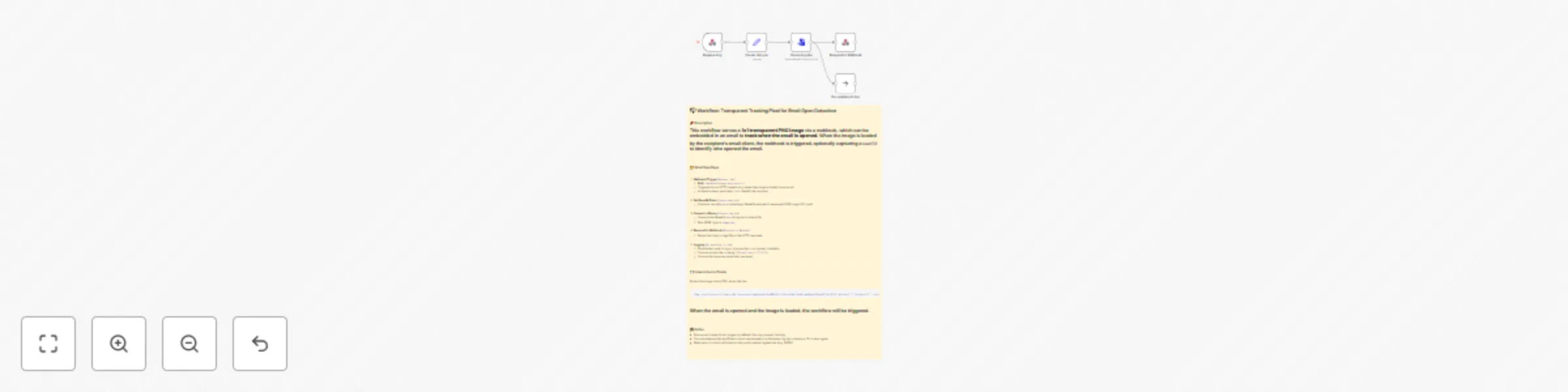
Workflow preview
100%
Transparent tracking pixel for email open detection preview
Open on n8n.io

Important notice

This workflow is provided as-is. Please review and test before using in production.

1. Workflow Overview

Description This workflow serves a 1x1 transparent PNG image via a webhook, which can be embedded in an email to track when the email is opened . When the image is loaded by the recipient's emai...

Best for

  • Social Media automation workflows
  • intermediate n8n builders looking for reusable templates

Tools used

n8n-nodes-base.set, n8n-nodes-base.converttofile, n8n-nodes-base.respondtowebhook, n8n-nodes-base.webhook, n8n-nodes-base.noop, n8n-nodes-base.stickynote

Source and attribution

This workflow is cataloged by N8N Workflows and links back to its original n8n.io source page by Julien DEL RIO.

Original n8n.io source

1.1 Workflow description

Title
Transparent tracking pixel for email open detection
Workflow name
Transparent tracking pixel for email open detection

📌 Description

This workflow serves a 1x1 transparent PNG image via a webhook, which can be embedded in an email to track when the email is opened. When the image is loaded by the recipient's email client, the webhook is triggered, optionally capturing a userId to identify who opened the email.

📂 Workflow Steps

  1. Webhook Trigger (Request img)

    • Path: /webhook/change-with-your-id
    • Triggered by an HTTP request (e.g. when the image is loaded in an email).
    • Accepts a query parameter id to identify the recipient.
  2. Set Base64 Data (Create data pix)

    • Creates a variable data containing a Base64-encoded transparent PNG image (1x1 pixel).
  3. Convert to Binary (Create img bin)

    • Converts the Base64 data string into a binary file.
    • Sets MIME type to image/png.
  4. Respond to Webhook (Respond to Webhook)

    • Sends the binary image file in the HTTP response.
  5. Logging (Do anything to log)

    • Placeholder node to log or process the id or request metadata.
    • You can access the id using {{$json["query"]["id"]}}.
    • You can also use any parameter you want

✉️ How to Use in Emails

Embed the image in an HTML email like this:

<img src="https://&lt;your-n8n-instance&gt;/webhook/db4880e7-2134-4994-94e5-a4a3aa120440?id=1234" width="1" height="1" alt />

When the email is opened and the image is loaded, the workflow will be triggered.

🛠️ Notes

  • Some email clients block images by default; this may prevent tracking.
  • You can enhance the workflow to store open events in a database, log the timestamp, IP, or user agent.
  • Make sure to comply with data privacy and consent regulations (e.g. GDPR).

1.2 Logical Blocks

This catalog entry is organized from the workflow JSON. The node-level section below shows the executable blocks available for review before importing the template.

2. Block-by-Block Analysis

Block 1 - Create data pix

Type / Role
n8n-nodes-base.set - set
Config choices
Version 3.4

Block 2 - Create img bin

Type / Role
n8n-nodes-base.convertToFile - convertToFile
Config choices
Version 1.1

Block 3 - Respond to Webhook

Type / Role
n8n-nodes-base.respondToWebhook - respondToWebhook
Config choices
Version 1.1

Block 4 - Request img

Type / Role
n8n-nodes-base.webhook - webhook
Config choices
Version 2

Block 5 - Do anything to log

Type / Role
n8n-nodes-base.noOp - noOp
Config choices
Version 1

Block 6 - Sticky Note

Type / Role
n8n-nodes-base.stickyNote - stickyNote
Config choices
Version 1

3. Summary Table

Workflow Transparent tracking pixel for email open detection
Complexity intermediate
Nodes 6
Categories Social Media
Author Julien DEL RIO
Published 07 May 2025

4. Reproducing the Workflow from Scratch

  1. 1. Download the workflow JSON

    Use the JSON export at /data/workflows/3913/3913.json as the source template for this automation.

  2. 2. Import the template into n8n

    Open n8n, import the downloaded JSON, and review each node before activating the workflow.

  3. 3. Configure credentials and variables

    Replace placeholder credentials, API keys, webhook URLs, account IDs, and environment-specific values with your own settings.

  4. 4. Test with sample data

    Run the workflow manually or in a staging workspace, inspect node output, and confirm downstream systems receive the expected data.

  5. 5. Activate and monitor

    Enable the workflow only after testing, then monitor executions, errors, and rate limits during the first production runs.

5. General Notes & Resources

Review imported nodes carefully before activation. This catalog entry is intended to help you inspect the workflow structure, understand required services, and find related templates faster.

Node names, credentials, schedules, webhook paths, and external service limits may need adjustment for your workspace.

Frequently asked questions

What does Transparent tracking pixel for email open detection do?

Description This workflow serves a 1x1 transparent PNG image via a webhook, which can be embedded in an email to track when the email is opened . When the image is loaded by the recipient's emai...

What do I need before importing this workflow?

Review the workflow JSON, configure any required credentials in n8n, and test the automation in a safe workspace before using it in production.

Can I customize this workflow?

Yes. Use the block-by-block analysis and the downloadable JSON to inspect each node, then adjust credentials, prompts, schedules, filters, or destinations for your Social Media use case.



