Track software vulnerability patents with ScrapeGraphAI, Matrix, and Intercom
Workflow preview


 Early Deal
DISCOUNT 20%

Important notice
This workflow is provided as-is. Please review and test before using in production.
Overview
Software Vulnerability Patent Tracker
⚠️ COMMUNITY TEMPLATE DISCLAIMER: This is a community-contributed template that uses ScrapeGraphAI (a community node). Please ensure you have the ScrapeGraphAI community node installed in your n8n instance before using this template.
This workflow automatically tracks newly-published patent filings that mention software-security vulnerabilities, buffer-overflow mitigation techniques, and related technology keywords. Every week it aggregates fresh patent data from USPTO and international patent databases, filters it by relevance, and delivers a concise JSON digest (and optional Intercom notification) to R&D teams and patent attorneys.
Pre-conditions/Requirements
Prerequisites
- n8n instance (self-hosted or n8n cloud, v1.7.0+)
- ScrapeGraphAI community node installed
- Basic understanding of patent search syntax (for customizing keyword sets)
- Optional: Intercom account for in-app alerts
Required Credentials
| Credential | Purpose |
|---|---|
| ScrapeGraphAI API Key | Enables ScrapeGraphAI nodes to fetch and parse patent-office webpages |
| Intercom Access Token (optional) | Sends weekly digests directly to an Intercom workspace |
Additional Setup Requirements
| Setting | Recommended Value | Notes |
|---|---|---|
| Cron schedule | 0 9 * * 1 |
Triggers every Monday at 09:00 server time |
| Patent keyword matrix | See example CSV below | List of comma-separated keywords per tech focus |
Example keyword matrix (upload as keywords.csv or paste into the “Matrix” node):
topic,keywords
Buffer Overflow,"buffer overflow, stack smashing, stack buffer"
Memory Safety,"memory safety, safe memory allocation, pointer sanitization"
Code Injection,"SQL injection, command injection, injection prevention"
How it works
This workflow automatically tracks newly-published patent filings that mention software-security vulnerabilities, buffer-overflow mitigation techniques, and related technology keywords. Every week it aggregates fresh patent data from USPTO and international patent databases, filters it by relevance, and delivers a concise JSON digest (and optional Intercom notification) to R&D teams and patent attorneys.
Key Steps:
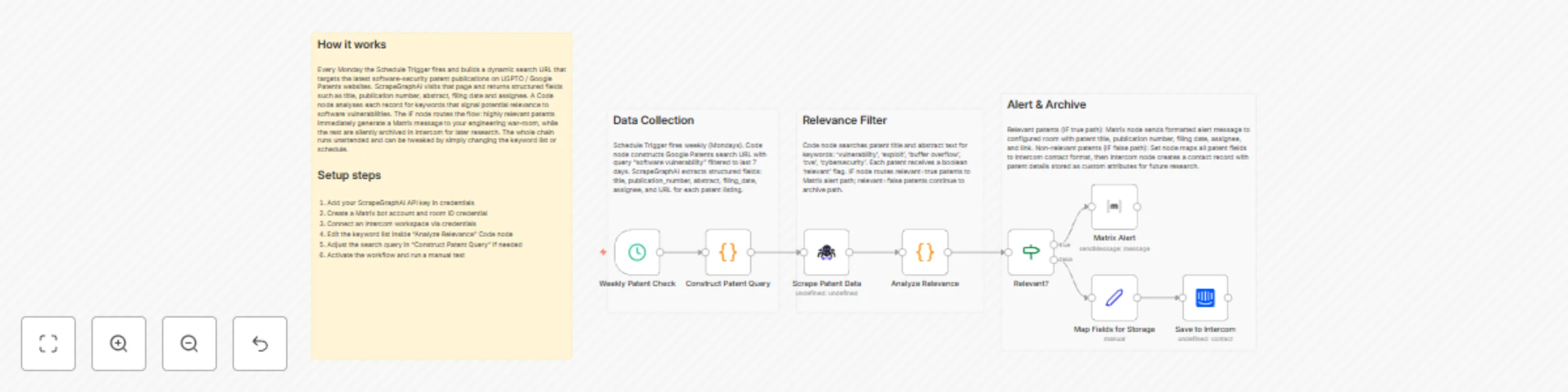
- Schedule Trigger: Fires weekly based on the configured cron expression.
- Matrix (Keyword Loader): Loads the CSV-based technology keyword matrix into memory.
- Code (Build Search Queries): Dynamically assembles patent-search URLs for each keyword group.
- ScrapeGraphAI (Fetch Results): Scrapes USPTO, EPO, and WIPO result pages and parses titles, abstracts, publication numbers, and dates.
- If (Relevance Filter): Removes patents older than 1 year or without vulnerability-related terms in the abstract.
- Set (Normalize JSON): Formats the remaining records into a uniform JSON schema.
- Intercom (Notify Team): Sends a summarized digest to your chosen Intercom workspace.
(Skip or disable this node if you prefer to consume the raw JSON output instead.) - Sticky Notes: Contain inline documentation and customization tips for future editors.
Set up steps
Setup Time: 10-15 minutes
- Install Community Node
Navigate to “Settings → Community Nodes”, search for ScrapeGraphAI, and click “Install”. - Create Credentials
- Go to “Credentials” → “New Credential” → select ScrapeGraphAI API → paste your API key.
- (Optional) Add an Intercom credential with a valid access token.
- Import the Workflow
- Click “Import” → “Workflow JSON” and paste the template JSON, or drag-and-drop the
.jsonfile.
- Click “Import” → “Workflow JSON” and paste the template JSON, or drag-and-drop the
- Configure Schedule
Open the Schedule Trigger node and adjust the cron expression if a different frequency is required. - Upload / Edit Keyword Matrix
Open the Matrix node, paste your custom CSV, or modify existing topics & keywords. - Review Search Logic
In the Code (Build Search Queries) node, review the base URLs and adjust patent databases as needed. - Define Notification Channel
If using Intercom, select your Intercom credential in the Intercom node and choose the target channel. - Execute & Activate
Click “Execute Workflow” for a trial run. Verify the output. If satisfied, switch the workflow to “Active”.
Node Descriptions
Core Workflow Nodes:
- Schedule Trigger – Initiates the workflow on a weekly cron schedule.
- Matrix – Holds the CSV keyword table and makes each row available as an item.
- Code (Build Search Queries) – Generates search URLs and attaches meta-data for later nodes.
- ScrapeGraphAI – Scrapes patent listings and extracts structured fields (title, abstract, pub. date, link).
- If (Relevance Filter) – Applies date and keyword relevance filters.
- Set (Normalize JSON) – Maps scraped fields into a clean JSON schema for downstream use.
- Intercom – Sends formatted patent summaries to an Intercom inbox or channel.
- Sticky Notes – Provide inline documentation and edit history markers.
Data Flow:
- Schedule Trigger → Matrix → Code → ScrapeGraphAI → If → Set → Intercom
Customization Examples
Change Data Source to Google Patents
// In the Code node
const base = 'https://patents.google.com/?q=';
items.forEach(item => {
  item.json.searchUrl = `${base}${encodeURIComponent(item.json.keywords)}&oq=${encodeURIComponent(item.json.keywords)}`;
});
return items;
Send Digest via Slack Instead of Intercom
// Replace Intercom node with Slack node
{
  "text": `🚀 New Vulnerability-related Patents (${items.length})\n` +
          items.map(i => `• <${i.json.link}|${i.json.title}>`).join('\n')
}
Data Output Format
The workflow outputs structured JSON data:
{
  "topic": "Memory Safety",
  "keywords": "memory safety, safe memory allocation, pointer sanitization",
  "title": "Memory protection for compiled binary code",
  "publicationNumber": "US20240123456A1",
  "publicationDate": "2024-03-21",
  "abstract": "Techniques for enforcing memory safety in compiled software...",
  "link": "https://patents.google.com/patent/US20240123456A1/en",
  "source": "USPTO"
}
Troubleshooting
Common Issues
- Empty Result Set – Ensure that the keywords are specific but not overly narrow; test queries manually on USPTO.
- ScrapeGraphAI Timeouts – Increase the
timeoutparameter in the ScrapeGraphAI node or reduce concurrent requests.
Performance Tips
- Limit the keyword matrix to <50 rows to keep weekly runs under 2 minutes.
- Schedule the workflow during off-peak hours to reduce load on patent-office servers.
Pro Tips:
- Combine this workflow with a vector database (e.g., Pinecone) to create a semantic patent knowledge base.
- Add a “Merge” node to correlate new patents with existing vulnerability CVE entries.
- Use a second ScrapeGraphAI node to crawl citation trees and identify emerging technology clusters.