Track software security patents with ScrapeGraphAI, Notion, and Pushover alerts
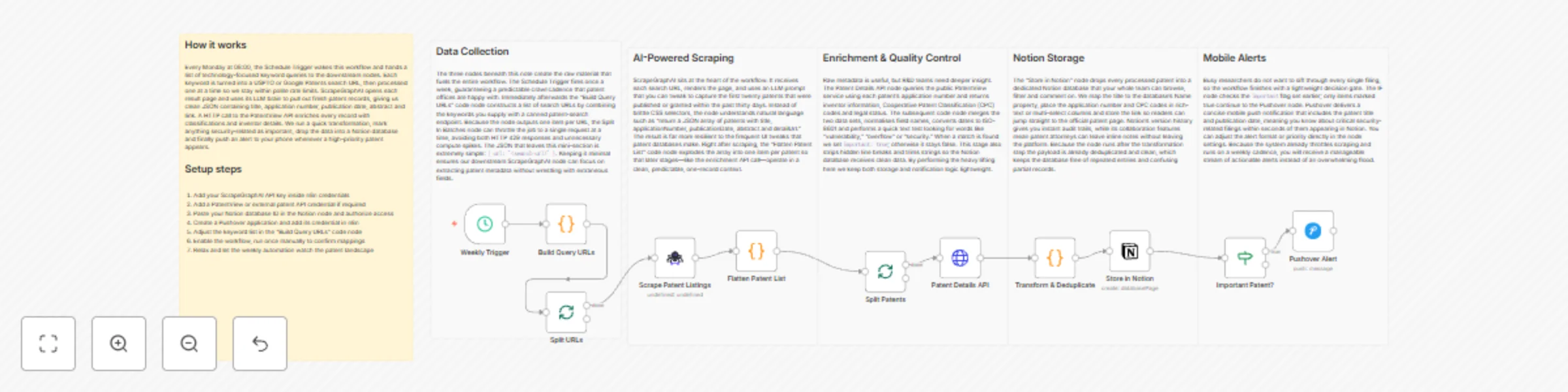
Workflow preview


 Early Deal
DISCOUNT 20%

Important notice
This workflow is provided as-is. Please review and test before using in production.
Overview
Software Vulnerability Tracker with Pushover and Notion
⚠️ COMMUNITY TEMPLATE DISCLAIMER: This is a community-contributed template that uses ScrapeGraphAI (a community node). Please ensure you have the ScrapeGraphAI community node installed in your n8n instance before using this template.
This workflow automatically scans multiple patent databases on a weekly schedule, filters new filings relevant to selected technology domains, saves the findings to Notion, and pushes instant alerts to your mobile device via Pushover. It is ideal for R&D teams and patent attorneys who need up-to-date insights on emerging technology trends and competitor activity.
Pre-conditions/Requirements
Prerequisites
- An n8n instance (self-hosted or n8n cloud)
- ScrapeGraphAI community node installed
- Active Notion account with an integration created
- Pushover account (user key & application token)
- List of technology keywords / CPC codes to monitor
Required Credentials
- ScrapeGraphAI API Key – Enables web scraping of patent portals
- Notion Credential – Internal Integration Token with database write access
- Pushover Credential – App Token + User Key for push notifications
Additional Setup Requirements
| Service | Needed Item | Where to obtain |
|---|---|---|
| USPTO, EPO, WIPO, etc. | Public URLs for search endpoints | Free/public |
| Notion | Database with properties: Title, Abstract, URL, Date |
Create in Notion |
| Keyword List | Text file or environment variable PATENT_KEYWORDS |
Define yourself |
How it works
This workflow automatically scans multiple patent databases on a weekly schedule, filters new filings relevant to selected technology domains, saves the findings to Notion, and pushes instant alerts to your mobile device via Pushover. It is ideal for R&D teams and patent attorneys who need up-to-date insights on emerging technology trends and competitor activity.
Key Steps:
- Schedule Trigger: Fires every week (default Monday 08:00 UTC).
- Code (Prepare Queries): Builds search URLs for each keyword and data source.
- SplitInBatches: Processes one query at a time to respect rate limits.
- ScrapeGraphAI: Scrapes patent titles, abstracts, links, and publication dates.
- Code (Normalize & Deduplicate): Cleans data, converts dates, and removes already-logged patents.
- IF Node: Checks whether new patents were found.
- Notion Node: Inserts new patent entries into the specified database.
- Pushover Node: Sends a concise alert summarizing the new filings.
- Sticky Notes: Document configuration tips inside the workflow.
Set up steps
Setup Time: 10-15 minutes
- Install ScrapeGraphAI:
In n8n, go to “Settings → Community Nodes” and install@n8n-nodes/scrapegraphai. - Add Credentials:
- ScrapeGraphAI: paste your API key.
- Notion: add the internal integration token and select your database.
- Pushover: provide your App Token and User Key.
- Configure Keywords:
Open the first Code node and edit thekeywordsarray (e.g.,["quantum computing", "Li-ion battery", "5G antenna"]). - Point to Data Sources:
In the same Code node, adjust thesourcesarray if you want to add/remove patent portals. - Set Notion Database Mapping:
In the Notion node, map properties (Name,Abstract,Link,Date) to incoming JSON fields. - Adjust Schedule (optional):
Double-click the Schedule Trigger and change the CRON expression to your preferred interval. - Test Run:
Execute the workflow manually. Confirm that the Notion page is populated and a Pushover notification arrives. - Activate:
Switch the workflow to “Active” to enable automatic weekly execution.
Node Descriptions
Core Workflow Nodes:
- Schedule Trigger – Defines the weekly execution time.
- Code (Build Search URLs) – Dynamically constructs patent search URLs.
- SplitInBatches – Sequentially feeds each query to the scraper.
- ScrapeGraphAI – Extracts patent metadata from HTML pages.
- Code (Normalize Data) – Formats dates, adds UUIDs, and checks for duplicates.
- IF – Determines whether new patents exist before proceeding.
- Notion – Writes new patent records to your Notion database.
- Pushover – Sends real-time mobile/desktop notifications.
Data Flow:
- Schedule Trigger → Code (Build Search URLs) → SplitInBatches → ScrapeGraphAI → Code (Normalize Data) → IF → Notion & Pushover
Customization Examples
Change Notification Message
// Inside the Pushover node "Message" field
return {
  message: `📜 ${items[0].json.count} new patent(s) detected in ${new Date().toDateString()}`,
  title: '🆕 Patent Alert',
  url: items[0].json.firstPatentUrl,
  url_title: 'Open first patent'
};
Add Slack Notification Instead of Pushover
// Replace the Pushover node with a Slack node
{
  text: `*${$json.count}* new patents published:\n${$json.list.join('\n')}`,
  channel: '#patent-updates'
}
Data Output Format
The workflow outputs structured JSON data:
{
  "title": "Quantum Computing Device",
  "abstract": "A novel qubit architecture that ...",
  "url": "https://patents.example.com/US20240012345A1",
  "publicationDate": "2024-06-01",
  "source": "USPTO",
  "keywordsMatched": ["quantum computing"]
}
Troubleshooting
Common Issues
- No data returned – Verify that search URLs are still valid and the ScrapeGraphAI selector matches the current page structure.
- Duplicate entries in Notion – Ensure the “Normalize Data” code correctly checks for existing URLs or IDs before insert.
Performance Tips
- Limit the number of keywords or schedule the workflow during off-peak hours to reduce API throttling.
- Enable caching inside ScrapeGraphAI (if available) to minimize repeated requests.
Pro Tips:
- Use environment variables (e.g.,
{{ $env.PATENT_KEYWORDS }}) to manage keyword lists without editing nodes. - Chain an additional “HTTP Request → ML Model” step to auto-classify patents by CPC codes.
- Create a Notion view filtered by
publicationDate is within past 30 daysfor quick scanning.