
Track policy expiry dates and ownership with Google Sheets and Gmail notifications

Workflow preview
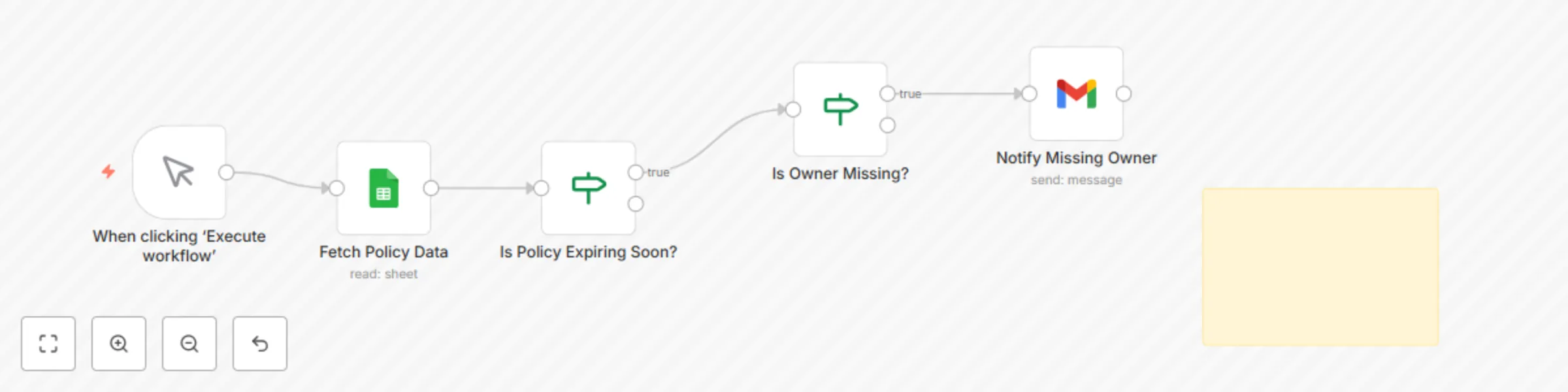
Workflow preview
100%
Track policy expiry dates and ownership with Google Sheets and Gmail notifications preview
Open on n8n.io

Important notice

This workflow is provided as-is. Please review and test before using in production.

1. Workflow Overview

Purpose Automates the monitoring of policy documents for expiry and ownership gaps. Ensures accountability by sending proactive notifications when policies are nearing renewal deadlines or when no ...

Best for

  • SecOps automation workflows
  • Multimodal AI automation workflows
  • intermediate n8n builders looking for reusable templates

Tools used

n8n-nodes-base.googlesheets, n8n-nodes-base.if, n8n-nodes-base.manualtrigger, n8n-nodes-base.gmail, n8n-nodes-base.stickynote

Source and attribution

This workflow is cataloged by N8N Workflows and links back to its original n8n.io source page by Adnan Tariq.

Original n8n.io source

1.1 Workflow description

Title
Track policy expiry dates and ownership with Google Sheets and Gmail notifications
Workflow name
Track policy expiry dates and ownership with Google Sheets and Gmail notifications

Purpose Automates the monitoring of policy documents for expiry and ownership gaps. Ensures accountability by sending proactive notifications when policies are nearing renewal deadlines or when no owner is assigned.

Key Benefits

Avoids missed policy reviews or lapses.

Enforces accountability by flagging missing owners.

Sends automated, clear email notifications.

Reduces manual tracking workload across teams.

Maintains an audit-ready record of policy metadata.

How It Works

Fetches policy metadata from Google Sheets.

Checks if policy expiry date is within 30 days.

Flags entries with blank owner fields.

Sends automated notifications to responsible teams.

Maintains an updated log of policy status for audits.

Requirements

Google Sheets (OAuth2) to store and manage policy metadata.

Gmail/SMTP node for notifications (optional).

Sheet must include:

policy_name

owner_email

last_reviewed

expiry_date

review_frequency_months

status

Customization Tips

Adjust expiry window to 60 or 90 days.

Replace Gmail with Slack/Teams notifications.

Integrate with Jira/ServiceNow for policy tasks.

Modify email templates to include escalation paths.

Compliance Alignment

ISO 27001: A.5.1.1 (Policies for Information Security)

NIST 800-53: PL-2 (System and Communications Protection Policy)

SOC 2: CC5.3 (Policies and Communication)

Supports lifecycle validation for external audits.

Supports

ISO 27001 Information Security

SOC 2 Compliance

NIST 800-53

ACSC Essential Eight

🔗 https://cyberpulsesolutions.com

1.2 Logical Blocks

This catalog entry is organized from the workflow JSON. The node-level section below shows the executable blocks available for review before importing the template.

2. Block-by-Block Analysis

Block 1 - Fetch Policy Data

Type / Role
n8n-nodes-base.googleSheets - googleSheets
Config choices
Version 4.6

Block 2 - Is Policy Expiring Soon?

Type / Role
n8n-nodes-base.if - if
Config choices
Version 2.2

Block 3 - When clicking ‘Execute workflow’

Type / Role
n8n-nodes-base.manualTrigger - manualTrigger
Config choices
Version 1

Block 4 - Is Owner Missing?

Type / Role
n8n-nodes-base.if - if
Config choices
Version 2.2

Block 5 - Notify Missing Owner

Type / Role
n8n-nodes-base.gmail - gmail
Config choices
Version 2.1

Block 6 - Sticky Note

Type / Role
n8n-nodes-base.stickyNote - stickyNote
Config choices
Version 1

3. Summary Table

Workflow Track policy expiry dates and ownership with Google Sheets and Gmail notifications
Complexity intermediate
Nodes 6
Categories SecOps, Multimodal AI
Author Adnan Tariq
Published 26 Aug 2025

4. Reproducing the Workflow from Scratch

  1. 1. Download the workflow JSON

    Use the JSON export at /data/workflows/7864/7864.json as the source template for this automation.

  2. 2. Import the template into n8n

    Open n8n, import the downloaded JSON, and review each node before activating the workflow.

  3. 3. Configure credentials and variables

    Replace placeholder credentials, API keys, webhook URLs, account IDs, and environment-specific values with your own settings.

  4. 4. Test with sample data

    Run the workflow manually or in a staging workspace, inspect node output, and confirm downstream systems receive the expected data.

  5. 5. Activate and monitor

    Enable the workflow only after testing, then monitor executions, errors, and rate limits during the first production runs.

5. General Notes & Resources

Review imported nodes carefully before activation. This catalog entry is intended to help you inspect the workflow structure, understand required services, and find related templates faster.

Node names, credentials, schedules, webhook paths, and external service limits may need adjustment for your workspace.

Frequently asked questions

What does Track policy expiry dates and ownership with Google Sheets and Gmail notifications do?

Purpose Automates the monitoring of policy documents for expiry and ownership gaps. Ensures accountability by sending proactive notifications when policies are nearing renewal deadlines or when no ...

What do I need before importing this workflow?

Review the workflow JSON, configure any required credentials in n8n, and test the automation in a safe workspace before using it in production.

Can I customize this workflow?

Yes. Use the block-by-block analysis and the downloadable JSON to inspect each node, then adjust credentials, prompts, schedules, filters, or destinations for your SecOps, Multimodal AI use case.



