
Track Facebook event RSVPs in Airtable and send Slack capacity alerts

Workflow preview
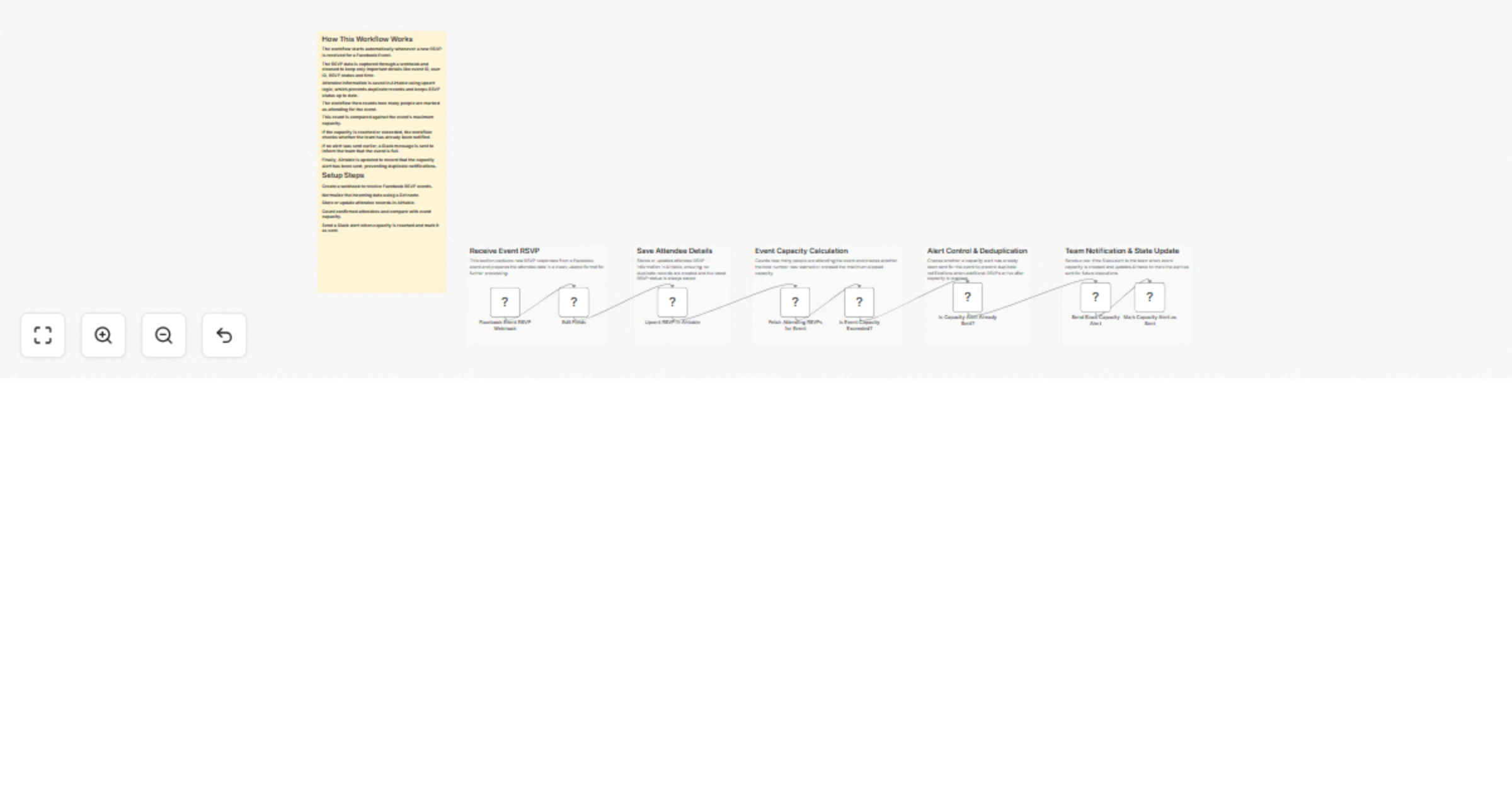
Workflow preview
100%
Track Facebook event RSVPs in Airtable and send Slack capacity alerts preview
Open on n8n.io

1. Workflow Overview

Facebook Event RSVP Webhook → Airtable Attendee Tracking → Slack Capacity Alerts This workflow automatically tracks Facebook Event RSVPs, stores attendee data in Airtable, checks event capacity and...

Best for

  • Project Management automation workflows
  • intermediate n8n builders looking for reusable templates

Tools used

n8n-nodes-base.set, n8n-nodes-base.webhook, n8n-nodes-base.airtable, n8n-nodes-base.if, n8n-nodes-base.slack, n8n-nodes-base.stickynote

Source and attribution

This workflow is cataloged by N8N Workflows and links back to its original n8n.io source page by WeblineIndia.

Original n8n.io source

1.1 Workflow description

Title
Track Facebook event RSVPs in Airtable and send Slack capacity alerts
Workflow name
Track Facebook event RSVPs in Airtable and send Slack capacity alerts

Facebook Event RSVP Webhook → Airtable Attendee Tracking → Slack Capacity Alerts

This workflow automatically tracks Facebook Event RSVPs, stores attendee data in Airtable, checks event capacity and notifies your team on Slack when the event becomes full. It eliminates manual RSVP tracking and prevents overbooking.

Quick Start: Get Up and Running Fast

  1. Create a custom Facebook webhook endpoint in n8n.
  2. Connect Airtable and select your preferred table.
  3. Ensure required fields exist in the Airtable table.
  4. Set the event capacity value.
  5. Connect Slack and choose the notification channel.
  6. Activate the workflow.

What It Does

This workflow begins when a new RSVP is received from a Facebook Event through a custom webhook endpoint. The incoming data is cleaned and standardized to extract only the required RSVP details, ensuring consistent processing.

Each RSVP is then stored in Airtable using an upsert operation. This ensures attendee records are created or updated correctly while preventing duplicate entries if Facebook sends the same RSVP more than once.

After storing the data, the workflow checks how many people are marked as attending for the event. If the total reaches or exceeds the defined capacity, a Slack notification is sent to the team. The workflow also records that the alert has been sent to avoid duplicate notifications.

Who’s It For

  • Event organizers and coordinators
  • Marketing and operations teams
  • Community and meetup managers
  • Businesses running limited-capacity events
  • Teams using Airtable to manage event data

Requirements to Use This Workflow

  • A running n8n instance
  • Facebook Developer access to configure a custom webhook
  • An Airtable base with any table name of your choice
  • The Airtable table must contain the required fields (see below)
  • A Slack workspace with permission to send messages

How It Works & How To Set Up

1. Webhook Configuration

Create a custom webhook endpoint in n8n and configure Facebook to send Event RSVP data to this endpoint.

2. Data Normalization

A Set node extracts and formats key RSVP fields such as event ID, user ID, RSVP status and timestamp.

3. Airtable Storage

You can select any Airtable table. The workflow requires the following fields to exist in that table:

  • event_Id (Text)
  • user_Id (Text)
  • rsvpStatus (Single select or Text)
  • receivedAt (Date)
  • capacity_alert_sent (Checkbox)

The upsert operation ensures records are updated without duplication.

4. Capacity Evaluation

The workflow searches the selected Airtable table for all attendees marked as “attending” for the same event and counts them.

5. Slack Notification

If the count reaches or exceeds the configured capacity value, a Slack alert is sent. The workflow then updates Airtable to mark that the alert has already been sent.

How To Customize Nodes

  • Airtable Table: Select any table as long as required fields exist.
  • Capacity Limit: Modify the static value in the IF node.
  • Slack Channel: Change the destination channel or user.
  • Webhook Endpoint: Rename the webhook path for different environments.
  • RSVP Status Logic: Adjust filters to include or exclude statuses.

Add-ons

  • Early warning alerts (e.g., 80% or 90% capacity)
  • Waitlist automation after capacity is reached
  • Email or Telegram notifications instead of Slack
  • Dynamic event capacity from Airtable
  • Error handling and retry logic for API limits

Use Case Examples

  • Managing workshop and training registrations
  • Tracking attendance for community meetups
  • Preventing overbooking for conferences or seminars
  • Alerting staff when venue limits are reached
  • Automating RSVP monitoring for internal company events

This workflow can support many more event-based automation scenarios.

Troubleshooting Guide

Issue Possible Cause Solution
No RSVPs received Webhook not configured correctly Verify Facebook webhook URL and subscription
Duplicate Slack alerts Alert flag not checked Ensure capacity_alert_sent logic is enabled
Wrong attendee count Field name mismatch Confirm Airtable field names match exactly
Slack message not sent Invalid Slack credentials Reconnect Slack account in n8n
Airtable errors API rate limit Add retry logic or reduce execution frequency

Need Help?

If you need help setting up this workflow, customizing add-ons or building similar automation, our n8n workflow developers at WeblineIndia can help.

Our team specializes in creating scalable business automation using n8n and modern cloud tools.

Contact WeblineIndia to get expert assistance or to build tailored workflows for your business needs.

1.2 Logical Blocks

This catalog entry is organized from the workflow JSON. The node-level section below shows the executable blocks available for review before importing the template.

2. Block-by-Block Analysis

Block 1 - Edit Fields

Type / Role
n8n-nodes-base.set - set
Config choices
Version 3.4

Block 2 - Facebook Event RSVP Webhook

Type / Role
n8n-nodes-base.webhook - webhook
Config choices
Version 2.1

Block 3 - Upsert RSVP in Airtable

Type / Role
n8n-nodes-base.airtable - airtable
Config choices
Version 2.1

Block 4 - Fetch Attending RSVPs for Event

Type / Role
n8n-nodes-base.airtable - airtable
Config choices
Version 2.1

Block 5 - Is Event Capacity Exceeded?

Type / Role
n8n-nodes-base.if - if
Config choices
Version 2.2

Block 6 - Is Capacity Alert Already Sent?

Type / Role
n8n-nodes-base.if - if
Config choices
Version 2.2

Block 7 - Send Slack Capacity Alert

Type / Role
n8n-nodes-base.slack - slack
Config choices
Version 2.3

Block 8 - Mark Capacity Alert as Sent

Type / Role
n8n-nodes-base.airtable - airtable
Config choices
Version 2.1

Block 9 - Sticky Note

Type / Role
n8n-nodes-base.stickyNote - stickyNote
Config choices
Version 1

Block 10 - Sticky Note1

Type / Role
n8n-nodes-base.stickyNote - stickyNote
Config choices
Version 1

Block 11 - Sticky Note2

Type / Role
n8n-nodes-base.stickyNote - stickyNote
Config choices
Version 1

Block 12 - Sticky Note3

Type / Role
n8n-nodes-base.stickyNote - stickyNote
Config choices
Version 1

Block 13 - Sticky Note4

Type / Role
n8n-nodes-base.stickyNote - stickyNote
Config choices
Version 1

Block 14 - Sticky Note5

Type / Role
n8n-nodes-base.stickyNote - stickyNote
Config choices
Version 1

3. Summary Table

Workflow Track Facebook event RSVPs in Airtable and send Slack capacity alerts
Complexity intermediate
Nodes 14
Categories Project Management
Author WeblineIndia
Published 04 Apr 2026

4. Reproducing the Workflow from Scratch

  1. 1. Download the workflow JSON

    Use the JSON export at /data/workflows/14705/14705.json as the source template for this automation.

  2. 2. Import the template into n8n

    Open n8n, import the downloaded JSON, and review each node before activating the workflow.

  3. 3. Configure credentials and variables

    Replace placeholder credentials, API keys, webhook URLs, account IDs, and environment-specific values with your own settings.

  4. 4. Test with sample data

    Run the workflow manually or in a staging workspace, inspect node output, and confirm downstream systems receive the expected data.

  5. 5. Activate and monitor

    Enable the workflow only after testing, then monitor executions, errors, and rate limits during the first production runs.

5. General Notes & Resources

Review imported nodes carefully before activation. This catalog entry is intended to help you inspect the workflow structure, understand required services, and find related templates faster.

Node names, credentials, schedules, webhook paths, and external service limits may need adjustment for your workspace.

Frequently asked questions

What does Track Facebook event RSVPs in Airtable and send Slack capacity alerts do?

Facebook Event RSVP Webhook → Airtable Attendee Tracking → Slack Capacity Alerts This workflow automatically tracks Facebook Event RSVPs, stores attendee data in Airtable, checks event capacity and...

What do I need before importing this workflow?

Review the workflow JSON, configure any required credentials in n8n, and test the automation in a safe workspace before using it in production.

Can I customize this workflow?

Yes. Use the block-by-block analysis and the downloadable JSON to inspect each node, then adjust credentials, prompts, schedules, filters, or destinations for your Project Management use case.



