
Track CVE vulnerability details & history with NVD API and Google Sheets

Workflow preview
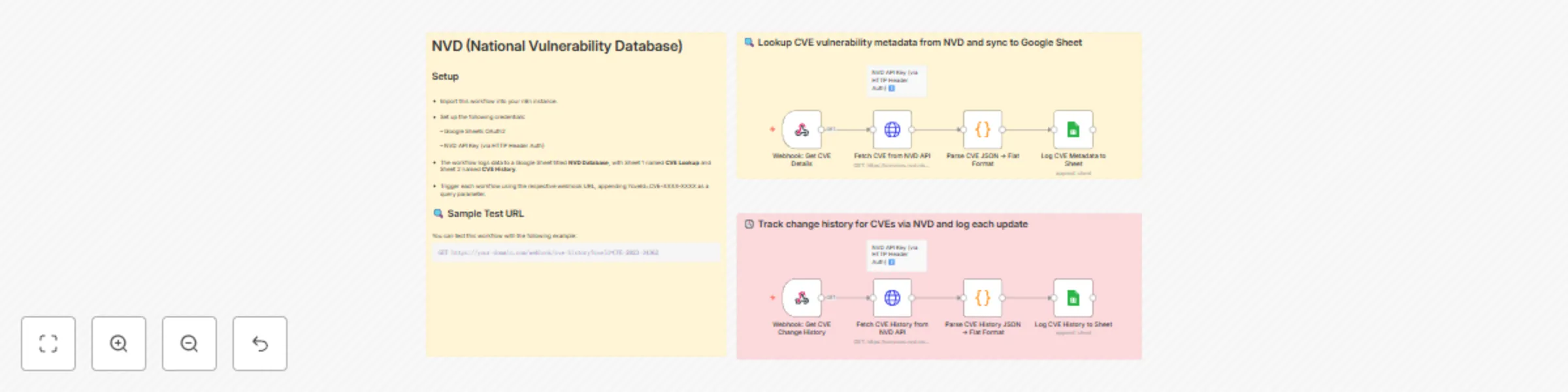
Workflow preview
100%
Track CVE vulnerability details & history with NVD API and Google Sheets preview
Open on n8n.io

Important notice

This workflow is provided as-is. Please review and test before using in production.

1. Workflow Overview

Who is this for? NVD (National Vulnerability Database) data is essential for security analysts, vulnerability managers, and DevSecOps professionals who need to perform both CVE lookups and monitor ...

Best for

  • SecOps automation workflows
  • intermediate n8n builders looking for reusable templates

Tools used

n8n-nodes-base.webhook, n8n-nodes-base.httprequest, n8n-nodes-base.code, n8n-nodes-base.googlesheets, n8n-nodes-base.stickynote

Source and attribution

This workflow is cataloged by N8N Workflows and links back to its original n8n.io source page by Niranjan G.

Original n8n.io source

1.1 Workflow description

Title
Track CVE vulnerability details & history with NVD API and Google Sheets
Workflow name
Track CVE vulnerability details & history with NVD API and Google Sheets

Who is this for?

NVD (National Vulnerability Database) data is essential for security analysts, vulnerability managers, and DevSecOps professionals who need to perform both CVE lookups and monitor historical change logs. This workflow helps streamline those efforts by providing structured outputs for audit, triage, or compliance tracking purposes.

📝 Note: While this example uses Google Sheets as the destination, you can easily modify the final destination node (e.g., send to Slack, email, database, etc.) based on your specific automation needs.?

What problem is this solving?

Security teams often manually look up CVE data and track changes across multiple tools. This process is inefficient and error-prone. This workflow automates the CVE lookup and historical change tracking by logging enriched vulnerability data into Google Sheets in real-time.

What this workflow does

This workflow is designed for CVE API lookup and change history tracking. In many vulnerability automation pipelines, it is essential to determine not only the metadata of a CVE but also how it has evolved over time. Based on the operational need—whether it's enrichment, risk scoring, or remediation validation—this workflow becomes particularly handy in surfacing both current and historical CVE data. This template performs the following actions:

  • Accepts incoming webhook requests containing a CVE ID
  • Queries the NVD CVE Lookup API to fetch vulnerability metadata
  • Queries the NVD CVE History API to retrieve all historical changes
  • Flattens both datasets into a sheet-compatible structure
  • Appends vulnerability metadata to one sheet and change history to another within the same Google Spreadsheet

Setup

🔑 Request an NVD API Key

To request an NVD API Key, please provide your organization name, a valid email address, and indicate your organization type at NVD API Key Request. You must scroll to the end of the Terms of Use Agreement and check "I agree to the Terms of Use" to obtain an API Key. After submission, you will receive a single-use hyperlink via email to activate and view your API Key. If not activated within seven days, a new request must be submitted.

📊 API Rate Limits

Without an API key, you're limited to 5 requests per 30-second window. With an API key, you’re allowed up to 50 requests in the same period. To prevent request throttling, it's recommended to introduce slight delays between consecutive API calls in production setups.

  1. Clone or import this workflow into your n8n instance.
  2. Set up the following credentials:
    • Google Sheets OAuth2
    • NVD API Key (via HTTP Header Auth)
  3. The workflow logs data to a Google Sheet titled NVD Database, with Sheet 1 named CVE Lookup and Sheet 2 named CVE History.
  4. Trigger each workflow using the respective webhook URL, appending ?cveId=CVE-XXXX-XXXX as a query parameter.

🔍 Example Webhook Request (CVE Change History)

You can test this workflow with the following example:

GET https://your-domain.com/webhook/cve-history?cveId=CVE-2023-34362

How to customize this workflow

  • Use the Edit Fields node (optional) to centralize configuration like sheet name or query input
  • Extend the CVE flattening logic to include more nested metadata if needed
  • Integrate notification systems (e.g., Slack or email) by branching from the processing nodes
  • Modify webhook paths for better endpoint organization

🔐 Production Security Tips

  • Use HTTP Header Auth on the webhook for secure access

> ⚠️ This template uses webhooks and NVD API access with authentication headers.


This template uses two flows:

  • Webhook 1: NVD CVE Lookup — Lookup CVE vulnerability metadata from NVD and sync to Google Sheet
  • Webhook 2: NVD CVE Change History — Track change history for CVEs via NVD and log each update

Each flow:

  • Hits NVD’s respective endpoint
  • Uses custom JS Code node to flatten the nested JSON
  • Syncs data to dedicated Google Sheet tabs
  • 🧩 4 nodes: Webhook → API Call → Parse → Sheet Sync

Make sure both flows are activated and webhooks exposed for external access. Based on your needs, ensure you have a secure setup—whether hosted internally or in a cloud environment—when running n8n in production.

1.2 Logical Blocks

This catalog entry is organized from the workflow JSON. The node-level section below shows the executable blocks available for review before importing the template.

2. Block-by-Block Analysis

Block 1 - Webhook: Get CVE Details

Type / Role
n8n-nodes-base.webhook - webhook
Config choices
Version 2

Block 2 - Fetch CVE from NVD API

Type / Role
n8n-nodes-base.httpRequest - httpRequest
Config choices
Version 4.2

Block 3 - Parse CVE JSON → Flat Format

Type / Role
n8n-nodes-base.code - code
Config choices
Version 2

Block 4 - Log CVE Metadata to Sheet

Type / Role
n8n-nodes-base.googleSheets - googleSheets
Config choices
Version 4.6

Block 5 - Webhook: Get CVE Change History

Type / Role
n8n-nodes-base.webhook - webhook
Config choices
Version 2

Block 6 - Fetch CVE History from NVD API

Type / Role
n8n-nodes-base.httpRequest - httpRequest
Config choices
Version 4.2

Block 7 - Parse CVE History JSON → Flat Format

Type / Role
n8n-nodes-base.code - code
Config choices
Version 2

Block 8 - Log CVE History to Sheet

Type / Role
n8n-nodes-base.googleSheets - googleSheets
Config choices
Version 4.6

Block 9 - Sticky Note2

Type / Role
n8n-nodes-base.stickyNote - stickyNote
Config choices
Version 1

Block 10 - Sticky Note3

Type / Role
n8n-nodes-base.stickyNote - stickyNote
Config choices
Version 1

Block 11 - Sticky Note

Type / Role
n8n-nodes-base.stickyNote - stickyNote
Config choices
Version 1

Block 12 - Sticky Note1

Type / Role
n8n-nodes-base.stickyNote - stickyNote
Config choices
Version 1

Block 13 - Sticky Note4

Type / Role
n8n-nodes-base.stickyNote - stickyNote
Config choices
Version 1

3. Summary Table

Workflow Track CVE vulnerability details & history with NVD API and Google Sheets
Complexity intermediate
Nodes 13
Categories SecOps
Author Niranjan G
Published 08 Jun 2025

4. Reproducing the Workflow from Scratch

  1. 1. Download the workflow JSON

    Use the JSON export at /data/workflows/4797/4797.json as the source template for this automation.

  2. 2. Import the template into n8n

    Open n8n, import the downloaded JSON, and review each node before activating the workflow.

  3. 3. Configure credentials and variables

    Replace placeholder credentials, API keys, webhook URLs, account IDs, and environment-specific values with your own settings.

  4. 4. Test with sample data

    Run the workflow manually or in a staging workspace, inspect node output, and confirm downstream systems receive the expected data.

  5. 5. Activate and monitor

    Enable the workflow only after testing, then monitor executions, errors, and rate limits during the first production runs.

5. General Notes & Resources

Review imported nodes carefully before activation. This catalog entry is intended to help you inspect the workflow structure, understand required services, and find related templates faster.

Node names, credentials, schedules, webhook paths, and external service limits may need adjustment for your workspace.

Frequently asked questions

What does Track CVE vulnerability details & history with NVD API and Google Sheets do?

Who is this for? NVD (National Vulnerability Database) data is essential for security analysts, vulnerability managers, and DevSecOps professionals who need to perform both CVE lookups and monitor ...

What do I need before importing this workflow?

Review the workflow JSON, configure any required credentials in n8n, and test the automation in a safe workspace before using it in production.

Can I customize this workflow?

Yes. Use the block-by-block analysis and the downloadable JSON to inspect each node, then adjust credentials, prompts, schedules, filters, or destinations for your SecOps use case.



