
Track competitor pricing and features with BrowserAct and Google Sheets

Workflow preview
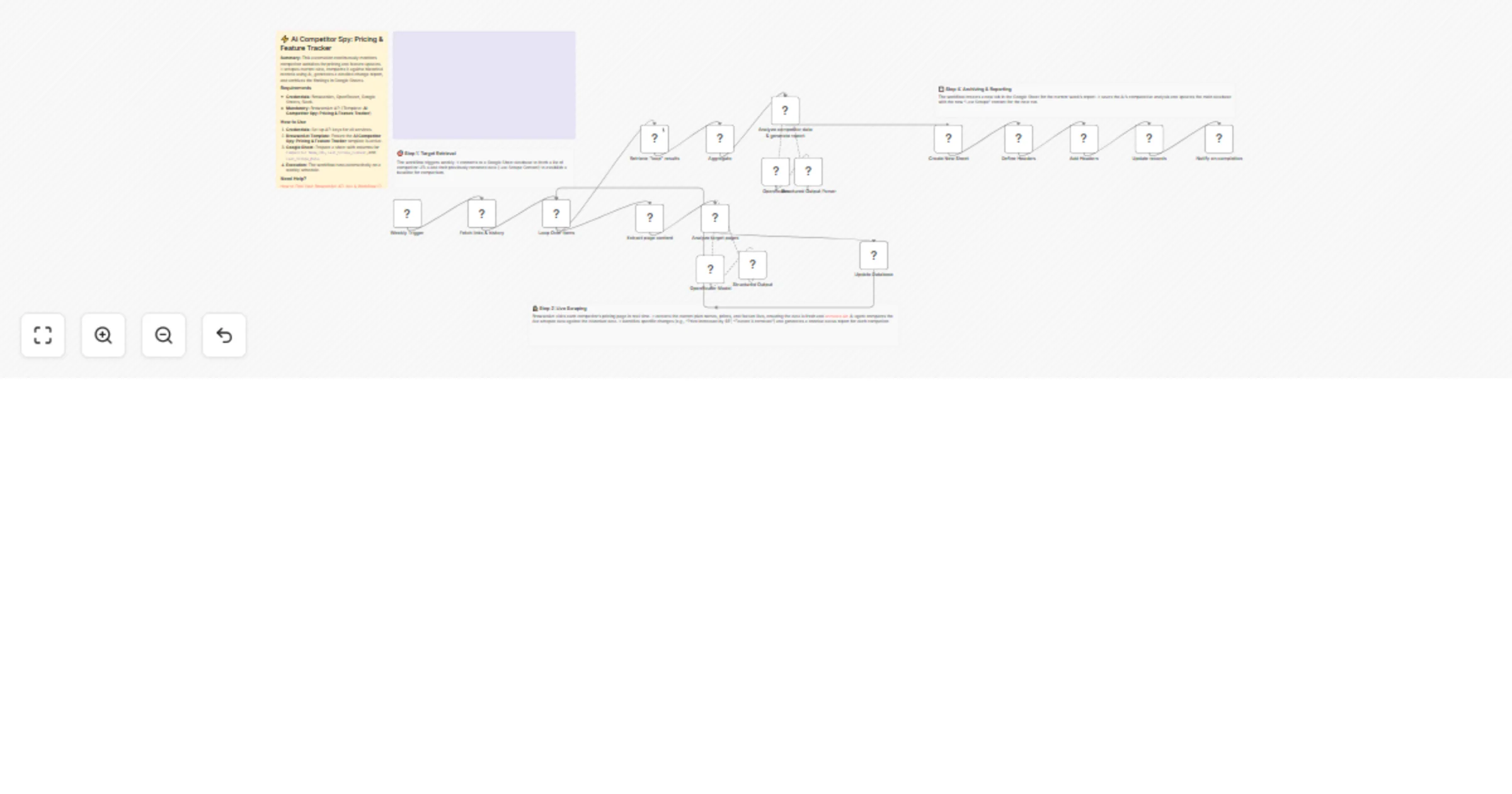
Workflow preview
100%
Track competitor pricing and features with BrowserAct and Google Sheets preview
Open on n8n.io

1. Workflow Overview

Track competitor pricing and features from BrowserAct to Google Sheets Introduction This workflow automates competitive intelligence by continuously monitoring competitor websites for pricing and f...

Best for

  • Market Research automation workflows
  • AI Summarization automation workflows
  • advanced n8n builders looking for reusable templates

Tools used

n8n-nodes-base.splitinbatches, n8n-nodes-base.aggregate, n8n-nodes-base.scheduletrigger, n8n-nodes-base.googlesheets, n8n-nodes-browseract.browseract, @n8n/n8n-nodes-langchain.agent, @n8n/n8n-nodes-langchain.outputparserstructured, n8n-nodes-base.set

Source and attribution

This workflow is cataloged by N8N Workflows and links back to its original n8n.io source page by Madame AI Team | Kai.

Original n8n.io source

1.1 Workflow description

Title
Track competitor pricing and features with BrowserAct and Google Sheets
Workflow name
Track competitor pricing and features with BrowserAct and Google Sheets

Track competitor pricing and features from BrowserAct to Google Sheets

Introduction

This workflow automates competitive intelligence by continuously monitoring competitor websites for pricing and feature updates. It scrapes current data using BrowserAct, compares it against historical records using AI to identify specific changes (like price increases or removed features), and archives the findings in a new Google Sheet tab every week.

Target Audience

Product managers, pricing analysts, and market researchers who need to stay updated on competitor moves without manually checking websites.

How it works

  1. Scheduling: A Weekly Trigger initiates the workflow to ensure regular monitoring.
  2. Database Retrieval: The workflow fetches a list of competitor URLs and their previous scrape data from a Google Sheet.
  3. Data Extraction:

A BrowserAct node visits each URL and extracts the current pricing plans and feature lists using the "AI Competitor Spy" template. 4. AI Comparison: An AI Agent (using Google Gemini Flash via OpenRouter) compares the live data against the historical data stored in the sheet. It identifies exactly what changed (e.g., "Basic plan increased by $5"). 5. Database Update: The workflow updates the main database with the new "Last Scrape Content" and the date, establishing a new baseline for the next run. 6. Report Generation: After processing all competitors, a second AI Agent (using Google Gemini Pro) aggregates the findings into a comprehensive text report. 7. Archiving: The workflow creates a new tab in the Google Sheet (named with the current date) and appends the full comparative report. 8. Notification: A Slack message is sent to notify the team that the weekly analysis is complete.

How to set up

  1. Configure Credentials: Connect your BrowserAct, OpenRouter, Google Sheets, and Slack accounts in n8n.
  2. Prepare BrowserAct: Ensure the AI Competitor Spy: Pricing & Feature Tracker template is active in your BrowserAct library.
  3. Prepare Google Sheet: Create a Google Sheet with the headers listed below. Populate the Competitor Name, URL, and row_number columns with your targets. Leave the other columns blank initially.
  4. Configure IDs: Select your Google Sheet in the Fetch links & history, Update Database, and Create New Sheet nodes.

Google Sheet Headers

To use this workflow, create a Google Sheet with the following headers in the first row:

  • row_number (Must be populated, e.g., 1, 2, 3...)
  • Competitor Name
  • URL
  • Last_Scrape_Content
  • Last_Scrape_Date
  • Comparison

Requirements

  • BrowserAct Account: Required for scraping. Template: AI Competitor Spy: Pricing & Feature Tracker.
  • OpenRouter Account: Required to access Google Gemini models for analysis.
  • Google Sheets: Used as the database and report archive.
  • Slack Account: Used for notifications.

How to customize the workflow

  1. Change the AI Model: The workflow currently uses Google Gemini models. You can swap this for GPT-4 or Claude within the OpenRouter nodes for different analytical styles.
  2. Add Email Alerts: Replace or augment the Slack node with a Gmail or SendGrid node to email the weekly report to stakeholders.
  3. Filter Minor Changes: Modify the System Prompt in the Analyze target pages node to ignore small price changes (e.g., less than 5%) or specific formatting updates.

Need Help?


Workflow Guidance and Showcase Video

1.2 Logical Blocks

This catalog entry is organized from the workflow JSON. The node-level section below shows the executable blocks available for review before importing the template.

2. Block-by-Block Analysis

Block 1 - Loop Over Items

Type / Role
n8n-nodes-base.splitInBatches - splitInBatches
Config choices
Version 3

Block 2 - Aggregate

Type / Role
n8n-nodes-base.aggregate - aggregate
Config choices
Version 1

Block 3 - Weekly Trigger

Type / Role
n8n-nodes-base.scheduleTrigger - scheduleTrigger
Config choices
Version 1.3

Block 4 - Update Database

Type / Role
n8n-nodes-base.googleSheets - googleSheets
Config choices
Version 4.7

Block 5 - Extract page content

Type / Role
n8n-nodes-browseract.browserAct - browserAct
Config choices
Version 1

Block 6 - Analyze target pages

Type / Role
@n8n/n8n-nodes-langchain.agent - agent
Config choices
Version 3

Block 7 - Retrieve "loop" results

Type / Role
n8n-nodes-base.googleSheets - googleSheets
Config choices
Version 4.7

Block 8 - Analyze competitor data & generate report

Type / Role
@n8n/n8n-nodes-langchain.agent - agent
Config choices
Version 3

Block 9 - Structured Output

Type / Role
@n8n/n8n-nodes-langchain.outputParserStructured - outputParserStructured
Config choices
Version 1.3

Block 10 - Structured Output Parser

Type / Role
@n8n/n8n-nodes-langchain.outputParserStructured - outputParserStructured
Config choices
Version 1.3

Block 11 - Create New Sheet

Type / Role
n8n-nodes-base.googleSheets - googleSheets
Config choices
Version 4.7

Block 12 - Define Headers

Type / Role
n8n-nodes-base.set - set
Config choices
Version 3.4

Block 13 - Add Headers

Type / Role
n8n-nodes-base.googleSheets - googleSheets
Config choices
Version 4.7

Block 14 - Update records

Type / Role
n8n-nodes-base.googleSheets - googleSheets
Config choices
Version 4.7

Block 15 - Notify on completion

Type / Role
n8n-nodes-base.slack - slack
Config choices
Version 2.4

Block 16 - OpenRouter

Type / Role
@n8n/n8n-nodes-langchain.lmChatOpenRouter - lmChatOpenRouter
Config choices
Version 1

Block 17 - OpenRouter Model

Type / Role
@n8n/n8n-nodes-langchain.lmChatOpenRouter - lmChatOpenRouter
Config choices
Version 1

Block 18 - Documentation

Type / Role
n8n-nodes-base.stickyNote - stickyNote
Config choices
Version 1

Block 19 - Step 1 Explanation

Type / Role
n8n-nodes-base.stickyNote - stickyNote
Config choices
Version 1

Block 20 - Step 2 Explanation

Type / Role
n8n-nodes-base.stickyNote - stickyNote
Config choices
Version 1

Block 21 - Step 4 Explanation

Type / Role
n8n-nodes-base.stickyNote - stickyNote
Config choices
Version 1

Block 22 - Fetch links & history

Type / Role
n8n-nodes-base.googleSheets - googleSheets
Config choices
Version 4.7

Block 23 - Sticky Note

Type / Role
n8n-nodes-base.stickyNote - stickyNote
Config choices
Version 1

3. Summary Table

Workflow Track competitor pricing and features with BrowserAct and Google Sheets
Complexity advanced
Nodes 23
Categories Market Research, AI Summarization
Author Madame AI Team | Kai
Published 13 Feb 2026

4. Reproducing the Workflow from Scratch

  1. 1. Download the workflow JSON

    Use the JSON export at /data/workflows/13379/13379.json as the source template for this automation.

  2. 2. Import the template into n8n

    Open n8n, import the downloaded JSON, and review each node before activating the workflow.

  3. 3. Configure credentials and variables

    Replace placeholder credentials, API keys, webhook URLs, account IDs, and environment-specific values with your own settings.

  4. 4. Test with sample data

    Run the workflow manually or in a staging workspace, inspect node output, and confirm downstream systems receive the expected data.

  5. 5. Activate and monitor

    Enable the workflow only after testing, then monitor executions, errors, and rate limits during the first production runs.

5. General Notes & Resources

Review imported nodes carefully before activation. This catalog entry is intended to help you inspect the workflow structure, understand required services, and find related templates faster.

Node names, credentials, schedules, webhook paths, and external service limits may need adjustment for your workspace.

Frequently asked questions

What does Track competitor pricing and features with BrowserAct and Google Sheets do?

Track competitor pricing and features from BrowserAct to Google Sheets Introduction This workflow automates competitive intelligence by continuously monitoring competitor websites for pricing and f...

What do I need before importing this workflow?

Review the workflow JSON, configure any required credentials in n8n, and test the automation in a safe workspace before using it in production.

Can I customize this workflow?

Yes. Use the block-by-block analysis and the downloadable JSON to inspect each node, then adjust credentials, prompts, schedules, filters, or destinations for your Market Research, AI Summarization use case.



