Track certification requirement changes with ScrapeGraphAI, GitHub and email
Workflow preview


 Early Deal
DISCOUNT 20%

Important notice
This workflow is provided as-is. Please review and test before using in production.
Overview
Job Posting Aggregator with Email and GitHub
⚠️ COMMUNITY TEMPLATE DISCLAIMER: This is a community-contributed template that uses ScrapeGraphAI (a community node). Please ensure you have the ScrapeGraphAI community node installed in your n8n instance before using this template.
This workflow automatically aggregates certification-related job-posting requirements from multiple industry sources, compares them against last year’s data stored in GitHub, and emails a concise change log to subscribed professionals. It streamlines annual requirement checks and renewal reminders, ensuring users never miss an update.
Pre-conditions/Requirements
Prerequisites
- n8n instance (self-hosted or n8n cloud)
- ScrapeGraphAI community node installed
- Git installed (for optional local testing of the repo)
- Working SMTP server or other Email credential supported by n8n
Required Credentials
- ScrapeGraphAI API Key – Enables web scraping of certification pages
- GitHub Personal Access Token – Allows the workflow to read/write files in the repo
- Email / SMTP Credentials – Sends the summary email to end-users
Specific Setup Requirements
| Resource | Purpose | Example |
|---|---|---|
| GitHub Repository | Stores certification_requirements.json versioned annually |
https://github.com/<you>/cert-requirements.git |
| Watch List File | List of page URLs & selectors to scrape | Saved in the repo under /config/watchList.json |
| Email List | Semicolon-separated list of recipients | [email protected];[email protected] |
How it works
This workflow automatically aggregates certification-related job-posting requirements from multiple industry sources, compares them against last year’s data stored in GitHub, and emails a concise change log to subscribed professionals. It streamlines annual requirement checks and renewal reminders, ensuring users never miss an update.
Key Steps:
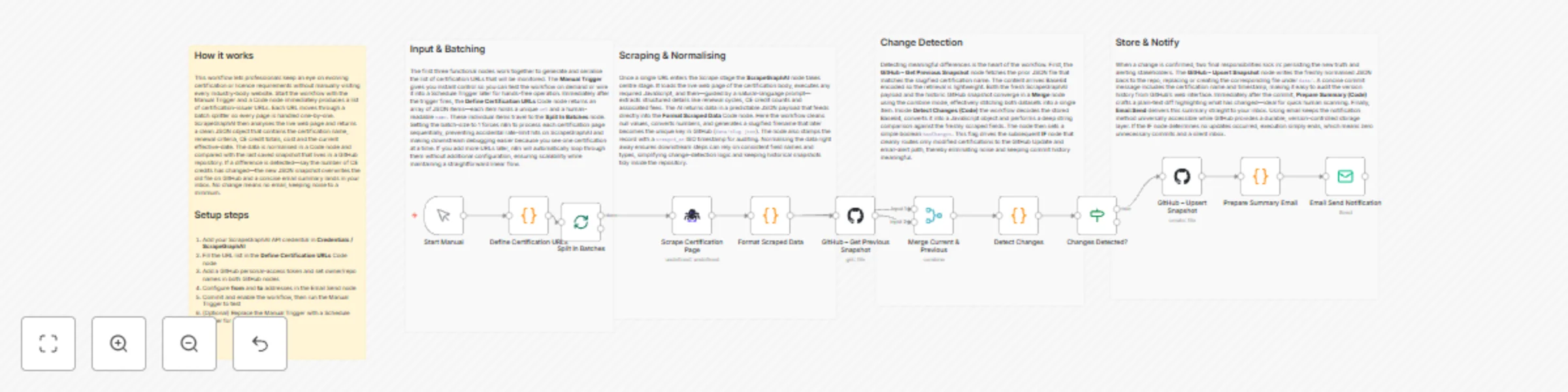
- Manual Trigger: Starts the workflow on demand or via scheduled cron.
- Load Watch List (Code Node): Reads the list of certification URLs and CSS selectors.
- Split In Batches: Iterates through each URL to avoid rate limits.
- ScrapeGraphAI: Scrapes requirement details from each page.
- Merge (Wait): Reassembles individual scrape results into a single JSON array.
- GitHub (Read File): Retrieves last year’s
certification_requirements.json. - IF (Change Detector): Compares current vs. previous JSON and decides whether changes exist.
- Email Send: Composes and sends a formatted summary of changes.
- GitHub (Upsert File): Commits the new JSON file back to the repo for future comparisons.
Set up steps
Setup Time: 15-25 minutes
- Install Community Node: From n8n UI → Settings → Community Nodes → search and install “ScrapeGraphAI”.
- Create/Clone GitHub Repo: Add an empty
certification_requirements.json({}) and aconfig/watchList.jsonwith an array of objects like:[ { "url": "https://cert-body.org/requirements", "selector": "#requirements" } ] - Generate GitHub PAT: Scope
repo, store in n8n Credentials as “GitHub API”. - Add ScrapeGraphAI Credential: Paste your API key into n8n Credentials.
- Configure Email Credentials: E.g., SMTP with username/password or OAuth2.
- Open Workflow: Import the template JSON into n8n.
- Update Environment Variables (in the Code node or via n8n variables):
GITHUB_REPO(e.g.,user/cert-requirements)EMAIL_RECIPIENTS
- Test Run: Trigger manually. Verify email content and GitHub commit.
- Schedule: Add a Cron node (optional) for yearly or quarterly automatic runs.
Node Descriptions
Core Workflow Nodes:
- Manual Trigger – Initiates the workflow manually or via external schedule.
- Code (Load Watch List) – Reads and parses
watchList.jsonfrom GitHub or static input. - SplitInBatches – Controls request concurrency to avoid scraping bans.
- ScrapeGraphAI – Extracts requirement text using provided CSS selectors or XPath.
- Merge (Combine) – Waits for all batches and merges them into one dataset.
- GitHub (Read/Write File) – Handles version-controlled storage of JSON data.
- IF (Change Detector) – Compares hashes/JSON diff to detect updates.
- EmailSend – Sends change log, including renewal reminders and diff summary.
- Sticky Note – Provides in-workflow documentation for future editors.
Data Flow:
- Manual Trigger → Code (Load Watch List) → SplitInBatches
- SplitInBatches → ScrapeGraphAI → Merge
- Merge → GitHub (Read File) → IF (Change Detector)
- IF (True) → Email Send → GitHub (Upsert File)
Customization Examples
Adjusting Scraper Configuration
// Inside the Watch List JSON object
{
  "url": "https://new-association.com/cert-update",
  "selector": ".content article:nth-of-type(1) ul"
}
Custom Email Template
// In Email Send node → HTML Content
<div>
  <h2>📋 Certification Updates – {{ $json.date }}</h2>
  <p>The following certifications have new requirements:</p>
  <ul>
    {{ $json.diffHtml }}
  </ul>
  <p>For full details visit our GitHub repo.</p>
</div>
Data Output Format
The workflow outputs structured JSON data:
{
  "timestamp": "2024-09-01T12:00:00Z",
  "source": "watchList.json",
  "current": {
    "AWS-SAA": "Version 3.0, requires renewed proctored exam",
    "PMP": "60 PDUs every 3 years"
  },
  "previous": {
    "AWS-SAA": "Version 2.0",
    "PMP": "60 PDUs every 3 years"
  },
  "changes": {
    "AWS-SAA": "Updated to Version 3.0; exam format changed."
  }
}
Troubleshooting
Common Issues
- ScrapeGraphAI returns empty data – Check CSS/XPath selectors and ensure page is publicly accessible.
- GitHub authentication fails – Verify PAT scope includes
repoand that the credential is linked in both GitHub nodes.
Performance Tips
- Limit
SplitInBatchessize to 3-5 URLs when sources are heavy to avoid timeouts. - Enable n8n execution mode “Queue” for long-running scrapes.
Pro Tips:
- Store selector samples in comments next to each watch list entry for future maintenance.
- Use a Cron node set to “0 0 1 1 *” for an annual run exactly on Jan 1st.
- Add a Telegram node after Email Send for instant mobile notifications.