
Syncing contacts with CentralStationCRM, Rapidmail, and Slack

Workflow preview
Workflow preview
100%
Syncing contacts with CentralStationCRM, Rapidmail, and Slack preview
Open on n8n.io

Important notice

This workflow is provided as-is. Please review and test before using in production.

1. Workflow Overview

This workflow benefits anyone who: wants to automate writing new contacts (with an associated 'Newsletter' tag) in CentralStationCRM to a Rapidmail list Tools in this workflow [CentralStationCRM](h...

Best for

  • Social Media automation workflows
  • advanced n8n builders looking for reusable templates

Tools used

n8n-nodes-base.stickynote, n8n-nodes-base.scheduletrigger, n8n-nodes-base.if, n8n-nodes-base.httprequest, n8n-nodes-base.slack, n8n-nodes-base.noop

Source and attribution

This workflow is cataloged by N8N Workflows and links back to its original n8n.io source page by CentralStationCRM.

Original n8n.io source

1.1 Workflow description

Title
Syncing contacts with CentralStationCRM, Rapidmail, and Slack
Workflow name
Syncing contacts with CentralStationCRM, Rapidmail, and Slack

Workflow Overview

This workflow benefits anyone who:

  • wants to automate writing new contacts (with an associated 'Newsletter' tag) in CentralStationCRM to a Rapidmail list

Tools in this workflow

Workflow Screenshot

Workflow Description

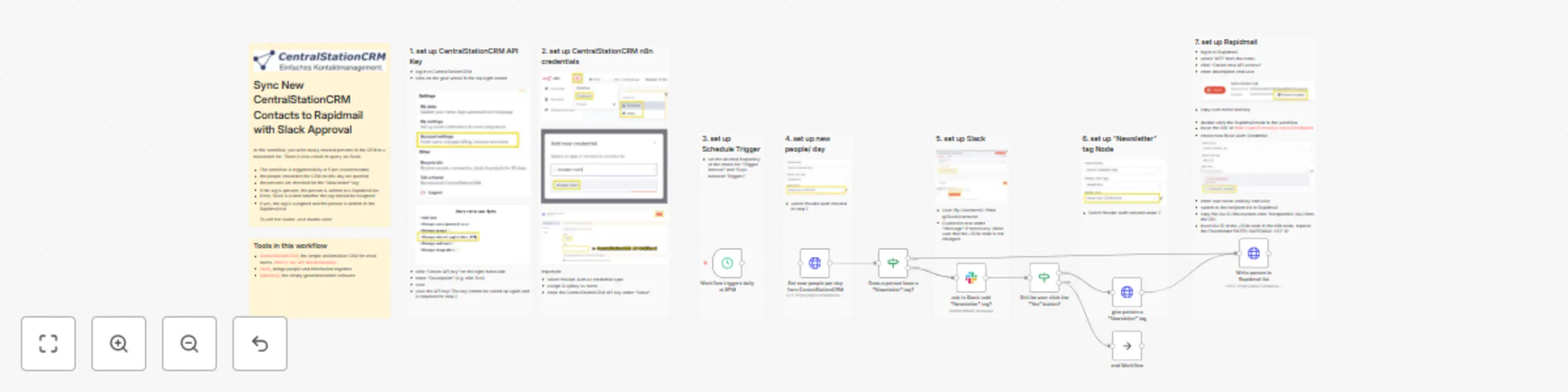
This workflow consists of:

  • a schedule trigger (set to 5 pm/daily)
  • three HTTP Requests to the CentralStationCRM API
  • two if-Nodes as logic gates
  • a Slack node
  • a "Do nothing, end workflow" node

The schedule trigger

The schedule trigger is set to trigger at 5 pm, every day.

The thinking here: If you added new contacts into CentralStationCRM during your workday, the workflow will collect them afterwards. You can of course set your own time.

First HTTP Request: Get new people of the day

This node talks to the CentralStationCRM API and gets every newly created person of the day. Included are the tags, adresses, associated companies, and emails of the person.

First if-gate: Does the person have a "Newsletter" tag?

If you tagged your person with "Newsletter" in CentralStationCRM after creating it, this if-node will see it. -> if true: go to last HTTP Request (Rapidmail list) -> if false: go to Slack node

Slack node: ask if the person should get a "Newsletter" tag

Pretty much what the title says. The slack user sees a private message with the question "Should <person> be on your newsletter list" and can click "yes" or "no".

second if-gate: Did the user click the "Yes"-button?

-> if false: end workflow (do nothing node) -> if true: go to second HTTP request node

second HTTP request: give person a "Newsletter" tag in CentralStationCRM

This node again talks to the CentralStationCRM API and creates a new tag for the person, called "Newsletter". This is so you know later that this person is also receiving your newsletter.

last HTTP request node: write person's name and email on Rapidmail list

This node uses the Rapidmail API and the Rapidmail list ID to write a person with the "Newsletter" tag on a pre-created Rapidmail list for your newsletter.

Customization ideas

With this workflow, you could

  • change the interval the workflow triggers, i.e. to once per week. you'd have to change the JSON code in the second node to fetch all the new people per week instead of per day
  • customize the slack approval message to include more information on the person than the name, i.e. the company the person works for
  • take the beginning - give tag to person in CentralStationCRM, trigger workflow, check for tag, ask for approval in slack - and then do something else with the last node, i.e. write the person a mail in Gmail or write their info in a Google sheet or do a web research with ai on the person. Go experiment ab bit!

Preconditions

For this workflow, you need:

  • a CentralStationCRM account with API access
  • an n8n account with API access
  • a Rapidmail account with API access
  • a Rapidmail recipient list

Have fun with our workflow!

1.2 Logical Blocks

This catalog entry is organized from the workflow JSON. The node-level section below shows the executable blocks available for review before importing the template.

2. Block-by-Block Analysis

Block 1 - Sticky Note1

Type / Role
n8n-nodes-base.stickyNote - stickyNote
Config choices
Version 1

Block 2 - Sticky Note2

Type / Role
n8n-nodes-base.stickyNote - stickyNote
Config choices
Version 1

Block 3 - Sticky Note

Type / Role
n8n-nodes-base.stickyNote - stickyNote
Config choices
Version 1

Block 4 - Sticky Note8

Type / Role
n8n-nodes-base.stickyNote - stickyNote
Config choices
Version 1

Block 5 - Sticky Note9

Type / Role
n8n-nodes-base.stickyNote - stickyNote
Config choices
Version 1

Block 6 - Sticky Note10

Type / Role
n8n-nodes-base.stickyNote - stickyNote
Config choices
Version 1

Block 7 - Sticky Note3

Type / Role
n8n-nodes-base.stickyNote - stickyNote
Config choices
Version 1

Block 8 - Sticky Note4

Type / Role
n8n-nodes-base.stickyNote - stickyNote
Config choices
Version 1

Block 9 - Sticky Note5

Type / Role
n8n-nodes-base.stickyNote - stickyNote
Config choices
Version 1

Block 10 - Workflow triggers daily at 5PM

Type / Role
n8n-nodes-base.scheduleTrigger - scheduleTrigger
Config choices
Version 1.2

Block 11 - Does a person have a "Newsletter" tag?

Type / Role
n8n-nodes-base.if - if
Config choices
Version 2.2

Block 12 - Get new people per day from CentralStationCRM

Type / Role
n8n-nodes-base.httpRequest - httpRequest
Config choices
Version 4.2

Block 13 - ask in Slack: add "Newsletter" tag?

Type / Role
n8n-nodes-base.slack - slack
Config choices
Version 2.3

Block 14 - Did the user click the "Yes" button?

Type / Role
n8n-nodes-base.if - if
Config choices
Version 2.2

Block 15 - end Workflow

Type / Role
n8n-nodes-base.noOp - noOp
Config choices
Version 1

Block 16 - give person a "Newsletter" tag

Type / Role
n8n-nodes-base.httpRequest - httpRequest
Config choices
Version 4.2

Block 17 - Write person to Rapidmail list

Type / Role
n8n-nodes-base.httpRequest - httpRequest
Config choices
Version 4.2

3. Summary Table

Workflow Syncing contacts with CentralStationCRM, Rapidmail, and Slack
Complexity advanced
Nodes 17
Categories Social Media
Author CentralStationCRM
Published 18 Jul 2025

4. Reproducing the Workflow from Scratch

  1. 1. Download the workflow JSON

    Use the JSON export at /data/workflows/6125/6125.json as the source template for this automation.

  2. 2. Import the template into n8n

    Open n8n, import the downloaded JSON, and review each node before activating the workflow.

  3. 3. Configure credentials and variables

    Replace placeholder credentials, API keys, webhook URLs, account IDs, and environment-specific values with your own settings.

  4. 4. Test with sample data

    Run the workflow manually or in a staging workspace, inspect node output, and confirm downstream systems receive the expected data.

  5. 5. Activate and monitor

    Enable the workflow only after testing, then monitor executions, errors, and rate limits during the first production runs.

5. General Notes & Resources

Review imported nodes carefully before activation. This catalog entry is intended to help you inspect the workflow structure, understand required services, and find related templates faster.

Node names, credentials, schedules, webhook paths, and external service limits may need adjustment for your workspace.

Frequently asked questions

What does Syncing contacts with CentralStationCRM, Rapidmail, and Slack do?

This workflow benefits anyone who: wants to automate writing new contacts (with an associated 'Newsletter' tag) in CentralStationCRM to a Rapidmail list Tools in this workflow [CentralStationCRM](h...

What do I need before importing this workflow?

Review the workflow JSON, configure any required credentials in n8n, and test the automation in a safe workspace before using it in production.

Can I customize this workflow?

Yes. Use the block-by-block analysis and the downloadable JSON to inspect each node, then adjust credentials, prompts, schedules, filters, or destinations for your Social Media use case.



