
Starred Slack messages to Notion database with AI auto-tagging

Workflow preview
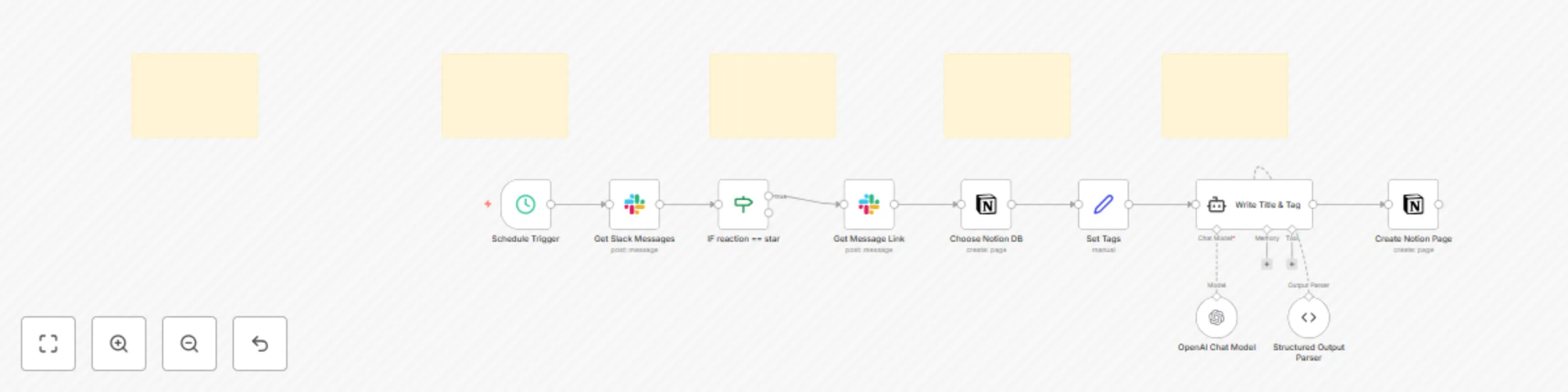
Workflow preview
100%
Starred Slack messages to Notion database with AI auto-tagging preview
Open on n8n.io

Important notice

This workflow is provided as-is. Please review and test before using in production.

1. Workflow Overview

Who is this for? Teams that want to capture important Slack messages in Notion with smart categorization. Perfect for knowledge workers, community managers, or any team that needs to preserve valua...

Best for

  • Internal Wiki automation workflows
  • AI Summarization automation workflows
  • advanced n8n builders looking for reusable templates

Tools used

n8n-nodes-base.if, n8n-nodes-base.scheduletrigger, @n8n/n8n-nodes-langchain.lmchatopenai, @n8n/n8n-nodes-langchain.outputparserstructured, n8n-nodes-base.slack, n8n-nodes-base.set, @n8n/n8n-nodes-langchain.agent, n8n-nodes-base.notion

Source and attribution

This workflow is cataloged by N8N Workflows and links back to its original n8n.io source page by Matty Reed.

Original n8n.io source

1.1 Workflow description

Title
Starred Slack messages to Notion database with AI auto-tagging
Workflow name
Starred Slack messages to Notion database with AI auto-tagging

Who is this for?

Teams that want to capture important Slack messages in Notion with smart categorization. Perfect for knowledge workers, community managers, or any team that needs to preserve valuable conversations from Slack and organize them automatically in a Notion database.

What problem does this solve?

Important Slack messages get buried in chat history and are hard to find later. This workflow monitors your Slack channel and automatically saves starred messages to Notion with AI-generated titles and smart tags. No more manually copying messages or losing track of important discussions.

How it works

Trigger - Schedule Trigger fires every 10 minutes to check for new messages.

Get Slack Messages - fetches recent messages from your specified Slack channel within the last 10 minutes.

Star Filter - only processes messages that have been reacted to with a ⭐ emoji (configurable to any emoji).

Get Message Link - retrieves the permanent link to the starred Slack message.

Choose Notion DB - connects to your target Notion database and loads available tag options.

Set Tags - prepares the available tags from your Notion database for AI processing.

AI Processing - uses OpenAI GPT-4o-mini to:

  • Generate a concise title (under 50 characters)
  • Automatically categorize the message with existing tags (90%+ confidence threshold)

Create Notion Page - saves the message to Notion with:

  • AI-generated title
  • Auto-selected tags
  • Original message content
  • Permanent link back to Slack

Setup steps

1. Import and connect credentials

2. Configure Slack integration

  • Create a Slack bot and add it to your target channel
  • Update the channelId in "Get Slack Messages" node with your channel ID
  • Ensure your bot has these permissions:
    • channels:history - to read channel messages
    • reactions:read - to detect star reactions
    • chat:write.public - to get message permalinks

Slack Bot Setup Resources:

3. Set up Notion database

  • Create or use existing Notion database with required properties:
    • Tags (Multi-select) - add tag options with descriptions for better AI accuracy
    • Link (URL) - for storing Slack permalink
    • Title (Title) - will be auto-populated by AI
  • Update the databaseId in "Choose Notion DB" and "Create Notion Page" nodes

4. Customize the workflow

  • Change trigger emoji: Edit the IF condition to use a different emoji (e.g., bookmark, pushpin)
  • Adjust timing: Modify the Schedule Trigger interval (remember to update the "oldest" filter in Get Slack Messages to match)
  • Improve AI prompts: Edit the prompt in "Write Title & Tag" node for better categorization

5. Test the setup

  • Star a message in your Slack channel
  • Wait for the next 10-minute trigger or manually execute the workflow
  • Check your Notion database for the new entry

Example output

Slack message: > "Hey team, just found this amazing tool for automating our design workflow. We should definitely consider it for next sprint: https://example.com/design-tool"

Generated Notion page:

  • Title: "Design Tool Recommendation for Next Sprint"
  • Tags: "Tools", "Design", "Sprint Planning"
  • Content: Full message text with Slack permalink
  • Link: Direct link back to original Slack message

Extending the flow

Multi-channel support - duplicate the "Get Slack Messages" node for different channels and merge the outputs.

Enhanced AI processing - modify the prompt to extract additional metadata like:

  • Priority levels
  • Action items
  • Mentioned team members
  • Due dates

Rich content preservation - add logic to handle Slack attachments, images, or threaded replies.

Notification system - add nodes to notify team members when important messages are archived.

Sentiment analysis - incorporate additional AI processing to categorize message sentiment or urgency.

This template provides a lean setup for intelligent Slack-to-Notion archiving. Star important messages, let AI handle the organization, and never lose track of valuable conversations again.

1.2 Logical Blocks

This catalog entry is organized from the workflow JSON. The node-level section below shows the executable blocks available for review before importing the template.

2. Block-by-Block Analysis

Block 1 - IF reaction == star

Type / Role
n8n-nodes-base.if - if
Config choices
Version 1

Block 2 - Schedule Trigger

Type / Role
n8n-nodes-base.scheduleTrigger - scheduleTrigger
Config choices
Version 1.2

Block 3 - OpenAI Chat Model

Type / Role
@n8n/n8n-nodes-langchain.lmChatOpenAi - lmChatOpenAi
Config choices
Version 1.2

Block 4 - Structured Output Parser

Type / Role
@n8n/n8n-nodes-langchain.outputParserStructured - outputParserStructured
Config choices
Version 1.2

Block 5 - Get Slack Messages

Type / Role
n8n-nodes-base.slack - slack
Config choices
Version 2.3

Block 6 - Set Tags

Type / Role
n8n-nodes-base.set - set
Config choices
Version 3.4

Block 7 - Write Title & Tag

Type / Role
@n8n/n8n-nodes-langchain.agent - agent
Config choices
Version 1.9

Block 8 - Create Notion Page

Type / Role
n8n-nodes-base.notion - notion
Config choices
Version 2.2

Block 9 - Get Message Link

Type / Role
n8n-nodes-base.slack - slack
Config choices
Version 2.3

Block 10 - Choose Notion DB

Type / Role
n8n-nodes-base.notion - notion
Config choices
Version 2.2

Block 11 - Sticky Note

Type / Role
n8n-nodes-base.stickyNote - stickyNote
Config choices
Version 1

Block 12 - Sticky Note1

Type / Role
n8n-nodes-base.stickyNote - stickyNote
Config choices
Version 1

Block 13 - Sticky Note2

Type / Role
n8n-nodes-base.stickyNote - stickyNote
Config choices
Version 1

Block 14 - Sticky Note3

Type / Role
n8n-nodes-base.stickyNote - stickyNote
Config choices
Version 1

Block 15 - Sticky Note4

Type / Role
n8n-nodes-base.stickyNote - stickyNote
Config choices
Version 1

3. Summary Table

Workflow Starred Slack messages to Notion database with AI auto-tagging
Complexity advanced
Nodes 15
Categories Internal Wiki, AI Summarization
Author Matty Reed
Published 30 May 2025

4. Reproducing the Workflow from Scratch

  1. 1. Download the workflow JSON

    Use the JSON export at /data/workflows/4502/4502.json as the source template for this automation.

  2. 2. Import the template into n8n

    Open n8n, import the downloaded JSON, and review each node before activating the workflow.

  3. 3. Configure credentials and variables

    Replace placeholder credentials, API keys, webhook URLs, account IDs, and environment-specific values with your own settings.

  4. 4. Test with sample data

    Run the workflow manually or in a staging workspace, inspect node output, and confirm downstream systems receive the expected data.

  5. 5. Activate and monitor

    Enable the workflow only after testing, then monitor executions, errors, and rate limits during the first production runs.

5. General Notes & Resources

Review imported nodes carefully before activation. This catalog entry is intended to help you inspect the workflow structure, understand required services, and find related templates faster.

Node names, credentials, schedules, webhook paths, and external service limits may need adjustment for your workspace.

Frequently asked questions

What does Starred Slack messages to Notion database with AI auto-tagging do?

Who is this for? Teams that want to capture important Slack messages in Notion with smart categorization. Perfect for knowledge workers, community managers, or any team that needs to preserve valua...

What do I need before importing this workflow?

Review the workflow JSON, configure any required credentials in n8n, and test the automation in a safe workspace before using it in production.

Can I customize this workflow?

Yes. Use the block-by-block analysis and the downloadable JSON to inspect each node, then adjust credentials, prompts, schedules, filters, or destinations for your Internal Wiki, AI Summarization use case.



