Send weekly Google Ads performance reports with GPT-5.1 and Gmail
Workflow preview


 Early Deal
DISCOUNT 20%

Important notice
This workflow is provided as-is. Please review and test before using in production.
Overview
Automatically analyzes your Google Ads performance every Monday and sends a comprehensive report to your inbox with AI-powered insights, week-over-week comparisons, and prioritized recommendations to optimize your campaigns.
How it works
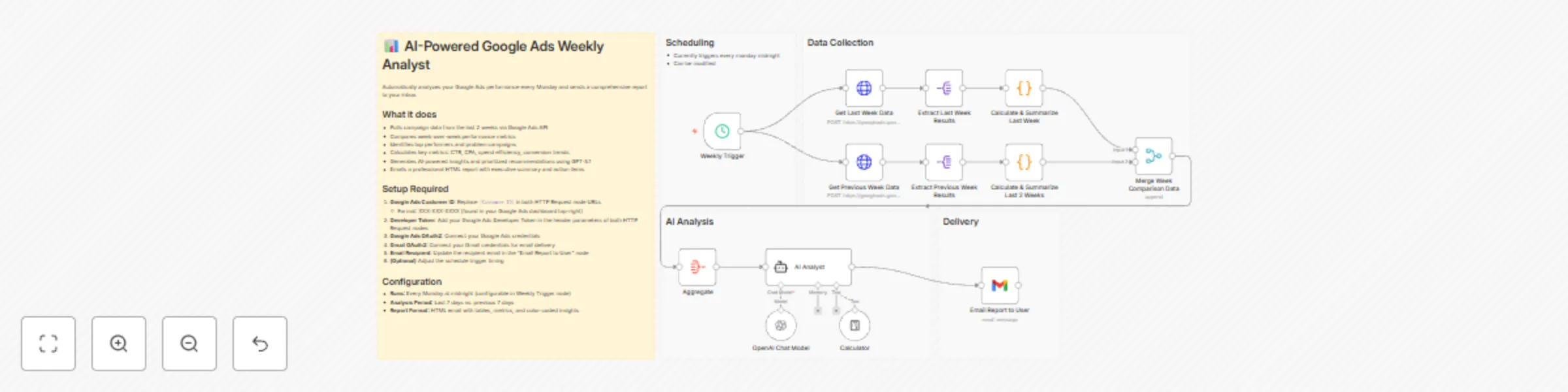
Step 1: Schedule Weekly Analysis
- Triggers automatically every Monday at midnight
- Can be customized to your preferred schedule
- Initiates the entire data collection and analysis process
Step 2: Collect Performance Data
- Fetches last 7 days of Google Ads data via API
- Retrieves previous 7 days of data (days 8-14) for comparison
- Extracts key metrics including impressions, clicks, cost, conversions, CTR, and CPA
- Calculates and summarizes performance for each week
- Identifies top performers, problem campaigns, and efficiency trends
- Merges data to create comprehensive week-over-week comparison
Step 3: AI-Powered Analysis
- Aggregates all performance data into a single view
- Sends data to AI Analyst powered by GPT-5.1
- AI analyzes trends, identifies insights, and spots anomalies
- Diagnoses root causes of performance changes
- Generates actionable, prioritized recommendations based on business impact
- Calculates efficiency metrics and budget optimization opportunities
Step 4: Deliver Insights Report
- Formats analysis into a professional HTML report
- Emails comprehensive insights directly to your inbox
- Includes executive summary, week-over-week comparison tables, and color-coded metrics
- Provides high/medium/low priority action items
- Ready for immediate action and strategy adjustments
What you'll get
The workflow delivers a comprehensive weekly analysis with:
- Performance Metrics: Impressions, clicks, CTR, conversions, cost, CPA, and efficiency trends
- Week-over-Week Comparison: Side-by-side analysis with percentage changes and visual indicators
- Top Performers Analysis: Detailed breakdown of your best-performing campaigns
- Issues & Performance Risks: Identification of campaigns with high spend but zero conversions, declining CTR, or rising CPA
- AI-Generated Insights: Intelligent pattern recognition and trend analysis with root cause diagnosis
- Actionable Recommendations: Prioritized action items (high/medium/low) with expected impact and risk levels
- Budget Efficiency Analysis: Spend allocation recommendations and wasted spend identification
- Campaign Intelligence: Clear understanding of what's working and what needs attention
- Data Confidence Assessment: Commentary on sample size adequacy and metric reliability
- Automated Delivery: Weekly HTML report sent directly to your email without manual effort
Why use this
- Save time on reporting: Eliminate 2-3 hours of manual weekly analysis and report creation
- Never miss insights: AI catches trends and patterns humans might overlook
- Consistent monitoring: Automated weekly reviews ensure you stay on top of performance
- Data-driven decisions: Make strategic adjustments based on comprehensive analysis with clear priorities
- Early problem detection: Spot performance issues and wasted spend before they impact your budget
- Optimize continuously: Regular insights enable ongoing campaign refinement
- Focus on strategy: Spend less time analyzing data, more time implementing improvements
- Scalable intelligence: Works whether you manage 1 campaign or 100
- Executive-ready reports: Professional HTML format suitable for sharing with stakeholders
Setup instructions
Before you start, you'll need:
Google Ads Account & API Access
- Go to your Google Ads account at https://ads.google.com
- Find your Customer ID (XXX-XXX-XXXX format in top-right corner)
- Get a Developer Token from Google Ads API Center
- Enable API access for your account
OpenAI API Key (for GPT-5.1 AI analysis)
- Sign up at https://platform.openai.com
- Navigate to API keys section and create a new key
- Ensure you have access to GPT-5.1 model
Gmail Account (for receiving reports)
- OAuth2 authentication will be used
- No app password needed
Configuration steps:
Replace Google Ads Customer ID:
- Open both "Get Last Week Data" and "Get Previous Week Data" HTTP Request nodes
- In the URL field, replace
[Customer ID]with your actual Customer ID (format: XXX-XXX-XXXX)
Add Developer Token:
- In both HTTP Request nodes, add your Google Ads Developer Token to the header parameters
Connect Google Ads OAuth2:
- In both HTTP Request nodes, authenticate with your Google Ads credentials
- Select your ad account
Connect OpenAI credentials:
- In the "OpenAI Chat Model" node, add your OpenAI API key
- Verify GPT-5.1 model is selected
Configure email delivery:
- In the "Email Report to User" node, connect your Gmail OAuth2 credentials
- Update the recipient email address (default: [email protected])
- Customize subject line if desired
Set your schedule (optional):
- In the "Weekly Trigger" node, configure your preferred day and time
- Default is Monday at midnight
Test the workflow:
- Click "Execute Workflow" to run manually
- Verify data pulls correctly from Google Ads
- Check that AI analysis provides meaningful insights
- Confirm email report arrives formatted correctly
Customize analysis focus (optional):
- Open the "AI Analyst" node
- Adjust the prompt to prioritize specific metrics or goals for your business
- Modify thresholds for "problem campaigns" in the calculation nodes
Activate automation:
- Enable the workflow to run automatically every Monday
- Monitor the first few reports to ensure accuracy
Note: The workflow analyzes the last 7 days vs. the previous 7 days, giving you rolling two-week comparisons every Monday. Adjust the date ranges in the HTTP Request nodes if you need different time periods.