
Send organized security CVE digests from NVD with AI-polished summaries to Gmail

Workflow preview
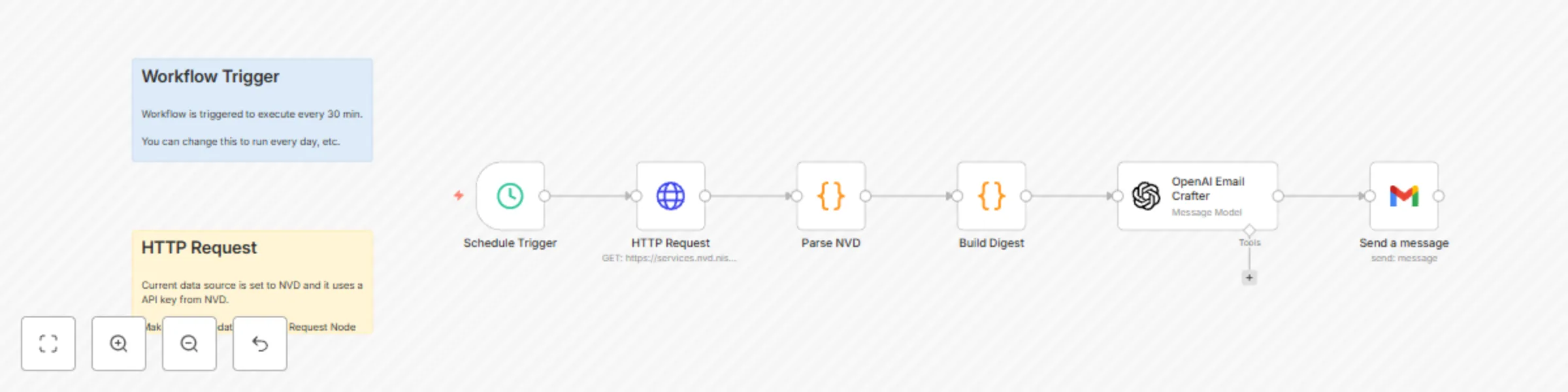
Workflow preview
100%
Send organized security CVE digests from NVD with AI-polished summaries to Gmail preview
Open on n8n.io

Important notice

This workflow is provided as-is. Please review and test before using in production.

1. Workflow Overview

Summary Turns the latest CVEs from NVD into a clean, sortable email digest (table + plaintext) and sends it via Gmail. The flow pulls the newest CVEs, extracts Vendor / Product / Version , severity...

Best for

  • SecOps automation workflows
  • AI Summarization automation workflows
  • intermediate n8n builders looking for reusable templates

Tools used

n8n-nodes-base.gmail, n8n-nodes-base.httprequest, n8n-nodes-base.scheduletrigger, n8n-nodes-base.code, @n8n/n8n-nodes-langchain.openai, n8n-nodes-base.stickynote

Source and attribution

This workflow is cataloged by N8N Workflows and links back to its original n8n.io source page by Calistus Christian.

Original n8n.io source

1.1 Workflow description

Title
Send organized security CVE digests from NVD with AI-polished summaries to Gmail
Workflow name
Send organized security CVE digests from NVD with AI-polished summaries to Gmail

Summary

Turns the latest CVEs from NVD into a clean, sortable email digest (table + plaintext) and sends it via Gmail. The flow pulls the newest CVEs, extracts Vendor / Product / Version, severity & CVSS, highlights public exploit references, drafts an HTML table, then asks OpenAI to tighten the copy before emailing it. Optionally, you can swap the Gmail node to Signal, Slack, Microsoft Teams, etc.

Perfect for: SecOps leads who want a low-noise digest of what changed recently, grouped and ranked by severity.


What this workflow does

  • Triggers on a schedule (every 30 minutes by default).

  • Calls the NVD 2.0 API to fetch recent CVEs.

  • Parses each CVE to extract:

    • Vendor / Product / Version(s) (from CPE 2.3 where available, with a text fallback)

    • Severity + CVSS (V3.1/V3.0/V2 fallback) and vector string

    • Exploit signal (tags/links like Exploit‑DB, GitHub PoCs, etc.)

    • Short English summary + direct NVD link

  • Builds an HTML email (and a plaintext fallback) ranked by severity then score.

  • Uses OpenAI to polish the subject line and copy into a concise, professional digest (JSON‑only contract).

  • Sends the digest with the Gmail node.


Prerequisites

  • NVD API key (free) --- create at https://nvd.nist.gov/developers/request-an-api-key

  • OpenAI API key with access to gpt-4o-mini (or change the model)

  • Email sending:

    • Gmail node with OAuth2 (recommended), or swap to the generic Email Send (SMTP) node if you prefer.

Quick start

  1. Import the workflow JSON below.

  2. Open HTTP Request → Headers and confirm apiKey uses {{$env.NVD_API_KEY}}.

  3. Open Send a message (Gmail) and set To to {{$env.RECIPIENT_EMAIL}} (or your address).

  4. Open OpenAI Email Crafter and connect your OpenAI credential (or change model if needed).

  5. Hit Execute to test, then Activate when happy.

Credits

Created by ca7ai (n8n Creator).


Tags

security, cve, cisa, nvd, email, monitoring, openai, gmail, automation

1.2 Logical Blocks

This catalog entry is organized from the workflow JSON. The node-level section below shows the executable blocks available for review before importing the template.

2. Block-by-Block Analysis

Block 1 - Send a message

Type / Role
n8n-nodes-base.gmail - gmail
Config choices
Version 2.1

Block 2 - HTTP Request

Type / Role
n8n-nodes-base.httpRequest - httpRequest
Config choices
Version 4.2

Block 3 - Schedule Trigger

Type / Role
n8n-nodes-base.scheduleTrigger - scheduleTrigger
Config choices
Version 1.2

Block 4 - Parse NVD

Type / Role
n8n-nodes-base.code - code
Config choices
Version 2

Block 5 - Build Digest

Type / Role
n8n-nodes-base.code - code
Config choices
Version 2

Block 6 - OpenAI Email Crafter

Type / Role
@n8n/n8n-nodes-langchain.openAi - openAi
Config choices
Version 1.8

Block 7 - Sticky Note

Type / Role
n8n-nodes-base.stickyNote - stickyNote
Config choices
Version 1

Block 8 - Sticky Note1

Type / Role
n8n-nodes-base.stickyNote - stickyNote
Config choices
Version 1

3. Summary Table

Workflow Send organized security CVE digests from NVD with AI-polished summaries to Gmail
Complexity intermediate
Nodes 8
Categories SecOps, AI Summarization
Author Calistus Christian
Published 31 Aug 2025

4. Reproducing the Workflow from Scratch

  1. 1. Download the workflow JSON

    Use the JSON export at /data/workflows/8097/8097.json as the source template for this automation.

  2. 2. Import the template into n8n

    Open n8n, import the downloaded JSON, and review each node before activating the workflow.

  3. 3. Configure credentials and variables

    Replace placeholder credentials, API keys, webhook URLs, account IDs, and environment-specific values with your own settings.

  4. 4. Test with sample data

    Run the workflow manually or in a staging workspace, inspect node output, and confirm downstream systems receive the expected data.

  5. 5. Activate and monitor

    Enable the workflow only after testing, then monitor executions, errors, and rate limits during the first production runs.

5. General Notes & Resources

Review imported nodes carefully before activation. This catalog entry is intended to help you inspect the workflow structure, understand required services, and find related templates faster.

Node names, credentials, schedules, webhook paths, and external service limits may need adjustment for your workspace.

Frequently asked questions

What does Send organized security CVE digests from NVD with AI-polished summaries to Gmail do?

Summary Turns the latest CVEs from NVD into a clean, sortable email digest (table + plaintext) and sends it via Gmail. The flow pulls the newest CVEs, extracts Vendor / Product / Version , severity...

What do I need before importing this workflow?

Review the workflow JSON, configure any required credentials in n8n, and test the automation in a safe workspace before using it in production.

Can I customize this workflow?

Yes. Use the block-by-block analysis and the downloadable JSON to inspect each node, then adjust credentials, prompts, schedules, filters, or destinations for your SecOps, AI Summarization use case.



