
Scrape latest 20 TechCrunch articles

Workflow preview
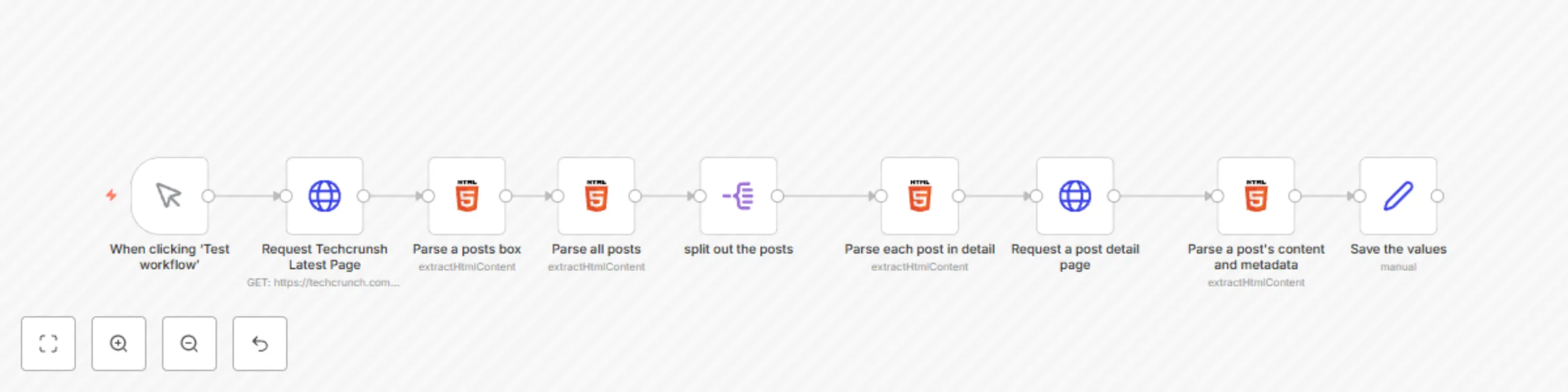
Workflow preview
100%
Scrape latest 20 TechCrunch articles preview
Open on n8n.io

Important notice

This workflow is provided as-is. Please review and test before using in production.

1. Workflow Overview

Retrieve 20 Latest TechCrunch Articles Who is this for? This workflow is designed for developers, content creators, and data analysts who need to scrape recent articles from TechCrunch. It’s perfec...

Best for

  • Market Research automation workflows
  • intermediate n8n builders looking for reusable templates

Tools used

n8n-nodes-base.manualtrigger, n8n-nodes-base.httprequest, n8n-nodes-base.html, n8n-nodes-base.splitout, n8n-nodes-base.set

Source and attribution

This workflow is cataloged by N8N Workflows and links back to its original n8n.io source page by Teddy.

Original n8n.io source

1.1 Workflow description

Title
Scrape latest 20 TechCrunch articles
Workflow name
Scrape latest 20 TechCrunch articles

Retrieve 20 Latest TechCrunch Articles

Who is this for?

This workflow is designed for developers, content creators, and data analysts who need to scrape recent articles from TechCrunch. It’s perfect for anyone looking to aggregate news articles or create custom feeds for analysis, reporting, or integration into other systems.

What problem is this workflow solving?

This workflow automates the process of scraping recent articles from TechCrunch. Manually collecting article data can be time-consuming and inefficient, but with this workflow, you can quickly gather up-to-date news articles with relevant metadata, saving time and effort.

What this workflow does

This workflow retrieves the latest 20 news articles from TechCrunch’s “Recent” page. It extracts the article URLs, metadata (such as titles and publication dates), and main content for each article, allowing you to access the information you need without any manual effort.

Setup

  1. Clone or download the workflow template.
  2. Ensure you have a working n8n environment.
  3. Configure the HTTP Request nodes with your desired parameters to connect to the TechCrunch API.
  4. (Optional) Customize the workflow to target specific sections or topics of interest.
  5. Run the workflow to retrieve the latest 20 articles.

How to customize this workflow to your needs

  • Modify the HTTP request to pull articles from different pages or sections of TechCrunch.
  • Adjust the number of articles to retrieve by changing the selection criteria.
  • Add additional processing steps to further filter or analyze the article data.

Workflow Steps

  1. Send an HTTP request to the TechCrunch "Recent" page.
  2. Parse a posts box that holds the list of articles.
  3. Parse all posts to extract all articles.
  4. spilt out posts for each article.
  5. Extract the URL and metadata from each article.
  6. Send an HTTP request for each article using its URL.
  7. Locate and parse the main content of each article.

Note: Be sure to update the HTTP Request nodes with any necessary headers or authentication to work with TechCrunch’s website.

1.2 Logical Blocks

This catalog entry is organized from the workflow JSON. The node-level section below shows the executable blocks available for review before importing the template.

2. Block-by-Block Analysis

Block 1 - When clicking ‘Test workflow’

Type / Role
n8n-nodes-base.manualTrigger - manualTrigger
Config choices
Version 1

Block 2 - Request Techcrunsh Latest Page

Type / Role
n8n-nodes-base.httpRequest - httpRequest
Config choices
Version 4.2

Block 3 - Parse a posts box

Type / Role
n8n-nodes-base.html - html
Config choices
Version 1.2

Block 4 - Parse all posts

Type / Role
n8n-nodes-base.html - html
Config choices
Version 1.2

Block 5 - split out the posts

Type / Role
n8n-nodes-base.splitOut - splitOut
Config choices
Version 1

Block 6 - Parse each post in detail

Type / Role
n8n-nodes-base.html - html
Config choices
Version 1.2

Block 7 - Request a post detail page

Type / Role
n8n-nodes-base.httpRequest - httpRequest
Config choices
Version 4.2

Block 8 - Parse a post's content and metadata

Type / Role
n8n-nodes-base.html - html
Config choices
Version 1.2

Block 9 - Save the values

Type / Role
n8n-nodes-base.set - set
Config choices
Version 3.4

3. Summary Table

Workflow Scrape latest 20 TechCrunch articles
Complexity intermediate
Nodes 9
Categories Market Research
Author Teddy
Published 01 Feb 2025

4. Reproducing the Workflow from Scratch

  1. 1. Download the workflow JSON

    Use the JSON export at /data/workflows/2832/2832.json as the source template for this automation.

  2. 2. Import the template into n8n

    Open n8n, import the downloaded JSON, and review each node before activating the workflow.

  3. 3. Configure credentials and variables

    Replace placeholder credentials, API keys, webhook URLs, account IDs, and environment-specific values with your own settings.

  4. 4. Test with sample data

    Run the workflow manually or in a staging workspace, inspect node output, and confirm downstream systems receive the expected data.

  5. 5. Activate and monitor

    Enable the workflow only after testing, then monitor executions, errors, and rate limits during the first production runs.

5. General Notes & Resources

Review imported nodes carefully before activation. This catalog entry is intended to help you inspect the workflow structure, understand required services, and find related templates faster.

Node names, credentials, schedules, webhook paths, and external service limits may need adjustment for your workspace.

Frequently asked questions

What does Scrape latest 20 TechCrunch articles do?

Retrieve 20 Latest TechCrunch Articles Who is this for? This workflow is designed for developers, content creators, and data analysts who need to scrape recent articles from TechCrunch. It’s perfec...

What do I need before importing this workflow?

Review the workflow JSON, configure any required credentials in n8n, and test the automation in a safe workspace before using it in production.

Can I customize this workflow?

Yes. Use the block-by-block analysis and the downloadable JSON to inspect each node, then adjust credentials, prompts, schedules, filters, or destinations for your Market Research use case.



