
Save Qualys reports to TheHive

Workflow preview
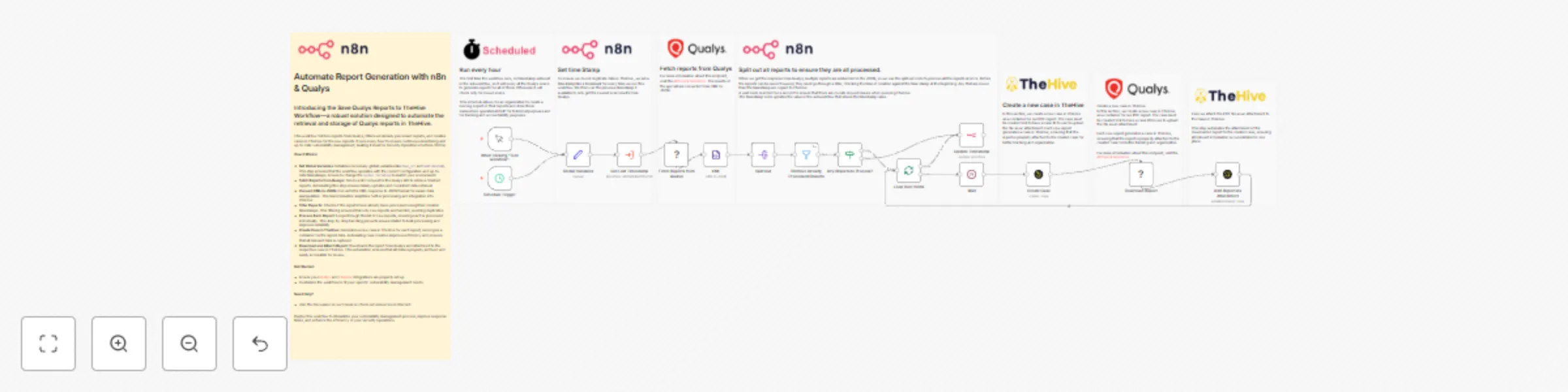
Workflow preview
100%
Save Qualys reports to TheHive preview
Open on n8n.io

Important notice

This workflow is provided as-is. Please review and test before using in production.

1. Workflow Overview

Automate Report Generation with n8n & Qualys Introducing the Save Qualys Reports to TheHive Workflow—a robust solution designed to automate the retr...

Best for

  • SecOps automation workflows
  • advanced n8n builders looking for reusable templates

Tools used

n8n-nodes-base.manualtrigger, n8n-nodes-base.set, n8n-nodes-base.httprequest, n8n-nodes-base.filter, n8n-nodes-base.if, n8n-nodes-base.splitinbatches, n8n-nodes-base.wait, n8n-nodes-base.n8n

Source and attribution

This workflow is cataloged by N8N Workflows and links back to its original n8n.io source page by Angel Menendez.

Original n8n.io source

1.1 Workflow description

Title
Save Qualys reports to TheHive
Workflow name
Save Qualys reports to TheHive

Automate Report Generation with n8n & Qualys

Introducing the Save Qualys Reports to TheHive Workflow—a robust solution designed to automate the retrieval and storage of Qualys reports in TheHive.

This workflow fetches reports from Qualys, filters out already processed reports, and creates cases in TheHive for the new reports. It runs every hour to ensure continuous monitoring and up-to-date vulnerability management, making it ideal for Security Operations Centers (SOCs).

How It Works:

  • Set Global Variables: Initializes necessary global variables like base_url and newtimestamp. This step ensures that the workflow operates with the correct configuration and up-to-date timestamps. Ensure to change the Global Variables to match your environment.

  • Fetch Reports from Qualys: Sends a GET request to the Qualys API to retrieve finished reports. Automating this step ensures timely updates and consistent data retrieval.

  • Convert XML to JSON: Converts the XML response to JSON format for easier data manipulation. This transformation simplifies further processing and integration into TheHive.

  • Filter Reports: Checks if the reports have already been processed using their creation timestamps. This filtering ensures that only new reports are handled, avoiding duplicates.

  • Process Each Report: Loops through the list of new reports, ensuring each is processed individually. This step-by-step handling prevents issues related to bulk processing and improves reliability.

  • Create Case in TheHive: Generates a new case in TheHive for each report, serving as a container for the report data. Automating case creation improves efficiency and ensures that all relevant data is captured.

  • Download and Attach Report: Downloads the report from Qualys and attaches it to the respective case in TheHive. This automation ensures that all data is properly archived and easily accessible for review.

Get Started:

  • Ensure your Qualys and TheHive integrations are properly set up.
  • Customize the workflow to fit your specific vulnerability management needs.

Need Help?

  • Join the discussion on our Forum or check out resources on Discord!

Deploy this workflow to streamline your vulnerability management process, improve response times, and enhance the efficiency of your security operations.

1.2 Logical Blocks

This catalog entry is organized from the workflow JSON. The node-level section below shows the executable blocks available for review before importing the template.

2. Block-by-Block Analysis

Block 1 - When clicking "Test workflow"

Type / Role
n8n-nodes-base.manualTrigger - manualTrigger
Config choices
Version 1

Block 2 - Global Variables

Type / Role
n8n-nodes-base.set - set
Config choices
Version 3.3

Block 3 - Fetch Reports from Qualys

Type / Role
n8n-nodes-base.httpRequest - httpRequest
Config choices
Version 4.2

Block 4 - Remove Already Processed Reports

Type / Role
n8n-nodes-base.filter - filter
Config choices
Version 2

Block 5 - Any Reports to Process?

Type / Role
n8n-nodes-base.if - if
Config choices
Version 2

Block 6 - Loop Over Items

Type / Role
n8n-nodes-base.splitInBatches - splitInBatches
Config choices
Version 3

Block 7 - Wait

Type / Role
n8n-nodes-base.wait - wait
Config choices
Version 1.1

Block 8 - Update Timestamp

Type / Role
n8n-nodes-base.n8n - n8n
Config choices
Version 1

Block 9 - Get Last Timestamp

Type / Role
n8n-nodes-base.executeWorkflow - executeWorkflow
Config choices
Version 1

Block 10 - XML

Type / Role
n8n-nodes-base.xml - xml
Config choices
Version 1

Block 11 - Split Out

Type / Role
n8n-nodes-base.splitOut - splitOut
Config choices
Version 1

Block 12 - Create Case

Type / Role
n8n-nodes-base.theHiveProject - theHiveProject
Config choices
Version 1

Block 13 - Download Report

Type / Role
n8n-nodes-base.httpRequest - httpRequest
Config choices
Version 4.2

Block 14 - Add Report As Attachment

Type / Role
n8n-nodes-base.theHiveProject - theHiveProject
Config choices
Version 1

Block 15 - Schedule Trigger

Type / Role
n8n-nodes-base.scheduleTrigger - scheduleTrigger
Config choices
Version 1.2

Block 16 - Sticky Note2

Type / Role
n8n-nodes-base.stickyNote - stickyNote
Config choices
Version 1

Block 17 - Sticky Note3

Type / Role
n8n-nodes-base.stickyNote - stickyNote
Config choices
Version 1

Block 18 - Sticky Note4

Type / Role
n8n-nodes-base.stickyNote - stickyNote
Config choices
Version 1

Block 19 - Sticky Note5

Type / Role
n8n-nodes-base.stickyNote - stickyNote
Config choices
Version 1

Block 20 - Sticky Note6

Type / Role
n8n-nodes-base.stickyNote - stickyNote
Config choices
Version 1

Block 21 - Sticky Note7

Type / Role
n8n-nodes-base.stickyNote - stickyNote
Config choices
Version 1

Block 22 - Sticky Note8

Type / Role
n8n-nodes-base.stickyNote - stickyNote
Config choices
Version 1

Block 23 - Sticky Note

Type / Role
n8n-nodes-base.stickyNote - stickyNote
Config choices
Version 1

3. Summary Table

Workflow Save Qualys reports to TheHive
Complexity advanced
Nodes 23
Categories SecOps
Author Angel Menendez
Published 05 Nov 2024

4. Reproducing the Workflow from Scratch

  1. 1. Download the workflow JSON

    Use the JSON export at /data/workflows/2531/2531.json as the source template for this automation.

  2. 2. Import the template into n8n

    Open n8n, import the downloaded JSON, and review each node before activating the workflow.

  3. 3. Configure credentials and variables

    Replace placeholder credentials, API keys, webhook URLs, account IDs, and environment-specific values with your own settings.

  4. 4. Test with sample data

    Run the workflow manually or in a staging workspace, inspect node output, and confirm downstream systems receive the expected data.

  5. 5. Activate and monitor

    Enable the workflow only after testing, then monitor executions, errors, and rate limits during the first production runs.

5. General Notes & Resources

Review imported nodes carefully before activation. This catalog entry is intended to help you inspect the workflow structure, understand required services, and find related templates faster.

Node names, credentials, schedules, webhook paths, and external service limits may need adjustment for your workspace.

Frequently asked questions

What does Save Qualys reports to TheHive do?

Automate Report Generation with n8n & Qualys Introducing the Save Qualys Reports to TheHive Workflow—a robust solution designed to automate the retr...

What do I need before importing this workflow?

Review the workflow JSON, configure any required credentials in n8n, and test the automation in a safe workspace before using it in production.

Can I customize this workflow?

Yes. Use the block-by-block analysis and the downloadable JSON to inspect each node, then adjust credentials, prompts, schedules, filters, or destinations for your SecOps use case.



