Repurpose LinkedIn posts into X tweets with Apify, Claude AI and Airtable
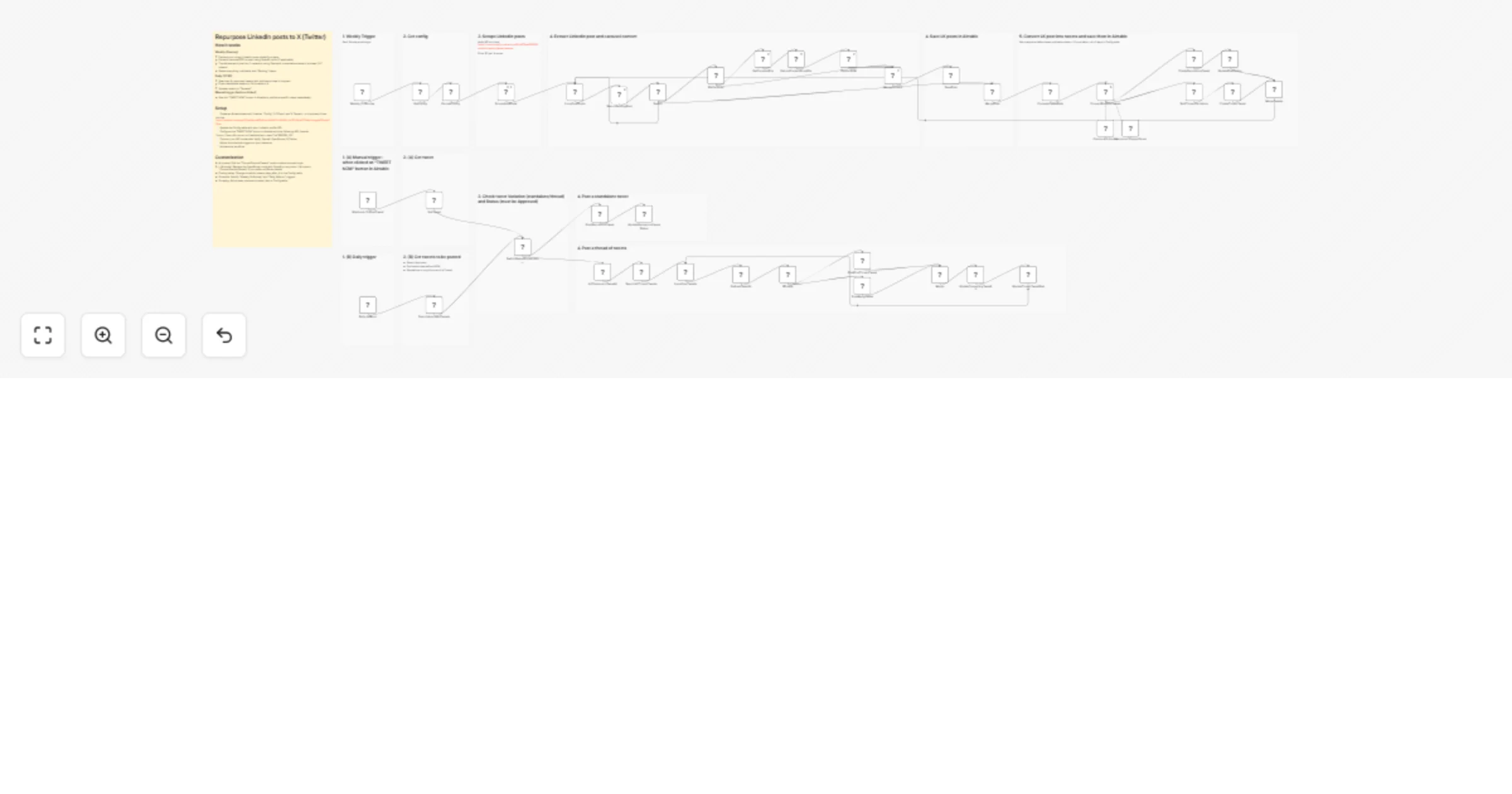
Workflow preview

$20/month : Unlimited workflows
2500 executions/month

THE #1 IN WEB SCRAPING
Scrape any website without limits
HOSTINGER  Early Deal
DISCOUNT 20% Try free
Early DealDISCOUNT 20%
Self-hosted n8n
Unlimited workflows - from $4.99/mo

#1 hub for scraping, AI & automation
6000+ actors - $5 credits/mo
Overview
Automatically scrape LinkedIn posts with Apify, transform them into optimized tweets and threads using Claude AI, store them in Airtable for approval, and publish to X on a daily schedule.
Who is this for
This workflow is designed for content creators, social media managers, and personal brand builders who want to maximize their content reach by repurposing LinkedIn posts for X (Twitter) without manual rewriting.
What it does
This workflow automates the entire LinkedIn-to-X content repurposing pipeline:
- Weekly scraping: Uses Apify to scrape your recent LinkedIn posts based on configurable parameters stored in Airtable
- Carousel extraction: If a post contains a carousel/PDF, OpenAI extracts the slide content via OCR
- AI transformation: Claude (via OpenRouter) converts each LinkedIn post into two X-optimized variations: a standalone tweet and a thread (3-7 tweets)
- Content storage: Saves both the original posts and generated tweets to Airtable with a "Pending" status for review
- Scheduled publishing: Daily at 12:30, searches for ‘Approved’ tweets whose publication date has passed and posts them to X
- Thread handling: Properly chains thread tweets as replies to maintain the conversation structure
Requirements
- Apify account (LinkedIn Profile Posts Scraper actor)
- Airtable account with configured base
- OpenAI API access (for carousel OCR)
- OpenRouter API access (for Claude)
- X/Twitter API access
How to set up
- Create an Airtable base with three tables:
Config,LK Posts, andX Tweets(see table configurations below) - Configure the
Configtable with your LinkedIn profile URL, scraping limits, and tweet scheduling delay - Configure the ‘TWEET NOW’ button in Airtable with the following URL formula:
"https://your-n8-server-url/webhook/post-tweet?id="&RECORD_ID() - Connect your credentials: Apify, Airtable, OpenAI, OpenRouter, and X/Twitter
- Set the weekly and daily schedule triggers according to your timezone
- Activate the workflow
Config Table
| Field Name | Type | Description |
|---|---|---|
| Name | String | Configuration parameter name |
| Type | Single Select | Data type indicator: String, Integer |
| String Value | String | Value when Type is "String" |
| Integer Value | Number | Value when Type is "Integer" |
Configuration parameters to create:
profile_url— LinkedIn profile URL to scrapeposted_limit— Time range for scraping (possible values: "any", "1h", "24h", "week", "3months", "6months", "year")max_posts— Maximum number of posts to scrapeschedule_tweets_days_after_lk— Number of days after LinkedIn post date to schedule the tweet
LK Posts Table
| Field Name | Type | Description |
|---|---|---|
| LK Post ID | String | LinkedIn post unique identifier |
| Status | Single Select | Post processing status: Scrapped, Converted, Tweeted |
| Date | DateTime | Original LinkedIn post publication date |
| Content | Long Text | LinkedIn post text content |
| Post URL | URL | Link to the original LinkedIn post |
| Post Img URL | URL | URL of post image (if any) |
| Post Doc URL | URL | URL of carousel/PDF document (if any) |
| Carousel Content | Long Text | Extracted text content from carousel slides |
X Tweets Table
| Field Name | Type | Description |
|---|---|---|
| Unique ID | Formula | Auto-generated unique identifier |
| LK Post ID | String | Reference to the source LinkedIn post |
| Status | Single Select | Tweet status: Pending, Approved, Rejected, Tweeted |
| Variation | Single Select | Tweet format: Standalone, Thread |
| Tweet Nb | Number | Tweet position in thread (0 for standalone, 1-7 for thread tweets) |
| Content | Long Text | The tweet text content |
| Publication Date | DateTime | Scheduled date/time to publish the tweet |
| Post Now | Button | Triggers webhook to post immediately |
How to customize
- AI prompt: Edit the "ConvertPostIntoTweets" node to adjust tone and style
- LLM model: Replace the OpenRouter node with OpenAI or any other LLM node in "ConvertPostIntoTweets" if you prefer a different model
- Posting delay: Change schedule_tweets_days_after_lk in the Config table
- Schedule: Modify "Weekly_OnSunday" and "Daily_AtNoon" triggers
- Scraping: Adjust max_posts and posted_limit in Config table