
Recover Abandoned Shopify Carts with Email Follow-ups, HubSpot CRM & Google Sheets Tracking

Workflow preview
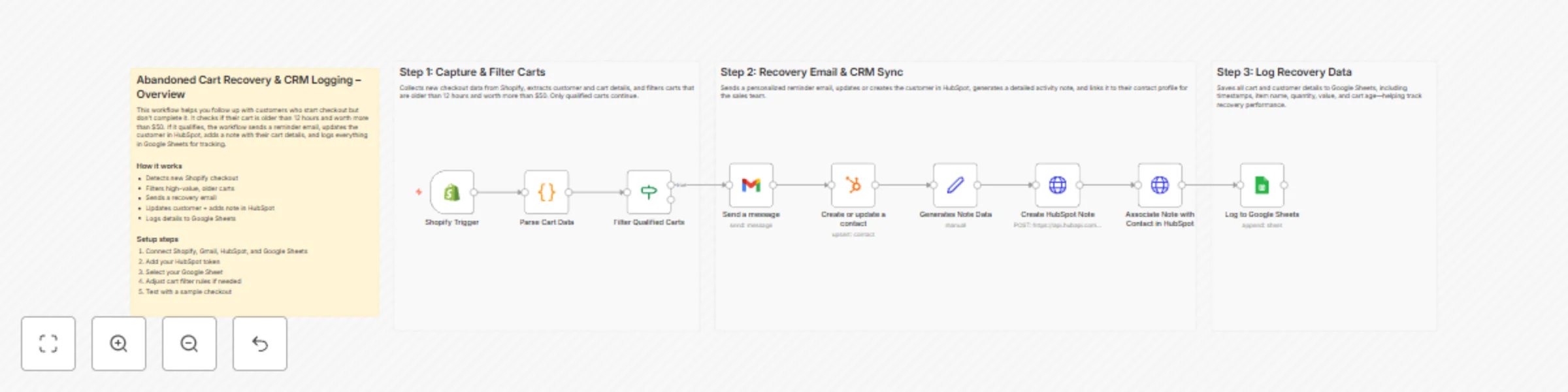
Workflow preview
100%
Recover Abandoned Shopify Carts with Email Follow-ups, HubSpot CRM & Google Sheets Tracking preview
Open on n8n.io

Important notice

This workflow is provided as-is. Please review and test before using in production.

1. Workflow Overview

How it works The workflow triggers on a new checkout event from Shopify and extracts all relevant cart data. It filters carts based on value and age to isolate qualified abandoned checkouts. For ea...

Best for

  • Lead Nurturing automation workflows
  • intermediate n8n builders looking for reusable templates

Tools used

n8n-nodes-base.code, n8n-nodes-base.if, n8n-nodes-base.googlesheets, n8n-nodes-base.shopifytrigger, n8n-nodes-base.gmail, n8n-nodes-base.hubspot, n8n-nodes-base.set, n8n-nodes-base.httprequest

Source and attribution

This workflow is cataloged by N8N Workflows and links back to its original n8n.io source page by Avkash Kakdiya.

Original n8n.io source

1.1 Workflow description

Title
Recover Abandoned Shopify Carts with Email Follow-ups, HubSpot CRM & Google Sheets Tracking
Workflow name
Recover Abandoned Shopify Carts with Email Follow-ups, HubSpot CRM & Google Sheets Tracking

How it works

The workflow triggers on a new checkout event from Shopify and extracts all relevant cart data. It filters carts based on value and age to isolate qualified abandoned checkouts. For each qualified cart, it sends a follow-up email, updates or creates the corresponding HubSpot contact, and generates a CRM note linked to that contact. Finally, it logs the processed cart into Google Sheets for tracking and review.

Step-by-step

  • Trigger on new Shopify checkout

    • Shopify Trigger – Starts the workflow when a new checkout is created.
  • Normalize and structure cart data

    • Parse Cart Data – Extracts email, customer name, items, cart totals, timestamps, and hours since creation.
  • Filter carts that meet follow-up criteria

    • Filter Qualified Carts – Passes only carts older than 12 hours and valued above 50.
  • Send follow-up message

    • Send a message – Delivers a reminder email to the customer about the pending checkout.
  • Create or update CRM contact

    • Create or update a contact – Ensures the shopper exists as a HubSpot contact.
  • Prepare CRM note details

    • Generates Note Data – Builds a structured note containing timing, cart details, and follow-up context.
  • Create the HubSpot note

    • Create HubSpot Note – Submits the prepared note to HubSpot’s CRM.
  • Associate note with the contact

    • Associate Note with Contact in HubSpot – Links the generated note to the correct HubSpot contact.
  • Record activity in tracker sheet

    • Log to Google Sheets – Appends processed cart fields including items, totals, timestamps, and customer info.

Why use this?

  • Identifies high-value or long-abandoned carts automatically and follows up without manual effort.
  • Keeps CRM records updated and adds contextual notes sales teams can act on.
  • Maintains a structured audit trail of every abandoned cart interaction.
  • Improves recovery chances by combining email outreach with CRM enrichment and logging.
  • Enables analysis of abandoned checkout patterns directly from Google Sheets.

1.2 Logical Blocks

This catalog entry is organized from the workflow JSON. The node-level section below shows the executable blocks available for review before importing the template.

2. Block-by-Block Analysis

Block 1 - Parse Cart Data

Type / Role
n8n-nodes-base.code - code
Config choices
Version 2

Block 2 - Filter Qualified Carts

Type / Role
n8n-nodes-base.if - if
Config choices
Version 2

Block 3 - Log to Google Sheets

Type / Role
n8n-nodes-base.googleSheets - googleSheets
Config choices
Version 4.5

Block 4 - Shopify Trigger

Type / Role
n8n-nodes-base.shopifyTrigger - shopifyTrigger
Config choices
Version 1

Block 5 - Send a message

Type / Role
n8n-nodes-base.gmail - gmail
Config choices
Version 2.1

Block 6 - Create or update a contact

Type / Role
n8n-nodes-base.hubspot - hubspot
Config choices
Version 2.1

Block 7 - Generates Note Data

Type / Role
n8n-nodes-base.set - set
Config choices
Version 3.4

Block 8 - Create HubSpot Note

Type / Role
n8n-nodes-base.httpRequest - httpRequest
Config choices
Version 4.2

Block 9 - Associate Note with Contact in HubSpot

Type / Role
n8n-nodes-base.httpRequest - httpRequest
Config choices
Version 4.2

Block 10 - Sticky Note

Type / Role
n8n-nodes-base.stickyNote - stickyNote
Config choices
Version 1

Block 11 - Sticky Note1

Type / Role
n8n-nodes-base.stickyNote - stickyNote
Config choices
Version 1

Block 12 - Sticky Note2

Type / Role
n8n-nodes-base.stickyNote - stickyNote
Config choices
Version 1

Block 13 - Sticky Note3

Type / Role
n8n-nodes-base.stickyNote - stickyNote
Config choices
Version 1

3. Summary Table

Workflow Recover Abandoned Shopify Carts with Email Follow-ups, HubSpot CRM & Google Sheets Tracking
Complexity intermediate
Nodes 13
Categories Lead Nurturing
Author Avkash Kakdiya
Published 14 Nov 2025

4. Reproducing the Workflow from Scratch

  1. 1. Download the workflow JSON

    Use the JSON export at /data/workflows/10818/10818.json as the source template for this automation.

  2. 2. Import the template into n8n

    Open n8n, import the downloaded JSON, and review each node before activating the workflow.

  3. 3. Configure credentials and variables

    Replace placeholder credentials, API keys, webhook URLs, account IDs, and environment-specific values with your own settings.

  4. 4. Test with sample data

    Run the workflow manually or in a staging workspace, inspect node output, and confirm downstream systems receive the expected data.

  5. 5. Activate and monitor

    Enable the workflow only after testing, then monitor executions, errors, and rate limits during the first production runs.

5. General Notes & Resources

Review imported nodes carefully before activation. This catalog entry is intended to help you inspect the workflow structure, understand required services, and find related templates faster.

Node names, credentials, schedules, webhook paths, and external service limits may need adjustment for your workspace.

Frequently asked questions

What does Recover Abandoned Shopify Carts with Email Follow-ups, HubSpot CRM & Google Sheets Tracking do?

How it works The workflow triggers on a new checkout event from Shopify and extracts all relevant cart data. It filters carts based on value and age to isolate qualified abandoned checkouts. For ea...

What do I need before importing this workflow?

Review the workflow JSON, configure any required credentials in n8n, and test the automation in a safe workspace before using it in production.

Can I customize this workflow?

Yes. Use the block-by-block analysis and the downloadable JSON to inspect each node, then adjust credentials, prompts, schedules, filters, or destinations for your Lead Nurturing use case.



