
Monitor security advisories

Workflow preview
Workflow preview
100%
Monitor security advisories preview
Open on n8n.io

Important notice

This workflow is provided as-is. Please review and test before using in production.

1. Workflow Overview

This n8n workflow automates the monitoring and notification of Palo Alto Networks security advisories. It is triggered manually from within the n8n UI or scheduled to run daily at midnight using th...

Best for

  • SecOps automation workflows
  • advanced n8n builders looking for reusable templates

Tools used

n8n-nodes-base.manualtrigger, n8n-nodes-base.rssfeedread, n8n-nodes-base.filter, n8n-nodes-base.jira, n8n-nodes-base.n8ntrainingcustomerdatastore, n8n-nodes-base.stickynote, n8n-nodes-base.gmail, n8n-nodes-base.set

Source and attribution

This workflow is cataloged by N8N Workflows and links back to its original n8n.io source page by n8n Team.

Original n8n.io source

1.1 Workflow description

Title
Monitor security advisories
Workflow name
Monitor security advisories

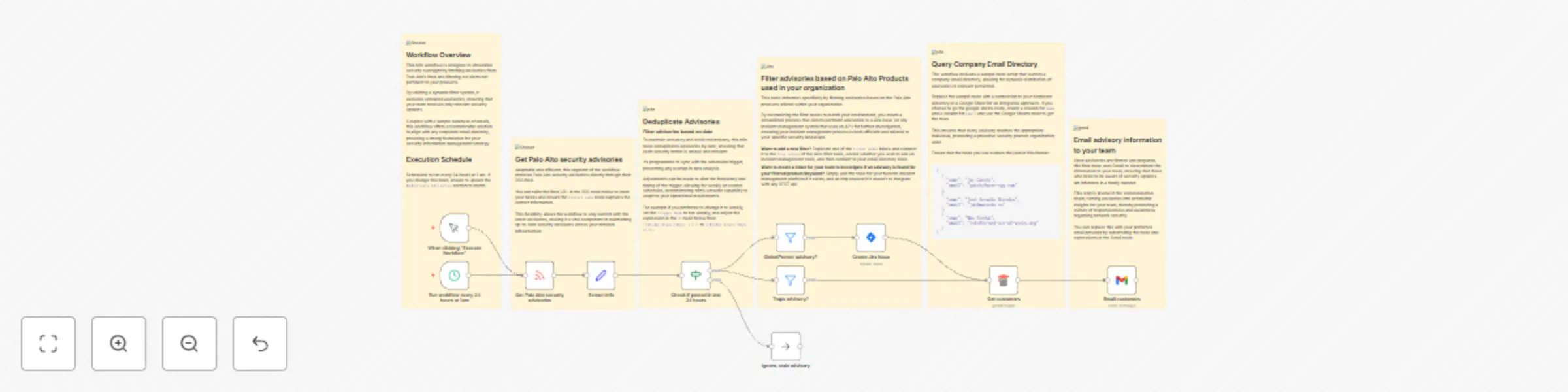
This n8n workflow automates the monitoring and notification of Palo Alto Networks security advisories. It is triggered manually from within the n8n UI or scheduled to run daily at midnight using the Schedule Trigger. The workflow begins by fetching the latest security advisories from Palo Alto Networks' RSS feed.

Each advisory is then processed, and relevant information is extracted and categorized, including the advisory type, subject, and severity. The workflow checks the publication date of each advisory to ensure that it was posted within the last 24 hours, filtering out older advisories.

The workflow then splits into two paths based on the advisory type: GlobalProtect and Traps. In the GlobalProtect path, advisories related to GlobalProtect are identified and used to create Jira issues. The Jira issues include a summary with the advisory title and a description that provides details about the advisory, its severity, link, and publication date.

In the Traps path, advisories related to Traps are recognized, and dummy data (which should be replaced with logic to retrieve valid user emails) is generated for sample purposes. These email addresses are then used to send email notifications using the Gmail node. Each email's subject includes the type of advisory, while the body contains the advisory title and a link for more information.

Potential issues when setting up this workflow for the first time might involve configuring the Schedule Trigger to match the desired time zone. Additionally, ensuring that the Jira and Gmail nodes are configured correctly with the required credentials and email addresses is crucial. The placeholder for generating dummy data for email recipients should be replaced with logic to retrieve valid user emails. Proper error handling and testing with real and sample advisories can help identify and resolve any potential issues during setup.

1.2 Logical Blocks

This catalog entry is organized from the workflow JSON. The node-level section below shows the executable blocks available for review before importing the template.

2. Block-by-Block Analysis

Block 1 - When clicking "Execute Workflow"

Type / Role
n8n-nodes-base.manualTrigger - manualTrigger
Config choices
Version 1

Block 2 - Get Palo Alto security advisories

Type / Role
n8n-nodes-base.rssFeedRead - rssFeedRead
Config choices
Version 1

Block 3 - GlobalProtect advisory?

Type / Role
n8n-nodes-base.filter - filter
Config choices
Version 1

Block 4 - Traps advisory?

Type / Role
n8n-nodes-base.filter - filter
Config choices
Version 1

Block 5 - Create Jira issue

Type / Role
n8n-nodes-base.jira - jira
Config choices
Version 1

Block 6 - Get customers

Type / Role
n8n-nodes-base.n8nTrainingCustomerDatastore - n8nTrainingCustomerDatastore
Config choices
Version 1

Block 7 - Sticky Note

Type / Role
n8n-nodes-base.stickyNote - stickyNote
Config choices
Version 1

Block 8 - Email customers

Type / Role
n8n-nodes-base.gmail - gmail
Config choices
Version 2

Block 9 - Extract info

Type / Role
n8n-nodes-base.set - set
Config choices
Version 2

Block 10 - Sticky Note1

Type / Role
n8n-nodes-base.stickyNote - stickyNote
Config choices
Version 1

Block 11 - Check if posted in last 24 hours

Type / Role
n8n-nodes-base.if - if
Config choices
Version 1

Block 12 - Sticky Note2

Type / Role
n8n-nodes-base.stickyNote - stickyNote
Config choices
Version 1

Block 13 - Sticky Note3

Type / Role
n8n-nodes-base.stickyNote - stickyNote
Config choices
Version 1

Block 14 - Sticky Note4

Type / Role
n8n-nodes-base.stickyNote - stickyNote
Config choices
Version 1

Block 15 - Sticky Note5

Type / Role
n8n-nodes-base.stickyNote - stickyNote
Config choices
Version 1

Block 16 - Ignore, stale advisory

Type / Role
n8n-nodes-base.noOp - noOp
Config choices
Version 1

Block 17 - Run workflow every 24 hours at 1am

Type / Role
n8n-nodes-base.scheduleTrigger - scheduleTrigger
Config choices
Version 1.1

3. Summary Table

Workflow Monitor security advisories
Complexity advanced
Nodes 17
Categories SecOps
Author n8n Team
Published 13 Nov 2023

4. Reproducing the Workflow from Scratch

  1. 1. Download the workflow JSON

    Use the JSON export at /data/workflows/1974/1974.json as the source template for this automation.

  2. 2. Import the template into n8n

    Open n8n, import the downloaded JSON, and review each node before activating the workflow.

  3. 3. Configure credentials and variables

    Replace placeholder credentials, API keys, webhook URLs, account IDs, and environment-specific values with your own settings.

  4. 4. Test with sample data

    Run the workflow manually or in a staging workspace, inspect node output, and confirm downstream systems receive the expected data.

  5. 5. Activate and monitor

    Enable the workflow only after testing, then monitor executions, errors, and rate limits during the first production runs.

5. General Notes & Resources

Review imported nodes carefully before activation. This catalog entry is intended to help you inspect the workflow structure, understand required services, and find related templates faster.

Node names, credentials, schedules, webhook paths, and external service limits may need adjustment for your workspace.

Frequently asked questions

What does Monitor security advisories do?

This n8n workflow automates the monitoring and notification of Palo Alto Networks security advisories. It is triggered manually from within the n8n UI or scheduled to run daily at midnight using th...

What do I need before importing this workflow?

Review the workflow JSON, configure any required credentials in n8n, and test the automation in a safe workspace before using it in production.

Can I customize this workflow?

Yes. Use the block-by-block analysis and the downloadable JSON to inspect each node, then adjust credentials, prompts, schedules, filters, or destinations for your SecOps use case.



