Monitor regulatory updates with ScrapeGraphAI and send alerts via Telegram
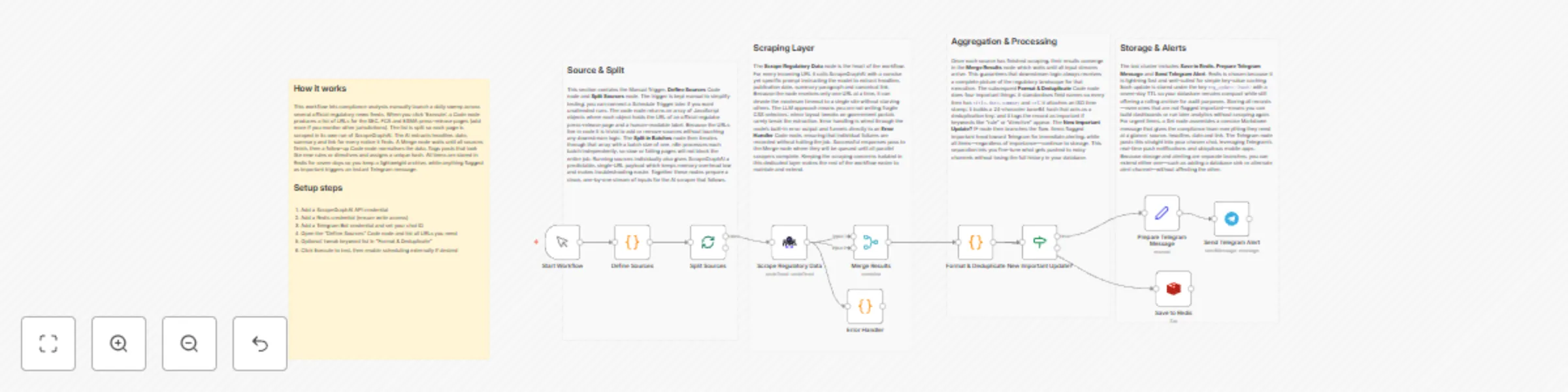
Workflow preview


 Early Deal
DISCOUNT 20%

Important notice
This workflow is provided as-is. Please review and test before using in production.
Overview
Breaking News Aggregator with Telegram and Redis
⚠️ COMMUNITY TEMPLATE DISCLAIMER: This is a community-contributed template that uses ScrapeGraphAI (a community node). Please ensure you have the ScrapeGraphAI community node installed in your n8n instance before using this template.
This workflow monitors selected government websites, regulatory bodies, and legal-news portals for new or amended regulations relevant to specific industries. It scrapes the latest headlines, compares them against previously recorded items in Redis, and pushes real-time compliance alerts to a Telegram channel or chat.
Pre-conditions/Requirements
Prerequisites
- n8n instance (self-hosted or cloud)
- ScrapeGraphAI community node installed
- Redis server accessible from n8n
- Telegram Bot created via BotFather
- (Optional) Cron node if you want fully automated scheduling instead of manual trigger
Required Credentials
- ScrapeGraphAI API Key – Enables ScrapeGraphAI scraping functionality
- Telegram Bot Token – Allows n8n to send messages via your bot
- Redis Credentials – Host, port, and (if set) password for your Redis instance
Redis Setup Requirements
| Key Name | Description | Example |
|---|---|---|
latestRegIds |
Redis Set used to store hashes/IDs of the most recent regulatory articles processed | latestRegIds |
> Hint: Use a dedicated Redis DB (e.g., DB 1) to keep workflow data isolated from other applications.
How it works
This workflow monitors selected government websites, regulatory bodies, and legal-news portals for new or amended regulations relevant to specific industries. It scrapes the latest headlines, compares them against previously recorded items in Redis, and pushes real-time compliance alerts to a Telegram channel or chat.
Key Steps:
- Manual Trigger / Cron: Starts the workflow manually or on a set schedule (e.g., daily at 06:00 UTC).
- Code (Define Sources): Returns an array of URL objects pointing to regulatory pages to monitor.
- SplitInBatches: Iterates through each source URL in manageable chunks.
- ScrapeGraphAI: Extracts article titles, publication dates, and article URLs from each page.
- Merge (Combine Results): Consolidates scraped items into a single stream.
- If (Deduplication Check): Verifies whether each article ID already exists in Redis.
- Set (Format Message): Creates a human-readable Telegram message string.
- Telegram: Sends the formatted compliance alert to your chosen chat/channel.
- Redis (Add New IDs): Stores the article ID so it is not sent again in the future.
- Sticky Note: Provides inline documentation inside the workflow canvas.
Set up steps
Setup Time: 10-15 minutes
- Install community nodes: In n8n, go to Settings → Community Nodes and install
n8n-nodes-scrapegraphai. - Create credentials:
a. Telegram → Credentials → Telegram API → paste your bot token.
b. Redis → Credentials → Redis → fill host, port, password, DB.
c. ScrapeGraphAI → Credentials → ScrapeGraphAI API → enter your key. - Configure the “Define Sources” Code node: Replace the placeholder URLs with the regulatory pages you need to monitor.
- Update Telegram chat ID: Open any chat with your bot and use
https://api.telegram.org/bot<token>/getUpdatesto find thechat.id. Insert this value in the Telegram node. - Adjust frequency: Replace the Manual Trigger with a Cron node (e.g., daily 06:00 UTC).
- Test the workflow: Execute once manually; confirm messages appear in Telegram and that Redis keys are created.
- Activate: Enable the workflow so it runs automatically according to your schedule.
Node Descriptions
Core Workflow Nodes:
- Manual Trigger – Allows on-demand execution during development/testing.
- Code (Define Sources) – Returns an array of page URLs and meta info to the workflow.
- SplitInBatches – Prevents overloading websites by scraping in controlled groups.
- ScrapeGraphAI – Performs the actual web scraping using an AI-assisted parser.
- Merge – Merges data streams from multiple batches into one.
- If (Check Redis) – Filters out already-processed articles using Redis SET membership.
- Set – Shapes output into a user-friendly Telegram message.
- Telegram – Delivers compliance alerts to stakeholders in real time.
- Redis – Persists article IDs to avoid duplicate notifications.
- Sticky Note – Contains usage tips directly on the canvas.
Data Flow:
- Manual Trigger → Code (Define Sources) → SplitInBatches → ScrapeGraphAI
- ScrapeGraphAI → Merge → If (Check Redis)
- If (true) → Set → Telegram → Redis
Customization Examples
Change industries or keywords
// Code node snippet
return [
  {
    url: "https://regulator.gov/energy-updates",
    industry: "Energy",
    keywords: ["renewable", "grid", "tariff"]
  },
  {
    url: "https://financewatch.gov/financial-rules",
    industry: "Finance",
    keywords: ["AML", "KYC", "cryptocurrency"]
  }
];
Modify Telegram message formatting
// Set node “Parameters → Value”
items[0].json.message = `🛡️ *${$json.industry} Regulation Update*\n\n*${$json.title}*\n${$json.date}\n${$json.url}`;
return items;
Data Output Format
The workflow outputs structured JSON data:
{
  "title": "EU Proposes New ESG Disclosure Rules",
  "date": "2024-04-18",
  "url": "https://europa.eu/legal/eu-proposes-esg-disclosure",
  "industry": "Finance"
}
Troubleshooting
Common Issues
- Empty scraped data – Verify CSS selectors/XPath in the ScrapeGraphAI node; website structure may have changed.
- Duplicate alerts – Ensure Redis credentials point to the same DB across nodes; otherwise IDs are not shared.
Performance Tips
- Limit
SplitInBatchesto 2-3 URLs at a time if sites implement rate limiting. - Use environment variables for credentials to simplify migration between stages.
Pro Tips:
- Combine this workflow with n8n’s Error Trigger to log failures to Slack or email.
- Maintain a CSV of source URLs in Google Sheets and fetch it dynamically via the Google Sheets node.
- Pair with the Webhook node to let team members add new sources on the fly.