Monitor CISA critical vulnerability alerts with RSS feed & Slack notifications
Workflow preview


 Early Deal
DISCOUNT 20%

Important notice
This workflow is provided as-is. Please review and test before using in production.
Overview
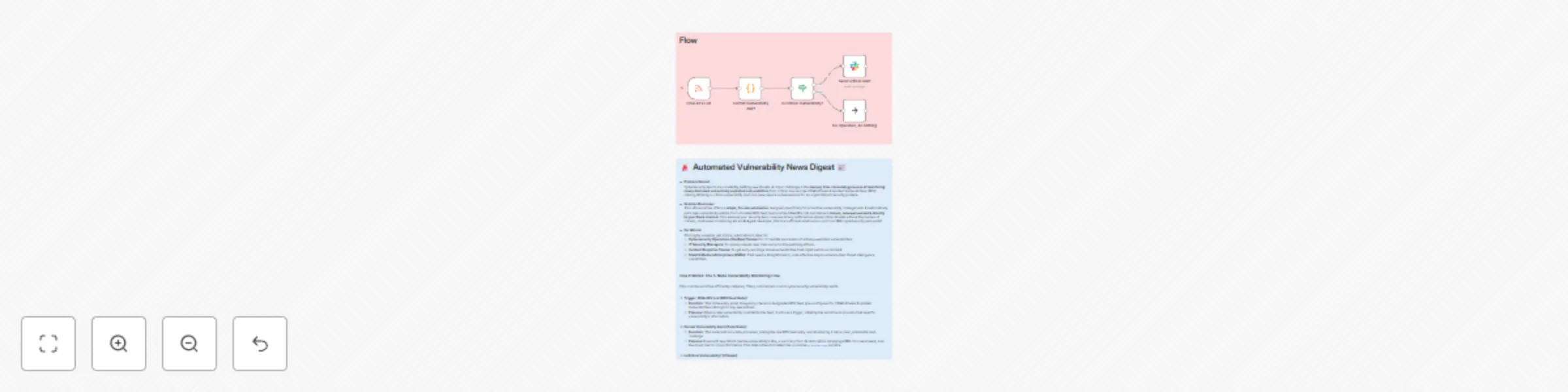
How It Works: The 5-Node Monitoring Flow
This concise workflow efficiently captures, filters, and delivers crucial cybersecurity-related mentions.
1. Monitor: Cybersecurity Keywords (X/Twitter Trigger)
This is the entry point of your workflow. It actively searches X (formerly Twitter) for tweets containing the specific keywords you define.
- Function: Continuously polls X for tweets that match your specified queries (e.g., your company name, "Log4j," "CVE-2024-XXXX," "ransomware").
- Process: As soon as a matching tweet is found, it triggers the workflow to begin processing that information.
2. Format Notification (Code Node)
This node prepares the raw tweet data, transforming it into a clean, actionable message for your alerts.
- Function: Extracts key details from the raw tweet and structures them into a clear, concise message.
- Process: It pulls out the tweet's text, the user's handle (
@screen_name), and the direct URL to the tweet. These pieces are then combined into a user-friendlynotificationMessage. You can also include basic filtering logic here if needed.
3. Valid Mention? (If Node)
This node acts as a quick filter to help reduce noise and prevent irrelevant alerts from reaching your team.
- Function: Serves as a simple conditional check to validate the mention's relevance.
- Process: It evaluates the
notificationMessageagainst specific criteria (e.g., ensuring it doesn't contain common spam words like "bot"). If the mention passes this basic validation, the workflow continues. Otherwise, it quietly ends for that particular tweet.
4. Send Notification (Slack Node)
This is the delivery mechanism for your alerts, ensuring your team receives instant, visible notifications.
- Function: Delivers the formatted alert message directly to your designated communication channel.
- Process: The
notificationMessageis sent straight to your specified Slack channel (e.g.,#cyber-alertsor#security-ops).
5. End Workflow (No-Op Node)
This node simply marks the successful completion of the workflow's execution path.
- Function: Indicates the end of the workflow's process for a given trigger.
How to Set Up
Implementing this simple cybersecurity monitor in your n8n instance is quick and straightforward.
1. Prepare Your Credentials
Before building the workflow, ensure all necessary accounts are set up and their respective credentials are ready for n8n.
- X (Twitter) API: You'll need an X (Twitter) developer account to create an application and obtain your Consumer Key/Secret and Access Token/Secret. Use these to set up your Twitter credential in n8n.
- Slack API: Set up your Slack credential in n8n. You'll also need the Channel ID of the Slack channel where you want your security alerts to be posted (e.g.,
#security-alertsor#it-ops).
2. Import the Workflow JSON
Get the workflow structure into your n8n instance.
- Import: In your n8n instance, go to the "Workflows" section. Click the "New" or "+" icon, then select "Import from JSON." Paste the provided JSON code (from the previous response) into the import dialog and import the workflow.
3. Configure the Nodes
Customize the imported workflow to fit your specific monitoring needs.
- Monitor: Cybersecurity Keywords (X/Twitter):
- Click on this node.
- Select your newly created Twitter Credential.
- CRITICAL: Modify the "Query" parameter to include your specific brand names, relevant CVEs, or general cybersecurity terms. For example:
"YourCompany" OR "CVE-2024-1234" OR "phishing alert". UseORto combine multiple terms.
- Send Notification (Slack):
- Click on this node.
- Select your Slack Credential.
- Replace
"YOUR_SLACK_CHANNEL_ID"with the actual Channel ID you noted earlier for your security alerts.
- (Optional: You can adjust the "Valid Mention?" node's condition if you find specific patterns of false positives in your search results that you want to filter out.)
4. Test and Activate
Verify that your workflow is working correctly before setting it live.
- Manual Test: Click the "Test Workflow" button (usually in the top right corner of the n8n editor). This will execute the workflow once.
- Verify Output: Check your specified Slack channel to confirm that any detected mentions are sent as notifications in the correct format. If no matching tweets are found, you won't see a notification, which is expected.
- Activate: Once you're satisfied with the test results, toggle the "Active" switch (usually in the top right corner of the n8n editor) to
ON. Your workflow will then automatically monitor X (Twitter) at the specified polling interval.