
Malicious file detection & response: Wazuh to VirusTotal with Slack alerts

Workflow preview
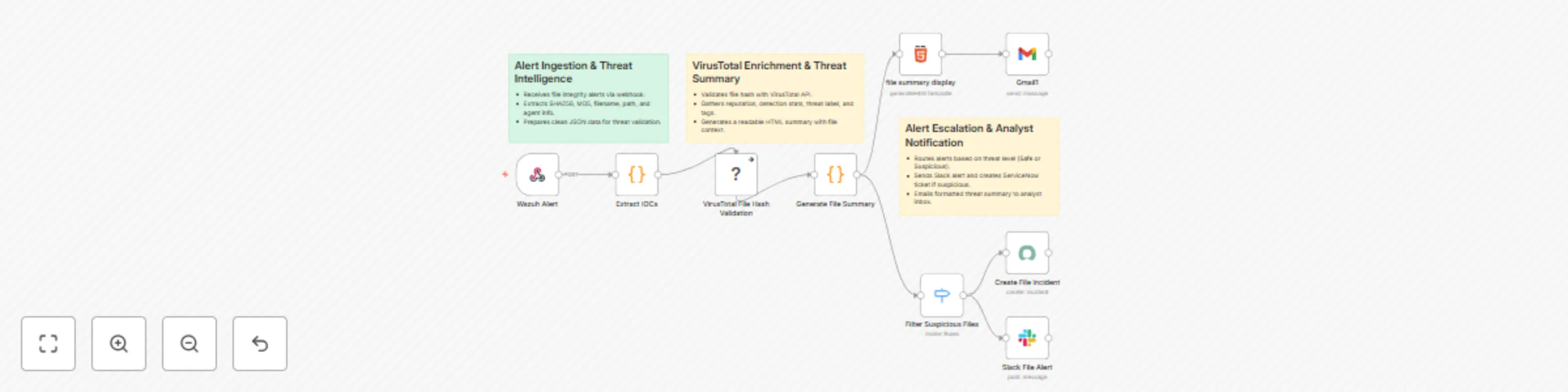
Workflow preview
100%
Malicious file detection & response: Wazuh to VirusTotal with Slack alerts preview
Open on n8n.io

Important notice

This workflow is provided as-is. Please review and test before using in production.

1. Workflow Overview

Malicious File Detection & Threat Summary Automation using Wazuh + VirusTotal + n8n This workflow helps SOC teams automate the detection and reporting of potentially malicious files using Wazuh ale...

Best for

  • SecOps automation workflows
  • intermediate n8n builders looking for reusable templates

Tools used

n8n-nodes-base.html, n8n-nodes-base.gmail, n8n-nodes-base.webhook, n8n-nodes-base.code, n8n-nodes-base.switch, n8n-nodes-base.servicenow, n8n-nodes-base.slack, n8n-nodes-base.httprequest

Source and attribution

This workflow is cataloged by N8N Workflows and links back to its original n8n.io source page by Rajneesh Gupta.

Original n8n.io source

1.1 Workflow description

Title
Malicious file detection & response: Wazuh to VirusTotal with Slack alerts
Workflow name
Malicious file detection & response: Wazuh to VirusTotal with Slack alerts

Malicious File Detection & Threat Summary Automation using Wazuh + VirusTotal + n8n

This workflow helps SOC teams automate the detection and reporting of potentially malicious files using Wazuh alerts, VirusTotal hash validation, and integrated summary/report generation. It's ideal for analysts who want instant context and communication for file-based threats — without writing a single line of code.


What It Does

When Wazuh detects a suspicious file:

  • Ingests Wazuh Alert
    A webhook node captures incoming alerts containing file hashes (SHA256/MD5).

  • Parses IOCs
    Extracts relevant indicators (file hash, filename, etc.).

  • Validates with VirusTotal
    Automatically checks the file hash reputation using VirusTotal's threat intelligence API.

  • Generates Human-Readable Summary
    Outputs a structured file report.

  • Routes Alerts Based on Threat Level

    • Sends a formatted email with the file summary using Gmail.
    • If the file is deemed malicious/suspicious:
      • Creates a file-related incident ticket.
      • Sends an instant Slack alert to notify the team.

Tech Stack Used

  • Wazuh – For endpoint alerting
  • VirusTotal API – For real-time hash validation
  • n8n – To orchestrate, parse, enrich, and communicate
  • Slack, Gmail, Incident Tool – To notify and take action

Ideal Use Case

This template is designed for security teams looking to automate file threat triage, IOC validation, and alert-to-ticket escalation, with zero human delay.


Included Nodes

  • Webhook (Wazuh)
  • Function (IOC extraction and summary)
  • HTTP Request (VirusTotal)
  • If / Switch (threat level check)
  • Gmail, Slack, Incident Creation

Tips

  • Make sure to add your VirusTotal API key in the HTTP node.
  • Customize the incident creation node to fit your ticketing platform (Jira, ServiceNow, etc.).
  • Add logic to enrich the file alert further using WHOIS or sandbox reports if needed.

1.2 Logical Blocks

This catalog entry is organized from the workflow JSON. The node-level section below shows the executable blocks available for review before importing the template.

2. Block-by-Block Analysis

Block 1 - file summary display

Type / Role
n8n-nodes-base.html - html
Config choices
Version 1.2

Block 2 - Gmail1

Type / Role
n8n-nodes-base.gmail - gmail
Config choices
Version 2.1

Block 3 - Wazuh Alert

Type / Role
n8n-nodes-base.webhook - webhook
Config choices
Version 2

Block 4 - Extract IOCs

Type / Role
n8n-nodes-base.code - code
Config choices
Version 2

Block 5 - Generate File Summary

Type / Role
n8n-nodes-base.code - code
Config choices
Version 2

Block 6 - Filter Suspicious Files

Type / Role
n8n-nodes-base.switch - switch
Config choices
Version 3.2

Block 7 - Create File Incident

Type / Role
n8n-nodes-base.serviceNow - serviceNow
Config choices
Version 1

Block 8 - Slack File Alert

Type / Role
n8n-nodes-base.slack - slack
Config choices
Version 2.3

Block 9 - VirusTotal File Hash Validation

Type / Role
n8n-nodes-base.httpRequest - httpRequest
Config choices
Version 4.2

Block 10 - Sticky Note

Type / Role
n8n-nodes-base.stickyNote - stickyNote
Config choices
Version 1

Block 11 - Sticky Note1

Type / Role
n8n-nodes-base.stickyNote - stickyNote
Config choices
Version 1

Block 12 - Sticky Note2

Type / Role
n8n-nodes-base.stickyNote - stickyNote
Config choices
Version 1

3. Summary Table

Workflow Malicious file detection & response: Wazuh to VirusTotal with Slack alerts
Complexity intermediate
Nodes 12
Categories SecOps
Author Rajneesh Gupta
Published 14 Jul 2025

4. Reproducing the Workflow from Scratch

  1. 1. Download the workflow JSON

    Use the JSON export at /data/workflows/5997/5997.json as the source template for this automation.

  2. 2. Import the template into n8n

    Open n8n, import the downloaded JSON, and review each node before activating the workflow.

  3. 3. Configure credentials and variables

    Replace placeholder credentials, API keys, webhook URLs, account IDs, and environment-specific values with your own settings.

  4. 4. Test with sample data

    Run the workflow manually or in a staging workspace, inspect node output, and confirm downstream systems receive the expected data.

  5. 5. Activate and monitor

    Enable the workflow only after testing, then monitor executions, errors, and rate limits during the first production runs.

5. General Notes & Resources

Review imported nodes carefully before activation. This catalog entry is intended to help you inspect the workflow structure, understand required services, and find related templates faster.

Node names, credentials, schedules, webhook paths, and external service limits may need adjustment for your workspace.

Frequently asked questions

What does Malicious file detection & response: Wazuh to VirusTotal with Slack alerts do?

Malicious File Detection & Threat Summary Automation using Wazuh + VirusTotal + n8n This workflow helps SOC teams automate the detection and reporting of potentially malicious files using Wazuh ale...

What do I need before importing this workflow?

Review the workflow JSON, configure any required credentials in n8n, and test the automation in a safe workspace before using it in production.

Can I customize this workflow?

Yes. Use the block-by-block analysis and the downloadable JSON to inspect each node, then adjust credentials, prompts, schedules, filters, or destinations for your SecOps use case.



