
๐Ÿ”ค Inventory ABC & Pareto analysis with Google Sheets for supply chain

Workflow preview

Workflow preview
100%
๐Ÿ”ค Inventory ABC & Pareto analysis with Google Sheets for supply chain preview
Open on n8n.io

Important notice

This workflow is provided as-is. Please review and test before using in production.

1. Workflow Overview

Tags : Supply Chain, Inventory Management, ABC Analysis, Pareto Principle, Demand Variability, Automation, Google Sheets Context Hi! Iโ€™m Samir Saci, a Supply Chain Engineer...

Best for

  • Market Research automation workflows
  • advanced n8n builders looking for reusable templates

Tools used

n8n-nodes-base.manualtrigger, n8n-nodes-base.googlesheets, n8n-nodes-base.filter, n8n-nodes-base.code, n8n-nodes-base.if, n8n-nodes-base.stickynote

Source and attribution

This workflow is cataloged by N8N Workflows and links back to its original n8n.io source page by Samir Saci.

Original n8n.io source

1.1 Workflow description

Title
๐Ÿ”ค Inventory ABC & Pareto analysis with Google Sheets for supply chain
Workflow name
๐Ÿ”ค Inventory ABC & Pareto analysis with Google Sheets for supply chain

Tags: Supply Chain, Inventory Management, ABC Analysis, Pareto Principle, Demand Variability, Automation, Google Sheets

Context

Hi! Iโ€™m Samir Saci, a Supply Chain Engineer and Data Scientist based in Paris, and founder of LogiGreen Consulting.

I help companies optimise inventory and logistics operations by combining data analytics and workflow automation.

This workflow is part of our inventory optimisation toolkit, allowing businesses to perform ABC classification and Pareto analysis directly from their transactional sales data.

> Automate inventory segmentation with n8n!

๐Ÿ“ฌ For business inquiries, feel free to connect with me on LinkedIn

Who is this template for?

This workflow is designed for supply chain analysts, demand planners, or inventory managers who want to:

  • Identify their top-performing items (Pareto 80/20 principle)
  • Classify products into ABC categories based on sales contribution
  • Evaluate demand variability (XYZ classification support)

Imagine you have a Google Sheet where daily sales transactions are stored:
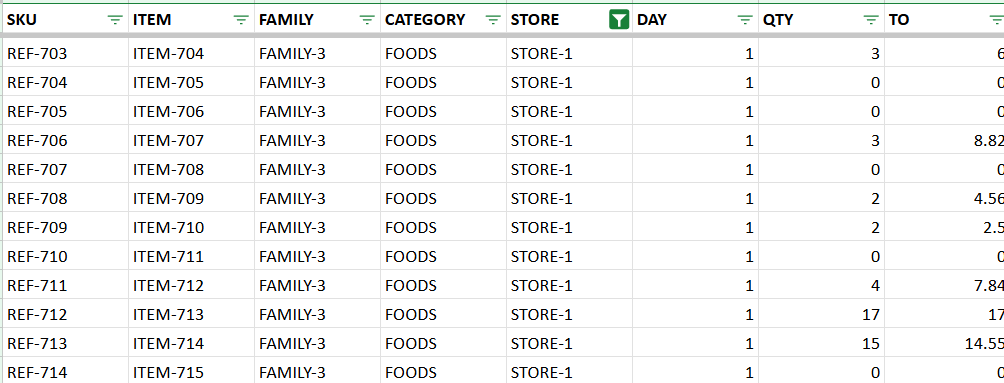
The workflow aggregates sales by item, calculates cumulative contribution, and assigns A, B, or C classes. It also computes mean, standard deviation, and coefficient of variation (CV) to highlight demand volatility.
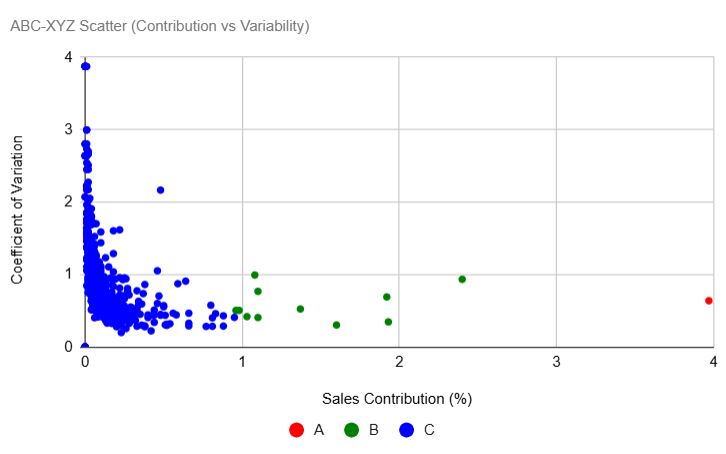
How does it work?

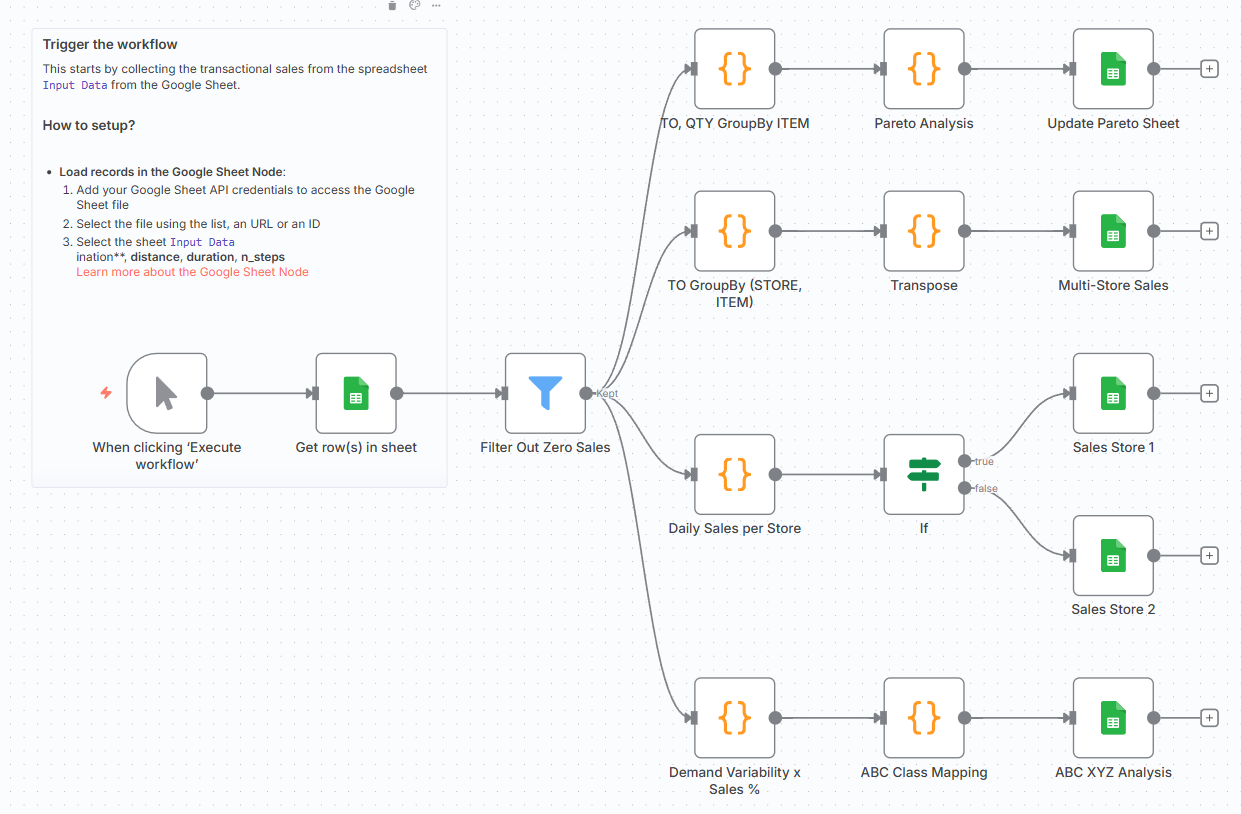
This workflow automates the process of ABC & Pareto analysis from raw sales data:

  • ๐Ÿ“Š Google Sheets input provides daily transactional sales
  • ๐Ÿงฎ Aggregation & code nodes compute sales, turnover, and cumulative shares
  • ๐Ÿง  ABC class mapping assigns items into A/B/C buckets
  • ๐Ÿ“ˆ Demand variability metrics (XYZ) are calculated
  • ๐Ÿ“‘ Results are appended into dedicated Google Sheets tabs for reporting

๐ŸŽฅ Watch My Tutorial

Steps:

  1. ๐Ÿ“ Load daily sales records from Google Sheets
  2. ๐Ÿ”Ž Filter out items with zero sales
  3. ๐Ÿ“Š Aggregate sales by store, item, and day
  4. ๐Ÿ“ˆ Perform Pareto analysis to calculate cumulative turnover share
  5. ๐Ÿงฎ Compute demand variability (mean, stdev, CV)
  6. ๐Ÿง  Assign ABC classes based on cumulative share thresholds
  7. ๐Ÿ“ฅ Append results into ABC XYZ and Pareto output sheets
What do I need to get started?

Youโ€™ll need:

  • A Google Sheet with sales transactions (date, item, quantity, turnover) that is available here: Test Sheet
  • A Google Sheets account connected in n8n
  • Basic knowledge of inventory analysis (ABC/XYZ)

Next Steps

๐Ÿ—’๏ธ Use the sticky notes in the n8n canvas to:

  • Add your Google Sheets credentials
  • Replace the Sheet ID with your own sales dataset
  • Run the workflow and check the output tabs: ABC XYZ, Pareto, and Store Sales

This template was built using n8n v1.107.3
Submitted: September 15, 2025

1.2 Logical Blocks

This catalog entry is organized from the workflow JSON. The node-level section below shows the executable blocks available for review before importing the template.

2. Block-by-Block Analysis

Block 1 - When clicking โ€˜Execute workflowโ€™

Type / Role
n8n-nodes-base.manualTrigger - manualTrigger
Config choices
Version 1

Block 2 - Get row(s) in sheet

Type / Role
n8n-nodes-base.googleSheets - googleSheets
Config choices
Version 4.7

Block 3 - Filter Out Zero Sales

Type / Role
n8n-nodes-base.filter - filter
Config choices
Version 2.2

Block 4 - Transpose

Type / Role
n8n-nodes-base.code - code
Config choices
Version 2

Block 5 - Daily Sales per Store

Type / Role
n8n-nodes-base.code - code
Config choices
Version 2

Block 6 - If

Type / Role
n8n-nodes-base.if - if
Config choices
Version 2.2

Block 7 - Sales Store 1

Type / Role
n8n-nodes-base.googleSheets - googleSheets
Config choices
Version 4.7

Block 8 - Sales Store 2

Type / Role
n8n-nodes-base.googleSheets - googleSheets
Config choices
Version 4.7

Block 9 - Pareto Analysis

Type / Role
n8n-nodes-base.code - code
Config choices
Version 2

Block 10 - TO, QTY GroupBy ITEM

Type / Role
n8n-nodes-base.code - code
Config choices
Version 2

Block 11 - TO GroupBy (STORE, ITEM)

Type / Role
n8n-nodes-base.code - code
Config choices
Version 2

Block 12 - Multi-Store Sales

Type / Role
n8n-nodes-base.googleSheets - googleSheets
Config choices
Version 4.7

Block 13 - Demand Variability x Sales %

Type / Role
n8n-nodes-base.code - code
Config choices
Version 2

Block 14 - ABC XYZ Analysis

Type / Role
n8n-nodes-base.googleSheets - googleSheets
Config choices
Version 4.7

Block 15 - Update Pareto Sheet

Type / Role
n8n-nodes-base.googleSheets - googleSheets
Config choices
Version 4.7

Block 16 - ABC Class Mapping

Type / Role
n8n-nodes-base.code - code
Config choices
Version 2

Block 17 - Sticky Note2

Type / Role
n8n-nodes-base.stickyNote - stickyNote
Config choices
Version 1

3. Summary Table

Workflow ๐Ÿ”ค Inventory ABC & Pareto analysis with Google Sheets for supply chain
Complexity advanced
Nodes 17
Categories Market Research
Author Samir Saci
Published 15 Sept 2025

4. Reproducing the Workflow from Scratch

  1. 1. Download the workflow JSON

    Use the JSON export at /data/workflows/8618/8618.json as the source template for this automation.

  2. 2. Import the template into n8n

    Open n8n, import the downloaded JSON, and review each node before activating the workflow.

  3. 3. Configure credentials and variables

    Replace placeholder credentials, API keys, webhook URLs, account IDs, and environment-specific values with your own settings.

  4. 4. Test with sample data

    Run the workflow manually or in a staging workspace, inspect node output, and confirm downstream systems receive the expected data.

  5. 5. Activate and monitor

    Enable the workflow only after testing, then monitor executions, errors, and rate limits during the first production runs.

5. General Notes & Resources

Review imported nodes carefully before activation. This catalog entry is intended to help you inspect the workflow structure, understand required services, and find related templates faster.

Node names, credentials, schedules, webhook paths, and external service limits may need adjustment for your workspace.

Frequently asked questions

What does ๐Ÿ”ค Inventory ABC & Pareto analysis with Google Sheets for supply chain do?

Tags : Supply Chain, Inventory Management, ABC Analysis, Pareto Principle, Demand Variability, Automation, Google Sheets Context Hi! Iโ€™m Samir Saci, a Supply Chain Engineer...

What do I need before importing this workflow?

Review the workflow JSON, configure any required credentials in n8n, and test the automation in a safe workspace before using it in production.

Can I customize this workflow?

Yes. Use the block-by-block analysis and the downloadable JSON to inspect each node, then adjust credentials, prompts, schedules, filters, or destinations for your Market Research use case.



