Healthcare policy monitoring with ScrapeGraphAI, Pipedrive and Matrix alerts
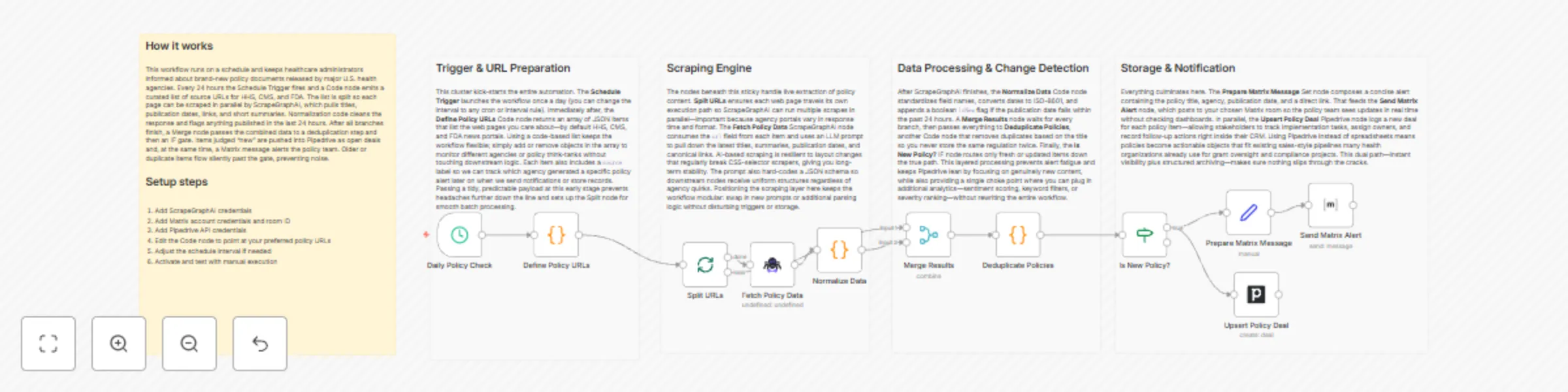
Workflow preview


 Early Deal
DISCOUNT 20%

Important notice
This workflow is provided as-is. Please review and test before using in production.
Overview
Medical Research Tracker with Matrix and Pipedrive
⚠️ COMMUNITY TEMPLATE DISCLAIMER: This is a community-contributed template that uses ScrapeGraphAI (a community node). Please ensure you have the ScrapeGraphAI community node installed in your n8n instance before using this template.
This workflow automatically monitors selected government and healthcare-policy websites, extracts newly published or updated policy documents, logs them as deals in a Pipedrive pipeline, and announces critical changes in a Matrix room. It gives healthcare administrators and policy analysts a near real-time view of policy developments without manual web checks.
Pre-conditions/Requirements
Prerequisites
- n8n instance (self-hosted or n8n cloud)
- ScrapeGraphAI community node installed
- Active Pipedrive account with at least one pipeline
- Matrix account & accessible room for notifications
- Basic knowledge of n8n credential setup
Required Credentials
- ScrapeGraphAI API Key – Enables the scraping engine
- Pipedrive OAuth2 / API Token – Creates & updates deals
- Matrix Credentials – Homeserver URL, user, access token (or password)
Specific Setup Requirements
| Variable | Description | Example |
|---|---|---|
POLICY_SITES |
Comma-separated list of URLs to scrape | https://health.gov/policies,https://who.int/proposals |
PD_PIPELINE_ID |
Pipedrive pipeline where deals are created | 5 |
PD_STAGE_ID_ALERT |
Stage ID for “Review Needed” | 17 |
MATRIX_ROOM_ID |
Room to send alerts (incl. leading !) |
!policy:matrix.org |
Edit the initial Set node to provide these values before running.
How it works
This workflow automatically monitors selected government and healthcare-policy websites, extracts newly published or updated policy documents, logs them as deals in a Pipedrive pipeline, and announces critical changes in a Matrix room. It gives healthcare administrators and policy analysts a near real-time view of policy developments without manual web checks.
Key Steps:
- Scheduled Trigger: Runs every 6 hours (configurable) to start the monitoring cycle.
- Code (URL List Builder): Generates an array from
POLICY_SITESfor downstream batching. - SplitInBatches: Iterates through each policy URL individually.
- ScrapeGraphAI: Scrapes page titles, publication dates, and summary paragraphs.
- If (New vs Existing): Compares scraped hash with last run; continues only for fresh content.
- Merge (Aggregate Results): Collects all “new” policies into a single payload.
- Set (Deal Formatter): Maps scraped data to Pipedrive deal fields.
- Pipedrive Node: Creates or updates a deal per policy item.
- Matrix Node: Posts a formatted alert message in the specified Matrix room.
Set up steps
Setup Time: 15-20 minutes
Install Community Node
– In n8n, go to Settings → Community Nodes → Install and search for ScrapeGraphAI.Add Credentials
– Create New credentials for ScrapeGraphAI, Pipedrive, and Matrix under Credentials.Configure Environment Variables
– Open the Set (Initial Config) node and replace placeholders (POLICY_SITES,PD_PIPELINE_ID, etc.) with your values.Review Schedule
– Double-click the Schedule Trigger node to adjust the interval if needed.Activate Workflow
– Click Activate. The workflow will run at the next scheduled interval.Verify Outputs
– Check Pipedrive for new deals and the Matrix room for alert messages after the first run.
Node Descriptions
Core Workflow Nodes:
- stickyNote – Provides an at-a-glance description of the workflow logic directly on the canvas.
- scheduleTrigger – Fires the workflow periodically (default 6 hours).
- code (URL List Builder) – Splits the
POLICY_SITESvariable into an array. - splitInBatches – Ensures each URL is processed individually to avoid timeouts.
- scrapegraphAi – Parses HTML and extracts policy metadata using XPath/CSS selectors.
- if (New vs Existing) – Uses hashing to ignore unchanged pages.
- merge – Combines all new items so they can be processed in bulk.
- set (Deal Formatter) – Maps scraped fields to Pipedrive deal properties.
- matrix – Sends formatted messages to a Matrix room for team visibility.
- pipedrive – Creates or updates deals representing each policy update.
Data Flow:
- scheduleTrigger → code → splitInBatches → scrapegraphAi → if → merge → set → pipedrive → matrix
Customization Examples
1. Add another data field (e.g., policy author)
// Inside ScrapeGraphAI node → Selectors
{
  "title": "//h1/text()",
  "date": "//time/@datetime",
  "summary": "//p[1]/text()",
  "author": "//span[@class='author']/text()"   // new line
}
2. Switch notifications from Matrix to Email
// Replace Matrix node with “Send Email”
{
  "to": "[email protected]",
  "subject": "New Healthcare Policy Detected: {{$json.title}}",
  "text": "Summary:\n{{$json.summary}}\n\nRead more at {{$json.url}}"
}
Data Output Format
The workflow outputs structured JSON data for each new policy article:
{
  "title": "Affordable Care Expansion Act – 2024",
  "url": "https://health.gov/policies/acea-2024",
  "date": "2024-06-14T09:00:00Z",
  "summary": "Proposes expansion of coverage to rural areas...",
  "source": "health.gov",
  "hash": "2d6f1c8e3b..."
}
Troubleshooting
Common Issues
ScrapeGraphAI returns empty objects
– Verify selectors match the current HTML structure; inspect the site with developer tools and update the node configuration.Duplicate deals appear in Pipedrive
– Ensure the “Find or Create” option is enabled in the Pipedrive node, using the pagehashorurlas a unique key.
Performance Tips
- Limit
POLICY_SITESto under 50 URLs per run to avoid hitting rate limits. - Increase Schedule Trigger interval if you notice ScrapeGraphAI rate-limiting.
Pro Tips:
- Store historical scraped data in a database node for long-term audit trails.
- Use the n8n Workflow Executions page to replay failed runs without waiting for the next schedule.
- Add an Error Trigger node to emit alerts if scraping or API calls fail.