Govern energy portfolios with GPT-4o, Perplexity, Slack, Gmail and Sheets
Workflow preview


 Early Deal
DISCOUNT 20%

Overview
How It Works
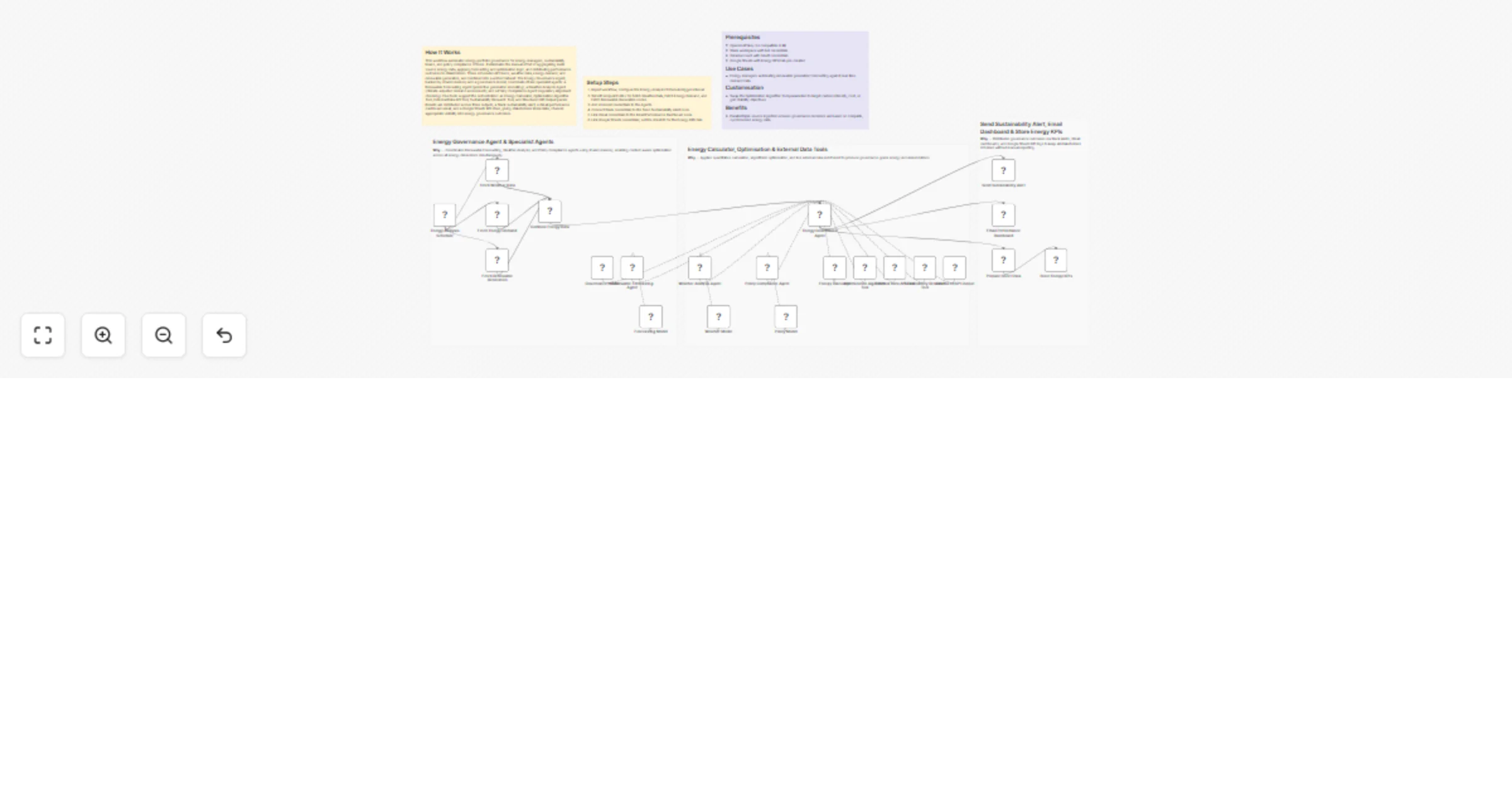
This workflow automates energy portfolio governance for energy managers, sustainability teams, and policy compliance officers. It eliminates the manual effort of aggregating multi-source energy data, applying forecasting and optimisation logic, and distributing performance outcomes to stakeholders. Three scheduled API feeds, weather data, energy demand, and renewable generation, are combined into a unified dataset. The Energy Governance Agent, backed by shared memory and a governance model, coordinates three specialist agents: a Renewable Forecasting Agent (predictive generation modelling), a Weather Analysis Agent (climate-adjusted demand assessment), and a Policy Compliance Agent (regulatory alignment checking). Five tools support the orchestration: an Energy Calculator, Optimisation Algorithm Tool, External Data API Tool, Sustainability Research Tool, and Structured KPI Output parser. Results are distributed across three outputs, a Slack sustainability alert, a Gmail performance dashboard email, and a Google Sheets KPI store, giving stakeholders immediate, channel-appropriate visibility into energy governance outcomes.
Setup Steps
- Import workflow; configure the Energy Analysis Schedule trigger interval.
- Set API endpoint URLs for Fetch Weather Data, Fetch Energy Demand, and Fetch Renewable Generation nodes.
- Add AI model credentials to the Agents.
- Connect Slack credentials to the Send Sustainability Alert node.
- Link Gmail credentials to the Email Performance Dashboard node.
- Link Google Sheets credentials; set the sheet ID for the Energy KPIs tab.
Prerequisites
- OpenAI API key (or compatible LLM)
- Slack workspace with bot credentials
- Gmail account with OAuth credentials
- Google Sheets with Energy KPIs tab pre-created
Use Cases
- Energy managers automating renewable generation forecasting against real-time demand data
Customisation
- Swap the Optimisation Algorithm Tool parameters to target carbon intensity, cost, or grid stability objectives
Benefits
- Parallel triple-source ingestion ensures governance decisions are based on complete, synchronised energy data