Forecast property CAPEX and ROI weekly using Google Sheets and GPT-4o
Workflow preview


 Early Deal
DISCOUNT 20%

Overview
How It Works
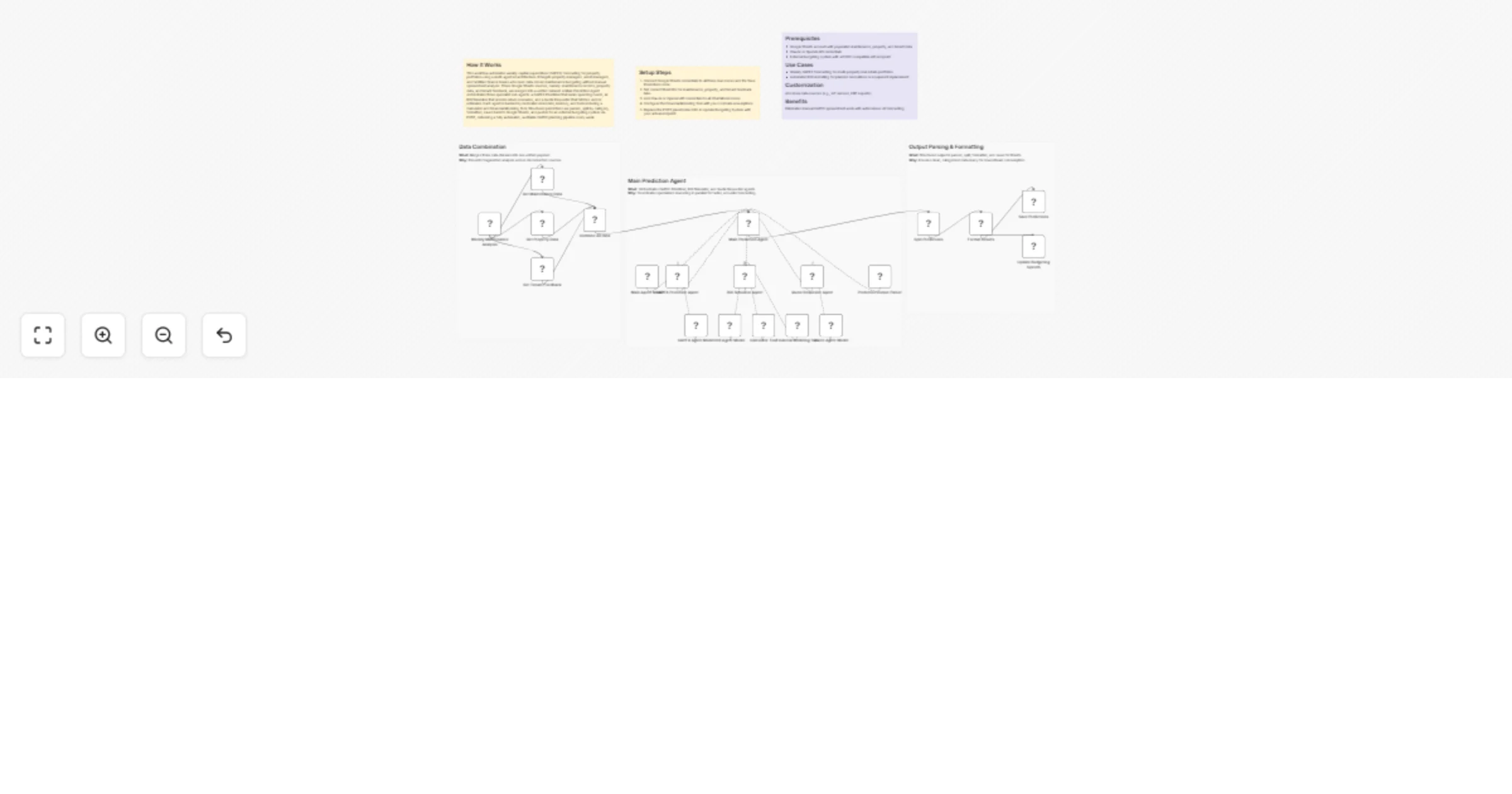
This workflow automates weekly capital expenditure (CAPEX) forecasting for property portfolios using a multi-agent AI architecture. It targets property managers, asset managers, and facilities finance teams who need data-driven maintenance budgeting without manual spreadsheet analysis. Three Google Sheets sources, namely: maintenance records, property data, and tenant feedback, are merged into a unified dataset. A Main Prediction Agent orchestrates three specialist sub-agents: a CAPEX Prioritizer that ranks spending needs, an ROI Simulator that models return scenarios, and a Quote Requester that fetches vendor estimates. Each agent is backed by dedicated AI models, memory, and tools including a Calculator and Financial Modeling Tool. Structured predictions are parsed, split by category, formatted, saved back to Google Sheets, and pushed to an external budgeting system via POST, delivering a fully automated, auditable CAPEX planning pipeline every week.
Setup Steps
- Connect Google Sheets credentials to all three read nodes and the Save Predictions node.
- Set correct Sheet IDs for maintenance, property, and tenant feedback tabs.
- Add Claude or OpenAI API credentials to all Chat Model nodes.
- Configure the Financial Modeling Tool with your cost rate assumptions.
- Replace the POST placeholder URL in Update Budgeting System with your actual endpoint.
Prerequisites
- Google Sheets account with populated maintenance, property, and tenant data
- Claude or OpenAI API credentials
- External budgeting system with a POST-compatible API endpoint
Use Cases
- Weekly CAPEX forecasting for multi-property real estate portfolios
- Automated ROI modelling for planned renovations or equipment replacement
Customization
Add more data sources (e.g., IoT sensors, ERP exports).
Benefits
Eliminates manual CAPEX spreadsheet work with autonomous AI forecasting.