Generate text & image responses in Telegram channels with GPT-4 and TGPT
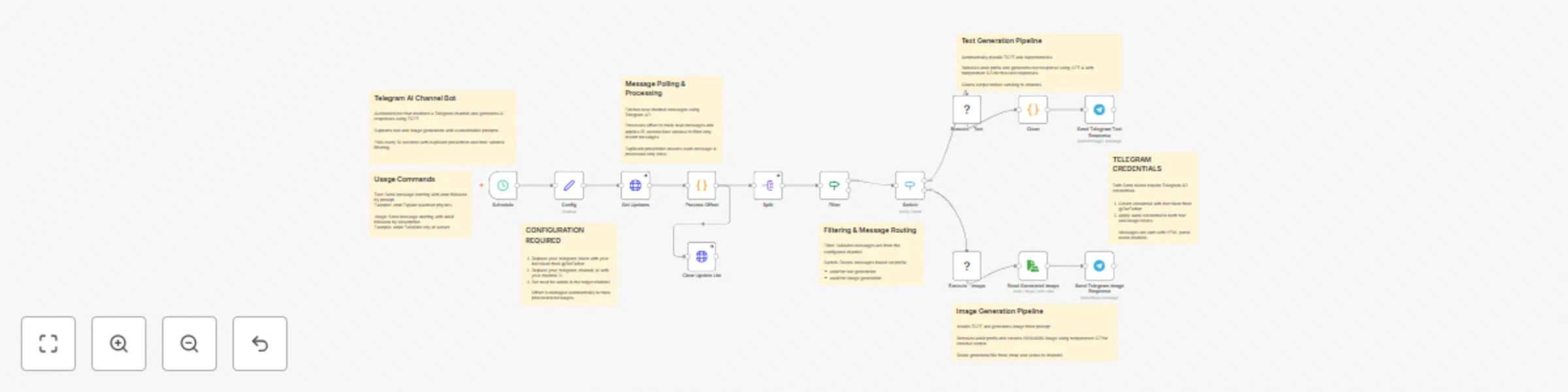
Workflow preview

$20/month : Unlimited workflows
2500 executions/month

THE #1 IN WEB SCRAPING
Scrape any website without limits
HOSTINGER  Early Deal
DISCOUNT 20% Try free
Early DealDISCOUNT 20%
Self-hosted n8n
Unlimited workflows - from $4.99/mo

#1 hub for scraping, AI & automation
6000+ actors - $5 credits/mo
Important notice
This workflow is provided as-is. Please review and test before using in production.
Overview
Telegram AI Channel Bot - Text & Image Response Generator with TGPT
Overview
This n8n workflow creates an automated Telegram channel bot that responds to messages with AI-generated text or images using TGPT. The bot monitors a specific Telegram channel and generates responses based on message prefixes.
Features
- Automated text response generation using TGPT
- Image generation capabilities with customizable dimensions (1920x1080)
- Duplicate message prevention
- Time-window filtering (15 seconds) to process only recent messages
- Continuous polling with 10-second intervals
Setup Instructions
Prerequisites
- n8n Instance: Ensure you have n8n installed and running
- Telegram Bot: Create a new bot via @BotFather on Telegram
- Telegram Channel: Create or have admin access to a Telegram channel
- Linux Environment: The workflow requires Linux for command execution
Configuration Steps
1. Obtain Telegram Bot Token
- Open Telegram and search for @BotFather
- Send
/newbotand follow the prompts - Save the bot token provided (format:
1234567890:ABCdefGHIjklMNOpqrsTUVwxyz)
2. Get Channel ID
- Add your bot as an administrator to your Telegram channel
- Send a test message to the channel
- Visit:
https://api.telegram.org/bot<YOUR_BOT_TOKEN>/getUpdates - Look for
"chat":{"id":-100XXXXXXXXXX}- this is your channel ID
3. Configure the Workflow
- Import the workflow JSON into n8n
- Open the Config node
- Replace
your_telegram_tokenwith your actual bot token - Replace
your_telegram_channel_idwith your channel ID - Save the changes
4. Set Up Telegram Credentials in n8n
- Navigate to the Send Telegram Text Response node
- Click on the credentials field
- Create new Telegram credentials using your bot token
- Apply the same credentials to Send Telegram Image Response node
5. System Requirements
The workflow automatically installs required packages:
util-linux-misc(for script command)curl(for downloading TGPT)- TGPT binary (downloaded automatically from GitHub)
Activation
- Save all configuration changes
- Toggle the workflow to Active status
- The bot will start polling every 10 seconds
How to Use
Sending Commands to the Bot
Text Generation
To generate a text response, send a message to your Telegram channel with the following format:
am# Your prompt here
Example:
am# Explain quantum computing in simple terms
The bot will:
- Remove the
am#prefix - Send the prompt to TGPT with GPT-4 model
- Generate a response with temperature 0.3 (more focused/deterministic)
- Reply with the generated text in the channel
Image Generation
To generate an image, send a message with this format:
ami# Your image description here
Example:
ami# A futuristic city with flying cars at sunset
The bot will:
- Remove the
ami#prefix - Use TGPT to generate an image (1920x1080 resolution)
- Save the image temporarily
- Send the generated image to the channel
Important Usage Notes
Response Time
- The bot checks for new messages every 10 seconds
- Messages older than 15 seconds are ignored
- Expect a delay of 10-30 seconds for responses depending on generation time
Message Processing
- Only messages from the configured channel are processed
- The bot maintains a list of processed message IDs to avoid duplicates
- Maximum of 15 messages are retrieved per polling cycle
Limitations
- Text generation uses temperature 0.3 (less creative, more accurate)
- Image generation uses temperature 0.7 (more creative)
- Images are generated at 1920x1080 resolution
- The bot requires continuous n8n execution
Troubleshooting
Bot Not Responding
- Verify the workflow is active
- Check that the bot is an admin in the channel
- Confirm the channel ID is correct (negative number for channels)
- Ensure messages start with exact prefixes:
am#orami#
Duplicate Responses
- The workflow includes duplicate prevention
- If issues persist, restart the workflow to clear the processed IDs cache
Missing Dependencies
- The workflow automatically downloads TGPT on first run
- If errors occur, check the Execute nodes' output for installation issues
Performance Issues
- Consider increasing the polling interval if server resources are limited
- Monitor the n8n execution logs for timeout errors
Advanced Configuration
Modify Polling Interval
Edit the Schedule node to change the 10-second interval
Adjust Time Window
In the Process Offset node, modify timeWindowSeconds variable (default: 15)
Change AI Model Parameters
- Text generation: Edit
--temperature "0.3"in Execute - Text node - Image generation: Edit
--temperature "0.7"in Execute - Image node - Both use
--model "gtp-4"by default
Customize Image Dimensions
In Execute - Image node, modify:
--height=1080--width=1920
Security Considerations
- Keep your bot token private
- Use private channels to prevent unauthorized access
- Regularly monitor bot activity through Telegram's BotFather
- Consider implementing rate limiting for production use
Maintenance
- Regularly check n8n logs for errors
- Update TGPT version URL in Execute nodes when new versions are released
- Clear
/tmp/directory periodically to remove temporary files - Monitor disk space for image generation temporary files