Block 1 - Schedule Trigger
- Type / Role
- n8n-nodes-base.scheduleTrigger - scheduleTrigger
- Config choices
- Version 1.3
How it works This workflow automatically discovers and qualifies local business leads using structured inputs. It runs on a schedule, reads search queries from Google Sheets, and fetches business d...
n8n-nodes-base.scheduletrigger, n8n-nodes-base.googlesheets, n8n-nodes-base.httprequest, n8n-nodes-base.code, @n8n/n8n-nodes-langchain.openai, n8n-nodes-base.stickynote
This workflow is cataloged by N8N Workflows and links back to its original n8n.io source page by Avkash Kakdiya.
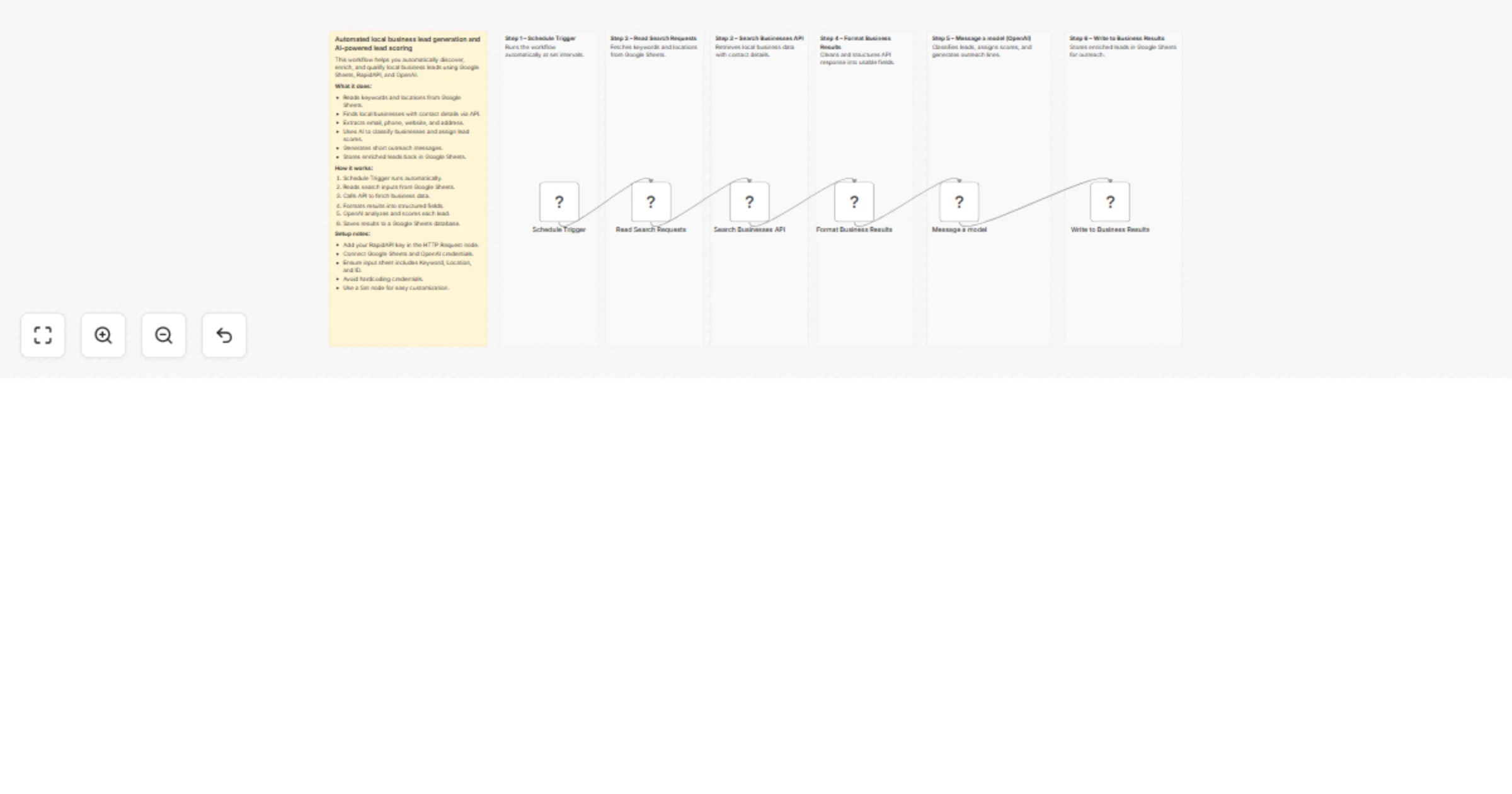
Original n8n.io sourceThis workflow automatically discovers and qualifies local business leads using structured inputs. It runs on a schedule, reads search queries from Google Sheets, and fetches business data via an API. The data is cleaned and enriched before being analyzed by AI for lead scoring and categorization. Finally, all enriched leads are stored back in Google Sheets for outreach and tracking.
Trigger workflow automatically
Schedule Trigger – Runs the workflow at defined time intervals.
Fetch lead search inputs
Read Search Requests – Retrieves keywords and locations from Google Sheets.
Collect business data from API
Search Businesses API – Queries RapidAPI to find local businesses with contact details.
Clean and structure results
Format Business Results – Extracts and formats business name, email, phone, website, and address.
Analyze and score leads with AI
Message a model – Uses OpenAI to classify businesses, assign lead scores, and generate outreach lines.
Store enriched leads
Write to Business Results – Saves all processed and scored leads into Google Sheets.
This catalog entry is organized from the workflow JSON. The node-level section below shows the executable blocks available for review before importing the template.
| Workflow | Generate and qualify local business leads using Google Sheets, RapidAPI and OpenAI |
|---|---|
| Complexity | intermediate |
| Nodes | 13 |
| Categories | Lead Generation, AI Summarization |
| Author | Avkash Kakdiya |
| Published | 26 Mar 2026 |
Use the JSON export at /data/workflows/14366/14366.json as the source template for this automation.
Open n8n, import the downloaded JSON, and review each node before activating the workflow.
Replace placeholder credentials, API keys, webhook URLs, account IDs, and environment-specific values with your own settings.
Run the workflow manually or in a staging workspace, inspect node output, and confirm downstream systems receive the expected data.
Enable the workflow only after testing, then monitor executions, errors, and rate limits during the first production runs.
Review imported nodes carefully before activation. This catalog entry is intended to help you inspect the workflow structure, understand required services, and find related templates faster.
Node names, credentials, schedules, webhook paths, and external service limits may need adjustment for your workspace.
How it works This workflow automatically discovers and qualifies local business leads using structured inputs. It runs on a schedule, reads search queries from Google Sheets, and fetches business d...
Review the workflow JSON, configure any required credentials in n8n, and test the automation in a safe workspace before using it in production.
Yes. Use the block-by-block analysis and the downloadable JSON to inspect each node, then adjust credentials, prompts, schedules, filters, or destinations for your Lead Generation, AI Summarization use case.