
Filter sitemap URLs and inspect indexing status with Google Search Console

Workflow preview
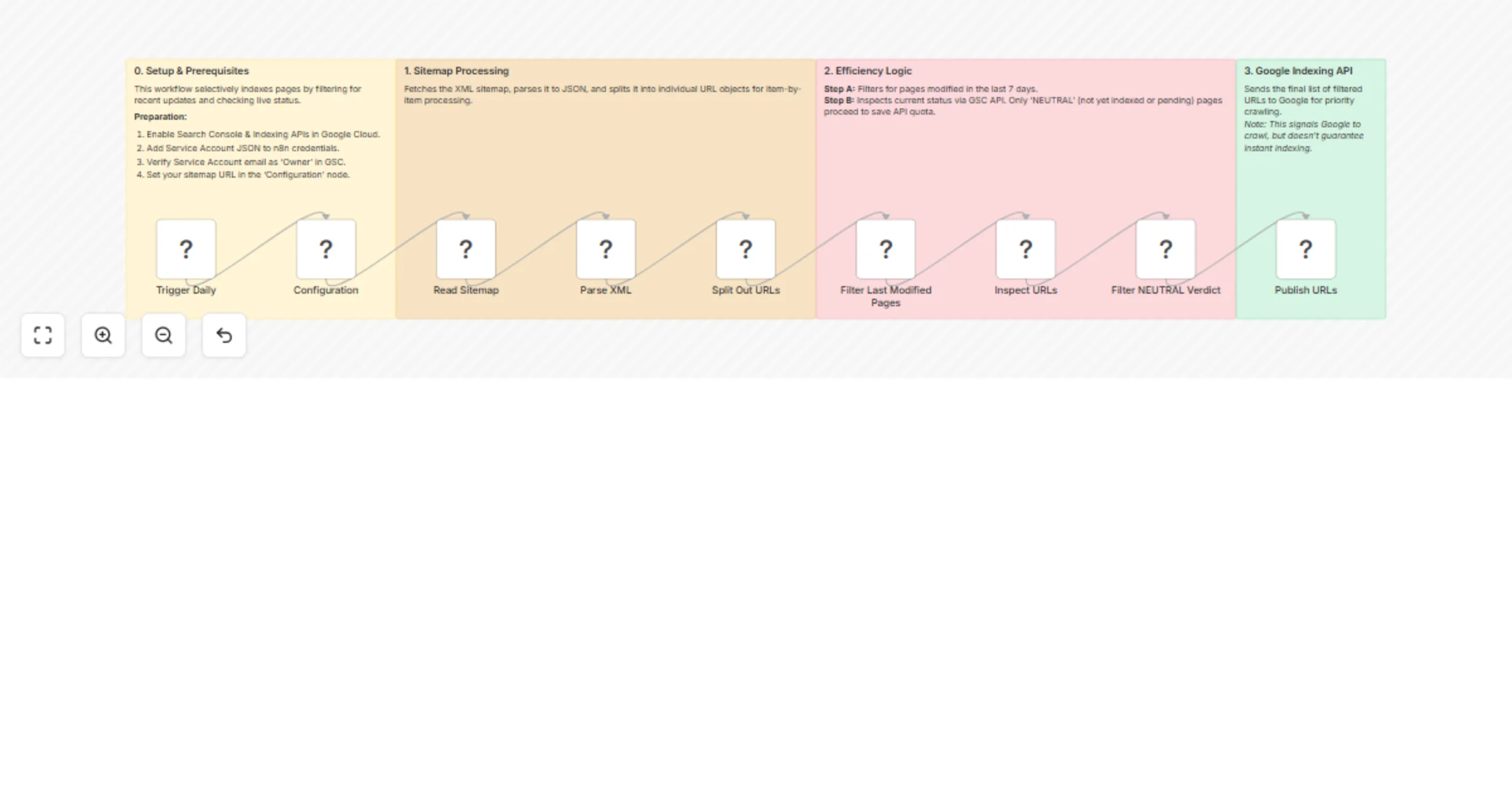
Workflow preview
100%
Filter sitemap URLs and inspect indexing status with Google Search Console preview
Open on n8n.io

1. Workflow Overview

This workflow provides a data driven approach to SEO by automating the indexing process. Instead of bulk submitting every URL, it intelligently filters your sitemap for recent updates and verifies ...

Best for

  • Market Research automation workflows
  • intermediate n8n builders looking for reusable templates

Tools used

n8n-nodes-base.httprequest, n8n-nodes-base.xml, n8n-nodes-base.splitout, n8n-nodes-base.set, n8n-nodes-base.filter, n8n-nodes-base.scheduletrigger, n8n-nodes-base.stickynote

Source and attribution

This workflow is cataloged by N8N Workflows and links back to its original n8n.io source page by Viktor Klepikovskyi.

Original n8n.io source

1.1 Workflow description

Title
Filter sitemap URLs and inspect indexing status with Google Search Console
Workflow name
Filter sitemap URLs and inspect indexing status with Google Search Console

This workflow provides a data-driven approach to SEO by automating the indexing process. Instead of bulk-submitting every URL, it intelligently filters your sitemap for recent updates and verifies their status via Google Search Console before using your Indexing API quota.

Goal & Purpose

The primary goal is to maintain a healthy search presence without wasting API resources. It identifies pages that are either new or recently modified but haven't been fully crawled or indexed by Google yet. By targeting only "Neutral" status pages, you ensure that Googlebot focuses its attention where it matters most.

Prerequisites

To use this workflow, you need a Google Cloud Project with the following configured:

  • APIs Enabled: Google Search Console API and Web Search Indexing API.
  • Credentials: A Service Account JSON key added to your n8n credentials.
  • Verification: The Service Account email must be added as an Owner in Google Search Console for your domain.
  • Sitemap: A standard XML sitemap (e.g., https://example.com/sitemap.xml).

Recommendations

  • Quota Management: The Indexing API has a default limit (often 200/day). This workflow helps stay under that limit by being selective.
  • Domain Format: Ensure your siteUrl in the Inspection node matches your GSC property type (Domain vs. URL Prefix).
  • Crawling Speed: Note that while this notifies Google, actual crawl time depends on Google's internal scheduling.

Detailed Guide & Logic: Read the full playbook here

1.2 Logical Blocks

This catalog entry is organized from the workflow JSON. The node-level section below shows the executable blocks available for review before importing the template.

2. Block-by-Block Analysis

Block 1 - Read Sitemap

Type / Role
n8n-nodes-base.httpRequest - httpRequest
Config choices
Version 4.3

Block 2 - Parse XML

Type / Role
n8n-nodes-base.xml - xml
Config choices
Version 1

Block 3 - Split Out URLs

Type / Role
n8n-nodes-base.splitOut - splitOut
Config choices
Version 1

Block 4 - Configuration

Type / Role
n8n-nodes-base.set - set
Config choices
Version 3.4

Block 5 - Inspect URLs

Type / Role
n8n-nodes-base.httpRequest - httpRequest
Config choices
Version 4.3

Block 6 - Publish URLs

Type / Role
n8n-nodes-base.httpRequest - httpRequest
Config choices
Version 4.3

Block 7 - Filter NEUTRAL Verdict

Type / Role
n8n-nodes-base.filter - filter
Config choices
Version 2.3

Block 8 - Filter Last Modified Pages

Type / Role
n8n-nodes-base.filter - filter
Config choices
Version 2.3

Block 9 - Trigger Daily

Type / Role
n8n-nodes-base.scheduleTrigger - scheduleTrigger
Config choices
Version 1.3

Block 10 - Sticky Note

Type / Role
n8n-nodes-base.stickyNote - stickyNote
Config choices
Version 1

Block 11 - Sticky Note1

Type / Role
n8n-nodes-base.stickyNote - stickyNote
Config choices
Version 1

Block 12 - Sticky Note2

Type / Role
n8n-nodes-base.stickyNote - stickyNote
Config choices
Version 1

Block 13 - Sticky Note3

Type / Role
n8n-nodes-base.stickyNote - stickyNote
Config choices
Version 1

3. Summary Table

Workflow Filter sitemap URLs and inspect indexing status with Google Search Console
Complexity intermediate
Nodes 13
Categories Market Research
Author Viktor Klepikovskyi
Published 11 Apr 2026

4. Reproducing the Workflow from Scratch

  1. 1. Download the workflow JSON

    Use the JSON export at /data/workflows/14991/14991.json as the source template for this automation.

  2. 2. Import the template into n8n

    Open n8n, import the downloaded JSON, and review each node before activating the workflow.

  3. 3. Configure credentials and variables

    Replace placeholder credentials, API keys, webhook URLs, account IDs, and environment-specific values with your own settings.

  4. 4. Test with sample data

    Run the workflow manually or in a staging workspace, inspect node output, and confirm downstream systems receive the expected data.

  5. 5. Activate and monitor

    Enable the workflow only after testing, then monitor executions, errors, and rate limits during the first production runs.

5. General Notes & Resources

Review imported nodes carefully before activation. This catalog entry is intended to help you inspect the workflow structure, understand required services, and find related templates faster.

Node names, credentials, schedules, webhook paths, and external service limits may need adjustment for your workspace.

Frequently asked questions

What does Filter sitemap URLs and inspect indexing status with Google Search Console do?

This workflow provides a data driven approach to SEO by automating the indexing process. Instead of bulk submitting every URL, it intelligently filters your sitemap for recent updates and verifies ...

What do I need before importing this workflow?

Review the workflow JSON, configure any required credentials in n8n, and test the automation in a safe workspace before using it in production.

Can I customize this workflow?

Yes. Use the block-by-block analysis and the downloadable JSON to inspect each node, then adjust credentials, prompts, schedules, filters, or destinations for your Market Research use case.



