Extract named entities from web pages with Google Natural Language API
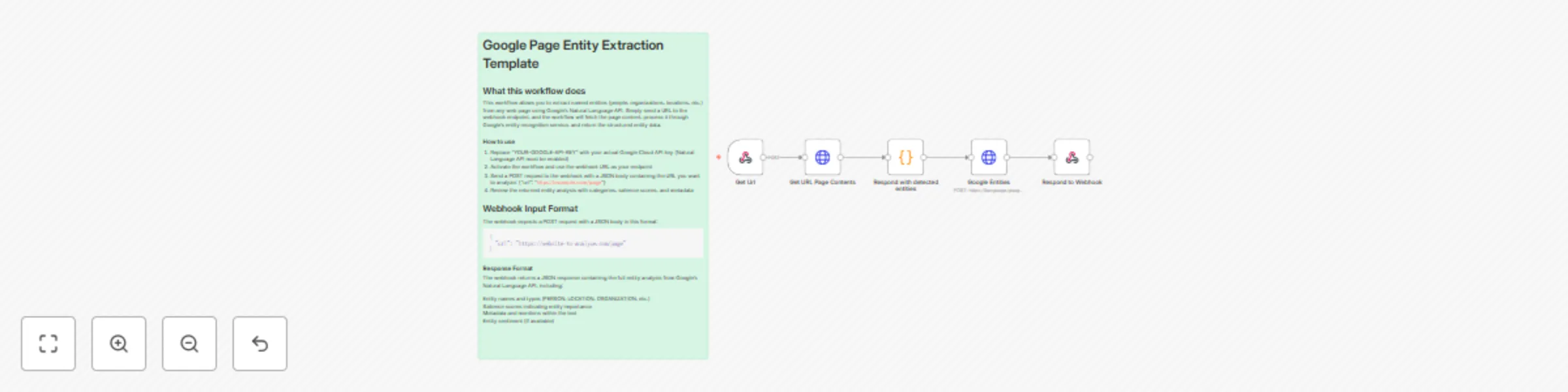
Workflow preview

$20/month : Unlimited workflows
2500 executions/month

THE #1 IN WEB SCRAPING
Scrape any website without limits
HOSTINGER  Early Deal
DISCOUNT 20% Try free
Early DealDISCOUNT 20%
Self-hosted n8n
Unlimited workflows - from $4.99/mo

#1 hub for scraping, AI & automation
6000+ actors - $5 credits/mo
Important notice
This workflow is provided as-is. Please review and test before using in production.
Overview
Who is this for?
- Content strategists analyzing web page semantic content
- SEO professionals conducting entity-based analysis
- Data analysts extracting structured data from web pages
- Marketers researching competitor content strategies
- Researchers organizing and categorizing web content
- Anyone needing to automatically extract entities from web pages
What problem is this workflow solving?
Manually identifying and categorizing entities (people, organizations, locations, etc.) on web pages is time-consuming and error-prone. This workflow solves this challenge by:
- Automating the extraction of named entities from any web page
- Leveraging Google's powerful Natural Language API for accurate entity recognition
- Processing web pages through a simple webhook interface
- Providing structured entity data that can be used for analysis or further processing
- Eliminating hours of manual content analysis and categorization
What this workflow does
This workflow creates an automated pipeline between a webhook and Google's Natural Language API to:
- Receive a URL through a webhook endpoint
- Fetch the HTML content from the specified URL
- Clean and prepare the HTML for processing
- Submit the HTML to Google's Natural Language API for entity analysis
- Return the structured entity data through the webhook response
- Extract entities including people, organizations, locations, and more with their salience scores
Setup
Prerequisites:
- An n8n instance (cloud or self-hosted)
- Google Cloud Platform account with Natural Language API enabled
- Google API key with access to the Natural Language API
Google Cloud Setup:
- Create a project in Google Cloud Platform
- Enable the Natural Language API for your project
- Create an API key with access to the Natural Language API
- Copy your API key for use in the workflow
n8n Setup:
- Import the workflow JSON into your n8n instance
- Replace "YOUR-GOOGLE-API-KEY" in the "Google Entities" node with your actual API key
- Activate the workflow to enable the webhook endpoint
- Copy the webhook URL from the "Webhook" node for later use
Testing:
- Use a tool like Postman or cURL to send a POST request to your webhook URL
- Include a JSON body with the URL you want to analyze: {"url": "https://example.com"}
- Verify that you receive a response containing the entity analysis data
How to customize this workflow to your needs
Analyzing Specific Entity
- Modify the "Google Entities" node parameters to include entityType filters
- Add a "Function" node after "Google Entities" to filter specific entity types
- Create conditions to extract only entities of interest (people, organizations, etc.)
Processing Multiple URLs in Batch:
- Replace the webhook with a different trigger (HTTP Request, Google Sheets, etc.)
- Add a "Split In Batches" node to process multiple URLs
- Use a "Merge" node to combine results before sending the response
Enhancing Entity Data:
- Add additional API calls to enrich extracted entities with more information
- Implement sentiment analysis alongside entity extraction
- Create a data transformation node to format entities by type or relevance
Additional Notes
- This workflow respects Google's API rate limits by processing one URL at a time
- The Natural Language API may not identify all entities on a page, particularly for highly technical content
- HTML content is trimmed to 100,000 characters if longer to avoid API limitations
- Consider legal and privacy implications when analyzing and storing entity data from web pages
- You may want to adjust the HTML cleaning process for specific website structures