Block 1 - Sticky Note2
- Type / Role
- n8n-nodes-base.stickyNote - stickyNote
- Config choices
- Version 1
This workflow is provided as-is. Please review and test before using in production.
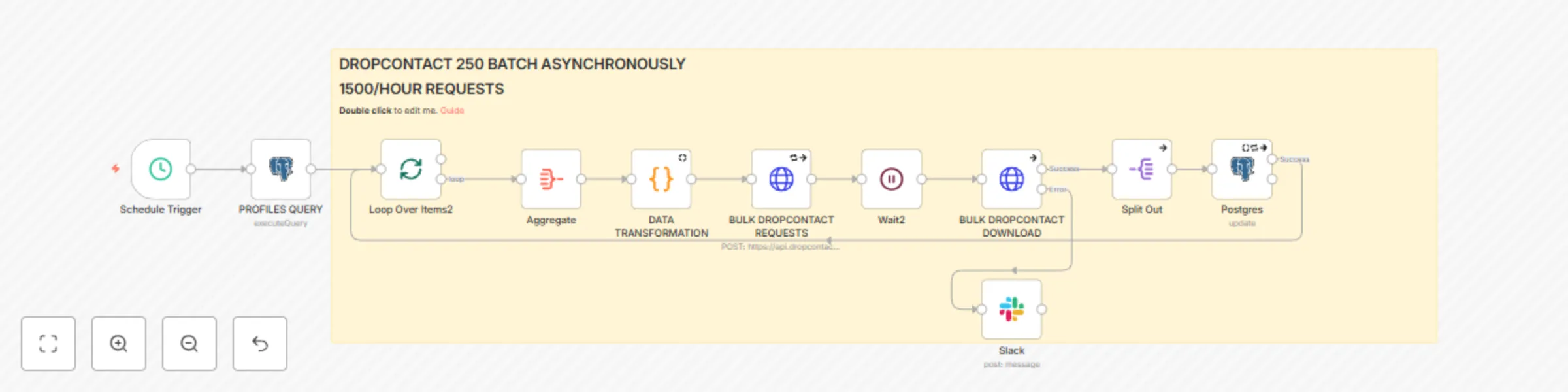
The template allows to make Dropcontact batch requests up to 250 requests every 10 minutes (1500/hour). Valuable if high volume email enrichment is expected. Dropcontact will look for email & basic...
n8n-nodes-base.stickynote, n8n-nodes-base.aggregate, n8n-nodes-base.postgres, n8n-nodes-base.httprequest, n8n-nodes-base.splitinbatches, n8n-nodes-base.splitout, n8n-nodes-base.wait, n8n-nodes-base.code
This workflow is cataloged by N8N Workflows and links back to its original n8n.io source page by victor de coster.
Original n8n.io sourceThe template allows to make Dropcontact batch requests up to 250 requests every 10 minutes (1500/hour). Valuable if high volume email enrichment is expected.
Dropcontact will look for email & basic email qualification if first_name, last_name, company_name is provided.
+++++++++++++++++++++++++++++++++++++++++
Step 1: Node "Profiles Query" Connect your own source (Airtable, Google Sheets, Supabase,...) the template is using Postgres by default.
Note I: Be careful your source is only returning a maximum of 250 items.
Note II: The next node uses the next variables, make sure you can map these from your source file:
Note III: This template is using the Dropcontact Batch API, which works in a POST & GET setup. Not a GET request only to retrieve data, as Dropcontact needs to process the batch data load properly.
+++++++++++++++++++++++++++++++++++++++++
Step 2: Node "Data Transformation" Will transform the input variables in the proper json format. This json format is expected from the Dropcontact API to make a batch request.
"full_name" is being used as a custom identifier to update the returned email to the proper contact in your source database.
To make things easy, use a unique identiefer in the full_name variable.
+++++++++++++++++++++++++++++++++++++++++
Step3: Node: "Bulk Dropcontact Requests". Enter your Dropcontact credentials in the node: Bulk Dropcontact Requests.
+++++++++++++++++++++++++++++++++++++++++
Step4: Connect your output source by mapping the data you like to use.
+++++++++++++++++++++++++++++++++++++++++
Step5: Node: "Slack" (OPTIONAL) Connect your slack account, if an error occur, you will be notified.
TIP: Try to run the workflow with a batch of 10 (not 250) as it might need to run initially before you will be able to map the data to your final destination. Once the data fields are properly mapped, adjust back to 250.
This catalog entry is organized from the workflow JSON. The node-level section below shows the executable blocks available for review before importing the template.
| Workflow | Enrich up to 1500 emails per hour with Dropcontact batch requests |
|---|---|
| Complexity | intermediate |
| Nodes | 12 |
| Categories | Lead Generation |
| Author | victor de coster |
| Published | 21 May 2024 |
Use the JSON export at /data/workflows/2272/2272.json as the source template for this automation.
Open n8n, import the downloaded JSON, and review each node before activating the workflow.
Replace placeholder credentials, API keys, webhook URLs, account IDs, and environment-specific values with your own settings.
Run the workflow manually or in a staging workspace, inspect node output, and confirm downstream systems receive the expected data.
Enable the workflow only after testing, then monitor executions, errors, and rate limits during the first production runs.
Review imported nodes carefully before activation. This catalog entry is intended to help you inspect the workflow structure, understand required services, and find related templates faster.
Node names, credentials, schedules, webhook paths, and external service limits may need adjustment for your workspace.
The template allows to make Dropcontact batch requests up to 250 requests every 10 minutes (1500/hour). Valuable if high volume email enrichment is expected. Dropcontact will look for email & basic...
Review the workflow JSON, configure any required credentials in n8n, and test the automation in a safe workspace before using it in production.
Yes. Use the block-by-block analysis and the downloadable JSON to inspect each node, then adjust credentials, prompts, schedules, filters, or destinations for your Lead Generation use case.