Enrich seller data with email & domain lookup using Bright Data & Google Search
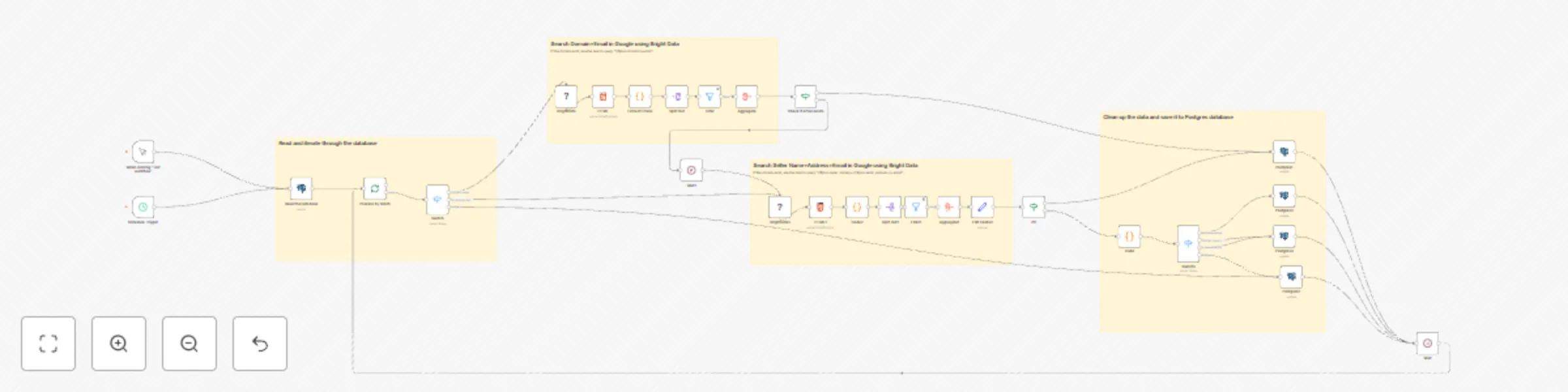
Workflow preview


 Early Deal
DISCOUNT 20%

Important notice
This workflow is provided as-is. Please review and test before using in production.
Overview
🔍 Email Lookup with Google Search from Postgres Database
This N8N workflow is designed to enrich seller data stored in a Postgres database by performing automated Google search lookups. It uses Bright Data's Web Unlocker to bypass search result restrictions and the HTML Extract node to parse and extract relevant information from webpages.
The main purpose of this workflow is to discover missing contact details, company domains, and secondary emails for businesses or sellers based on existing database entries.
🎯 Problem This Workflow Solves
Manually searching for missing seller or business details—like secondary emails, websites, or domain names—can be time-consuming and inefficient, especially for large datasets. This workflow automates the search and data enrichment process, significantly reducing manual effort while improving the quality and completeness of your seller database.
✅ Prerequisites
Before using this template, make sure the following requirements are met:
- ✔️ A Bright Data account with access to the Web Unlocker or Amazon Scraper API
- ✔️ A valid Bright Data API key
- ✔️ An active PostgreSQL database with seller data
- ✔️ N8N self-hosted instance (recommended for using community nodes like
n8n-nodes-brightdata) - ✔️ Installed
n8n-nodes-brightdatapackage (custom node for Bright Data integration)
⚙️ Setup Instructions
Step 1: Prepare Your Postgres Table
Create a table in Postgres with the following structure (you can adjust field names if needed):
CREATE TABLE sellers (
  seller_id SERIAL PRIMARY KEY,
  seller_name TEXT,
  primary_email TEXT,
  company_info TEXT,
  trade_name TEXT,
  business_address TEXT,
  coc_number TEXT,
  vat_number TEXT,
  commercial_register TEXT,
  secondary_email TEXT,
  domain TEXT,
  seller_slug TEXT,
  source TEXT
);
Step 2: Setup Web Unlocker on Bright Data
- Go to your Bright Data dashboard.
- Navigate to Proxies & Scraping → Web Unlocker.
- Create a new zone, selecting Web Unlocker API under Scraping Solutions.
- Whitelist your server IP if required.
Step 3: Generate API Key
- In the Bright Data dashboard, go to the API section.
- Generate a new API key.
- In N8N, create HTTP Request Credentials using Bearer Authentication with the API key.
Step 4: Install the Bright Data Node in N8N
- In your N8N self-hosted instance, go to Settings → Community Nodes.
- Search and install
n8n-nodes-brightdata.
🔄 Workflow Functionality
- 🔁 Trigger: Can be set to run on a schedule (e.g., daily) or manually.
- 📥 Read: Fetches seller records from the Postgres table.
- 🌐 Search: Uses Bright Data to perform a Google search based on
seller_name,company_info, ortrade_name. - 🧾 Extract: Parses the HTML content using the HTML Extract node to identify potential websites and email addresses.
- 📝 Update: Writes enriched data (like
domainorsecondary_email) back to the Postgres table.
💡 Use Cases
- Lead enrichment for e-commerce sellers
- Domain and contact info discovery for B2B databases
- Email and web domain verification for CRM systems
- Market research automation
🛠️ Customization Tips
- You can enhance the parsing logic in the HTML Extract node to look for phone numbers, LinkedIn profiles, or social media links.
- Modify the search query logic to include additional parameters like
locationorindustryfor more refined results. - Integrate additional APIs (e.g., Hunter.io, Clearbit) for email validation or social profile enrichment.
- Add filtering to skip entries that already have
domainorsecondary_email.