
Email news briefing by keyword from Bright Data with AI summary

Workflow preview
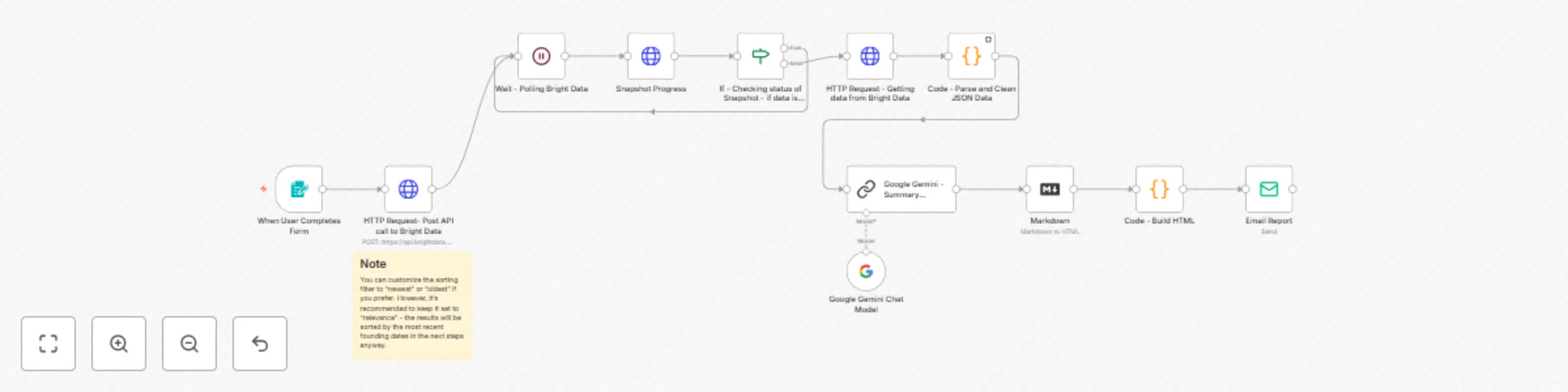
Workflow preview
100%
Email news briefing by keyword from Bright Data with AI summary preview
Open on n8n.io

Important notice

This workflow is provided as-is. Please review and test before using in production.

1. Workflow Overview

This n8n workflow automatically retrieves recent Reuters news articles related to a user specified keyword, summarizes the main findings using Google Gemini, formats the output into styled HTML, an...

Best for

  • Market Research automation workflows
  • AI Summarization automation workflows
  • intermediate n8n builders looking for reusable templates

Tools used

n8n-nodes-base.httprequest, n8n-nodes-base.wait, n8n-nodes-base.if, n8n-nodes-base.formtrigger, n8n-nodes-base.stickynote, n8n-nodes-base.code, @n8n/n8n-nodes-langchain.lmchatgooglegemini, n8n-nodes-base.emailsend

Source and attribution

This workflow is cataloged by N8N Workflows and links back to its original n8n.io source page by Gleb D.

Original n8n.io source

1.1 Workflow description

Title
Email news briefing by keyword from Bright Data with AI summary
Workflow name
Email news briefing by keyword from Bright Data with AI summary

This n8n workflow automatically retrieves recent Reuters news articles related to a user-specified keyword, summarizes the main findings using Google Gemini, formats the output into styled HTML, and sends a clean email report to a specified address.

šŸš€ What It Does

  • Collects news data from Bright Data's Reuters dataset.
  • Sorts and filters top 10 most recent news articles by publication_date.
  • Sends structured news data to Gemini Flash for summarization.
  • Converts Gemini's response (in Markdown) into styled HTML.
  • Delivers a concise news briefing via email, including clickable source links and topic highlights.

šŸ› ļø Step-by-Step Setup

  1. User Form: Accepts a keyword from the user via an n8n form trigger.
  2. Bright Data API: Posts a discover_new request to Bright Data's Reuters dataset using the keyword.
  3. Snapshot Polling: Waits and checks for dataset readiness using the snapshot ID.
  4. Data Retrieval: Downloads the news data once the snapshot is complete.
  5. Parsing: Filters and sorts the latest 10 articles using a Python Code node.
  6. AI Analysis: Google Gemini summarizes the filtered content into one briefing.
  7. Markdown → HTML: Converts AI response into styled HTML using Markdown + Code node.
  8. Email Delivery: Sends the briefing as an email to a predefined recipient.

🧠 How It Works

  • Polling Control: Uses Wait and If nodes to handle Bright Data snapshot readiness.
  • Date Sorting: Publication dates (ISO 8601 format) are parsed and used for sorting.
  • AI Summarization: Gemini condenses multiple articles into one cohesive summary.
  • Formatting: Clean HTML with readable styles is generated dynamically before sending.

šŸ“Ø Final Output The email includes:

  • A brief summary of the most important developments
  • Date range of the collected news
  • Topics covered

šŸ” Credentials Used Bright Data API (replace YOUR_API_KEY in the HTTP nodes)

Google Gemini (Flash) API

Email SMTP (configured in Email Send node)

āš ļø Notes

  • You must replace all YOUR_API_KEY placeholders in Bright Data request headers with your actual Bright Data API key.
  • You can customize the keyword prompt and output style freely.
  • I would recommend to keep the sort = relevance option for best chronological results - sorting by date is handled later.

1.2 Logical Blocks

This catalog entry is organized from the workflow JSON. The node-level section below shows the executable blocks available for review before importing the template.

2. Block-by-Block Analysis

Block 1 - Snapshot Progress

Type / Role
n8n-nodes-base.httpRequest - httpRequest
Config choices
Version 4.2

Block 2 - HTTP Request- Post API call to Bright Data

Type / Role
n8n-nodes-base.httpRequest - httpRequest
Config choices
Version 4.2

Block 3 - Wait - Polling Bright Data

Type / Role
n8n-nodes-base.wait - wait
Config choices
Version 1.1

Block 4 - If - Checking status of Snapshot - if data is ready or not

Type / Role
n8n-nodes-base.if - if
Config choices
Version 2.2

Block 5 - HTTP Request - Getting data from Bright Data

Type / Role
n8n-nodes-base.httpRequest - httpRequest
Config choices
Version 4.2

Block 6 - When User Completes Form

Type / Role
n8n-nodes-base.formTrigger - formTrigger
Config choices
Version 2.2

Block 7 - Sticky Note

Type / Role
n8n-nodes-base.stickyNote - stickyNote
Config choices
Version 1

Block 8 - Code - Parse and Clean JSON Data

Type / Role
n8n-nodes-base.code - code
Config choices
Version 2

Block 9 - Google Gemini Chat Model

Type / Role
@n8n/n8n-nodes-langchain.lmChatGoogleGemini - lmChatGoogleGemini
Config choices
Version 1

Block 10 - Email Report

Type / Role
n8n-nodes-base.emailSend - emailSend
Config choices
Version 2.1

Block 11 - Markdown

Type / Role
n8n-nodes-base.markdown - markdown
Config choices
Version 1

Block 12 - Code - Build HTML

Type / Role
n8n-nodes-base.code - code
Config choices
Version 2

Block 13 - Google Gemini - Summary Analisys

Type / Role
@n8n/n8n-nodes-langchain.chainLlm - chainLlm
Config choices
Version 1.6

3. Summary Table

Workflow Email news briefing by keyword from Bright Data with AI summary
Complexity intermediate
Nodes 13
Categories Market Research, AI Summarization
Author Gleb D
Published 01 Jun 2025

4. Reproducing the Workflow from Scratch

  1. 1. Download the workflow JSON

    Use the JSON export at /data/workflows/4570/4570.json as the source template for this automation.

  2. 2. Import the template into n8n

    Open n8n, import the downloaded JSON, and review each node before activating the workflow.

  3. 3. Configure credentials and variables

    Replace placeholder credentials, API keys, webhook URLs, account IDs, and environment-specific values with your own settings.

  4. 4. Test with sample data

    Run the workflow manually or in a staging workspace, inspect node output, and confirm downstream systems receive the expected data.

  5. 5. Activate and monitor

    Enable the workflow only after testing, then monitor executions, errors, and rate limits during the first production runs.

5. General Notes & Resources

Review imported nodes carefully before activation. This catalog entry is intended to help you inspect the workflow structure, understand required services, and find related templates faster.

Node names, credentials, schedules, webhook paths, and external service limits may need adjustment for your workspace.

Frequently asked questions

What does Email news briefing by keyword from Bright Data with AI summary do?

This n8n workflow automatically retrieves recent Reuters news articles related to a user specified keyword, summarizes the main findings using Google Gemini, formats the output into styled HTML, an...

What do I need before importing this workflow?

Review the workflow JSON, configure any required credentials in n8n, and test the automation in a safe workspace before using it in production.

Can I customize this workflow?

Yes. Use the block-by-block analysis and the downloadable JSON to inspect each node, then adjust credentials, prompts, schedules, filters, or destinations for your Market Research, AI Summarization use case.



