Curate key RSS articles with OpenAI, save to Notion, and notify via Telegram
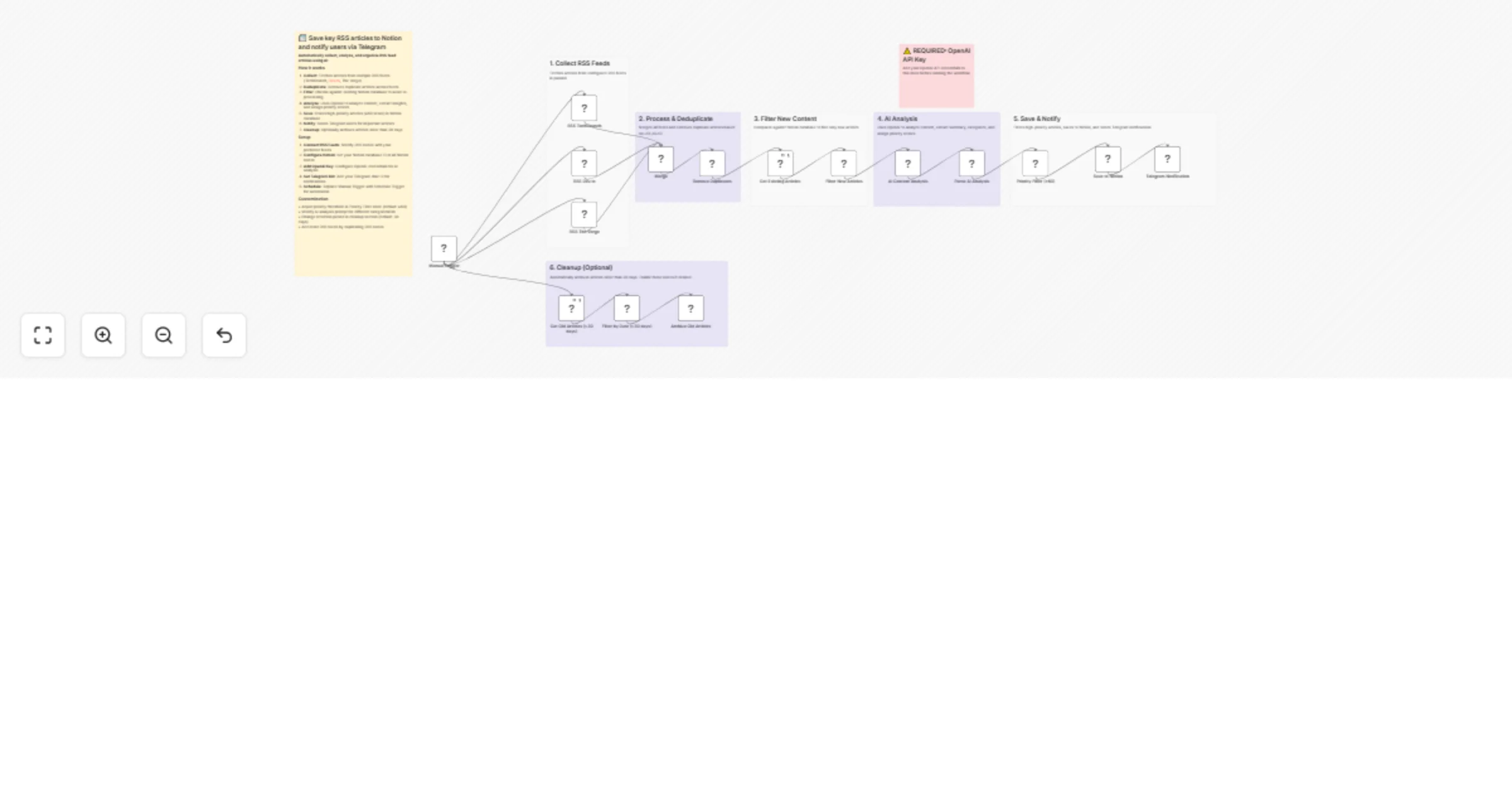
Workflow preview

$20/month : Unlimited workflows
2500 executions/month

THE #1 IN WEB SCRAPING
Scrape any website without limits
HOSTINGER  Early Deal
DISCOUNT 20% Try free
Early DealDISCOUNT 20%
Self-hosted n8n
Unlimited workflows - from $4.99/mo

#1 hub for scraping, AI & automation
6000+ actors - $5 credits/mo
Overview
Think of this workflow as your personal news assistant that:
- Monitors multiple technology websites 24/7
- Uses AI to read and understand each article
- Filters out low-quality content automatically.
- Saves the best articles to Notion with summaries.
- Sends you Telegram alerts for must-read content.
Prerequisites (What You Need Before Starting)
1. Notion Account (Free)
- Sign up at notion.so
- You'll store all curated articles here
2. OpenAI Account (Paid)
- Sign up at platform.openai.com
- Cost:
$0.01-0.02 per article ($15-30/month for 50 articles/day) - Needed for AI content analysis
3. Telegram Account (Free)
- Download Telegram app
- Needed for instant notifications
4. RSS Feed URLs (Free)
- Included: TechCrunch, Dev.to, The Verge
- Optional: Add your own favorite tech blogs
Step-by-Step Configuration
STEP 1: Create Your Notion Database
1.1 Create New Database
- Open Notion (notion.so)
- Click "+ New Page"
- Select "Table" view
- Name it "Content Curator"
1.2 Add Required Properties
Click "+ New Property" and add each:
- Title (Rich Text) - Already exists by default
- URL (URL type)
- Summary (Rich Text)
- Category (Select) - Add options: Technology, AI, Business, DevOps, Other
- Tags (Rich Text)
- Sentiment (Select) - Add options: Positive, Neutral, Negative
- Priority (Number)
- Source (Rich Text)
- Published (Date)
- Added Date (Date)
- Status (Select) - Add options: New, Read, Archived
1.3 Get Database ID
- Open your Notion database
- Click "Share" button (top right)
- Click "Copy Link"
- Extract the ID from URL:
- URL:
https://www.notion.so/28e3a42420b2801e8ef5c680e49afc2e - ID:
28e3a42420b2801e8ef5c680e49afc2e
- Save this ID - you'll need it multiple times
STEP 2: Create Notion Integration
2.1 Create Integration
- Go to: notion.so/my-integrations
- Click "+ New Integration"
- Name: "RSS Content Curator"
- Select your workspace
- Click "Submit"
- Copy the "Internal Integration Token" (starts with
secret_) - IMPORTANT: Save this token safely!
2.2 Connect Integration to Database
- Open your "Content Curator" database in Notion
- Click "•••" (three dots, top right)
- Scroll to "Add connections"
- Select "RSS Content Curator"
- Click "Confirm"
STEP 3: Set Up OpenAI
- Go to: platform.openai.com
- Sign up or log in
- Add payment method (required)
- Navigate to: platform.openai.com/api-keys
- Click "+ Create new secret key"
- Name: "n8n-content-curator"
- Copy the key (starts with
sk-) - IMPORTANT: You can't see this key again - save it now!
STEP 4: Create Telegram Bot
4.1 Create the Bot
- Open Telegram app
- Search for "@BotFather"
- Start chat with BotFather
- Send:
/newbot - Follow prompts:
- Bot name: "My Content Curator"
- Username: "my_content_curator_bot"
- Copy the HTTP API token
- Save this token
4.2 Get Your Chat ID
- Search for your bot in Telegram
- Start a chat and send any message
- Open in browser:
https://api.telegram.org/bot<YOUR_BOT_TOKEN>/getUpdates
(Replace <YOUR_BOT_TOKEN> with your actual token)
4. Find "chat":{"id": followed by a number
5. Copy that number (e.g., 8346316847)
6. Save this Chat ID
STEP 5: Import Workflow to n8n
- Log in to n8n
- Click "Workflows" → "Add Workflow"
- Click three dots (⋮) → "Import from File"
- Select
RSS_AI_Content_Curator_Enhanced.json - Click "Import"
STEP 6: Configure Notion Credentials
Four nodes need Notion connection:
- Get Existing Articles
- Get Old Articles (>30 days)
- Save to Notion
- Archive Old Articles
For EACH node:
- Click the node
- Find "Credential to connect with"
- Click "Create New"
- Select "Notion API"
- Name: "My Notion Curator"
- Paste your Integration Token from Step 2.1
- Click "Save"
Update Database IDs:
- In each Notion node, find "Database ID" field
- Click refresh icon next to it
- Select "From list"
- Choose your "Content Curator" database
- Test: Click "Execute Node"
- Success = green checkmark ✓
STEP 7: Configure OpenAI Credentials
- Click on "AI Content Analysis" node
- Find "Authentication" section
- Under "HTTP Header Auth", click "Create New"
- Fill in:
- Name:
Authorization - Value:
Bearer sk-YOUR_API_KEY_HERE(Replace with your actual OpenAI key from Step 3)
- Click "Save"
STEP 8: Configure Telegram Credentials
- Click on "Telegram Notification" node
- Under "Credential to connect with", click "Create New"
- Select "Telegram API"
- Name: "My Telegram Bot"
- Paste Bot Token from Step 4.1
- Click "Save"
Update Chat ID:
- In "Telegram Notification" node
- Find "Chat ID" field
- Paste your Chat ID from Step 4.2
- Test: Click "Execute Node"
STEP 9: Test the Workflow
Manual Test Run
- Verify all nodes show green (no errors)
- Click "Execute Workflow" (top right)
- Watch nodes light up in sequence
- Check for red error nodes
- If all green:
- Open Notion - should see new articles
- Check Telegram - may see notification if high-priority article found
Expected Results:
- Workflow fetches from 3 RSS feeds
- Removes duplicate articles
- Checks which are new (not already in Notion)
- AI analyzes each article (summary, category, priority)
- Articles with priority ≥60 saved to Notion
- High-priority articles trigger Telegram notification
STEP 10: Activate Automatic Execution
Replace Manual Trigger
- Click "Manual Trigger" node
- Press Delete
- Click "+" to add node
- Search "Schedule Trigger"
- Select it
Configure Schedule
Choose one:
- Every 4 hours: More updates, higher cost
- Every 6 hours: Balanced (recommended)
- Every 12 hours: Lower cost
- Daily at specific time: Minimal cost
Example for every 6 hours:
- Mode: "Every X"
- Value: 6
- Unit: Hours
Activate
- Click toggle switch (top right)
- Should turn green: "Active"
- Workflow now runs automatically!