
Create SEO outlines from top Google results with SerpAPI and GPT-4o

Workflow preview
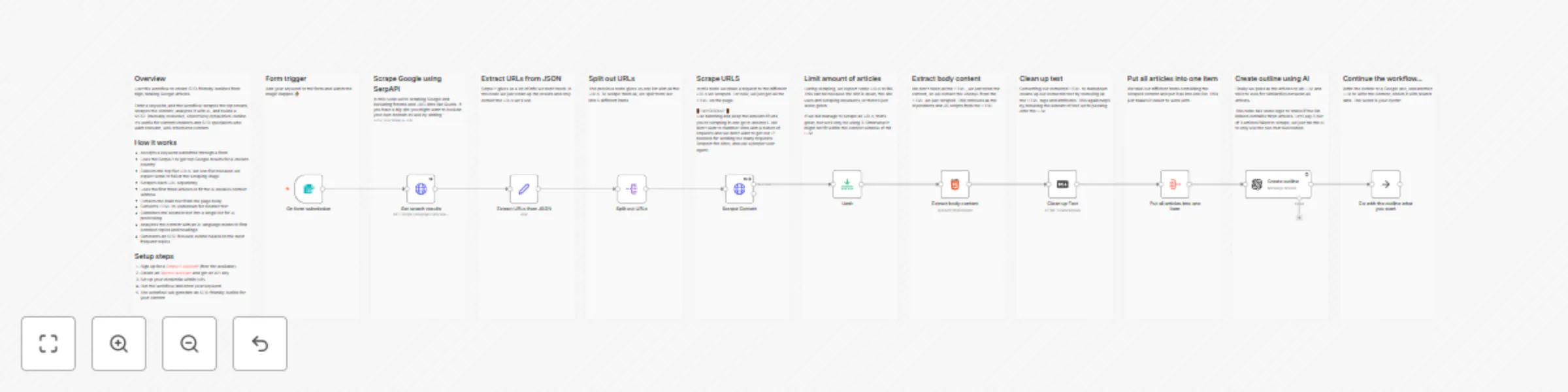
Workflow preview
100%
Create SEO outlines from top Google results with SerpAPI and GPT-4o preview
Open on n8n.io

Important notice

This workflow is provided as-is. Please review and test before using in production.

1. Workflow Overview

Use this workflow to create SEO friendly outlines based on articles that do well in Google. Enter a keyword, and the workflow scrapes the top results, scrapes the content, analyzes it with AI, and ...

Best for

  • Market Research automation workflows
  • AI Summarization automation workflows
  • advanced n8n builders looking for reusable templates

Tools used

@n8n/n8n-nodes-langchain.openai, n8n-nodes-base.httprequest, n8n-nodes-base.splitout, n8n-nodes-base.markdown, n8n-nodes-base.limit, n8n-nodes-base.stickynote, n8n-nodes-base.formtrigger, n8n-nodes-base.set

Source and attribution

This workflow is cataloged by N8N Workflows and links back to its original n8n.io source page by Robin Geuens.

Original n8n.io source

1.1 Workflow description

Title
Create SEO outlines from top Google results with SerpAPI and GPT-4o
Workflow name
Create SEO outlines from top Google results with SerpAPI and GPT-4o

Overview

Use this workflow to create SEO-friendly outlines based on articles that do well in Google.

Enter a keyword, and the workflow scrapes the top results, scrapes the content, analyzes it with AI, and builds a MECE (mutually exclusive, collectively exhaustive) outline.

It’s useful for content creators and SEO specialists who want relevant, well-structured content.

How it works

  • Accepts a keyword submitted through a form
  • Uses the SerpAPI to get top Google results for a chosen country
  • Collects the top five URLs. We use five because we expect some to fail at the scraping stage
  • Scrapes each URL separately
  • Uses the first three articles to fit the AI model’s context window
  • Extracts the main text from the page body
  • Converts HTML to Markdown to get rid of tags and attributes.
  • Combines the cleaned text into a single list for AI processing
  • Analyzes the content with an AI language model to find common topics and headings
  • Generates an SEO-focused outline based on the most frequent topics

Setup steps

  1. Sign up for a SerpAPI account (free tier available)
  2. Create an OpenAI account and get an API key
  3. Set up your credentials within N8N
  4. Run the workflow and enter your keyword in the form.
  5. The workflow will generate an SEO-friendly outline for your content

Improvement ideas

  • Add another LLM to turn the outline into an article
  • Use the Google docs API to add the outline to a Google doc
  • Enright the outline with data from Perplexity or Tavily

1.2 Logical Blocks

This catalog entry is organized from the workflow JSON. The node-level section below shows the executable blocks available for review before importing the template.

2. Block-by-Block Analysis

Block 1 - Create outline

Type / Role
@n8n/n8n-nodes-langchain.openAi - openAi
Config choices
Version 1.8

Block 2 - Get search results

Type / Role
n8n-nodes-base.httpRequest - httpRequest
Config choices
Version 4.2

Block 3 - Split out URLs

Type / Role
n8n-nodes-base.splitOut - splitOut
Config choices
Version 1

Block 4 - Clean up Text

Type / Role
n8n-nodes-base.markdown - markdown
Config choices
Version 1

Block 5 - Scrape Content

Type / Role
n8n-nodes-base.httpRequest - httpRequest
Config choices
Version 4.2

Block 6 - Limit

Type / Role
n8n-nodes-base.limit - limit
Config choices
Version 1

Block 7 - Sticky Note

Type / Role
n8n-nodes-base.stickyNote - stickyNote
Config choices
Version 1

Block 8 - On form submission

Type / Role
n8n-nodes-base.formTrigger - formTrigger
Config choices
Version 2.3

Block 9 - Sticky Note1

Type / Role
n8n-nodes-base.stickyNote - stickyNote
Config choices
Version 1

Block 10 - Sticky Note2

Type / Role
n8n-nodes-base.stickyNote - stickyNote
Config choices
Version 1

Block 11 - Sticky Note3

Type / Role
n8n-nodes-base.stickyNote - stickyNote
Config choices
Version 1

Block 12 - Extract URLs from JSON

Type / Role
n8n-nodes-base.set - set
Config choices
Version 3.4

Block 13 - Sticky Note4

Type / Role
n8n-nodes-base.stickyNote - stickyNote
Config choices
Version 1

Block 14 - Sticky Note5

Type / Role
n8n-nodes-base.stickyNote - stickyNote
Config choices
Version 1

Block 15 - Sticky Note6

Type / Role
n8n-nodes-base.stickyNote - stickyNote
Config choices
Version 1

Block 16 - Sticky Note7

Type / Role
n8n-nodes-base.stickyNote - stickyNote
Config choices
Version 1

Block 17 - Sticky Note8

Type / Role
n8n-nodes-base.stickyNote - stickyNote
Config choices
Version 1

Block 18 - Extract body content

Type / Role
n8n-nodes-base.html - html
Config choices
Version 1.2

Block 19 - Sticky Note9

Type / Role
n8n-nodes-base.stickyNote - stickyNote
Config choices
Version 1

Block 20 - Put all articles into one item

Type / Role
n8n-nodes-base.aggregate - aggregate
Config choices
Version 1

Block 21 - Sticky Note10

Type / Role
n8n-nodes-base.stickyNote - stickyNote
Config choices
Version 1

Block 22 - Do with the outline what you want

Type / Role
n8n-nodes-base.noOp - noOp
Config choices
Version 1

Block 23 - Sticky Note11

Type / Role
n8n-nodes-base.stickyNote - stickyNote
Config choices
Version 1

3. Summary Table

Workflow Create SEO outlines from top Google results with SerpAPI and GPT-4o
Complexity advanced
Nodes 23
Categories Market Research, AI Summarization
Author Robin Geuens
Published 28 Sept 2025

4. Reproducing the Workflow from Scratch

  1. 1. Download the workflow JSON

    Use the JSON export at /data/workflows/9056/9056.json as the source template for this automation.

  2. 2. Import the template into n8n

    Open n8n, import the downloaded JSON, and review each node before activating the workflow.

  3. 3. Configure credentials and variables

    Replace placeholder credentials, API keys, webhook URLs, account IDs, and environment-specific values with your own settings.

  4. 4. Test with sample data

    Run the workflow manually or in a staging workspace, inspect node output, and confirm downstream systems receive the expected data.

  5. 5. Activate and monitor

    Enable the workflow only after testing, then monitor executions, errors, and rate limits during the first production runs.

5. General Notes & Resources

Review imported nodes carefully before activation. This catalog entry is intended to help you inspect the workflow structure, understand required services, and find related templates faster.

Node names, credentials, schedules, webhook paths, and external service limits may need adjustment for your workspace.

Frequently asked questions

What does Create SEO outlines from top Google results with SerpAPI and GPT-4o do?

Use this workflow to create SEO friendly outlines based on articles that do well in Google. Enter a keyword, and the workflow scrapes the top results, scrapes the content, analyzes it with AI, and ...

What do I need before importing this workflow?

Review the workflow JSON, configure any required credentials in n8n, and test the automation in a safe workspace before using it in production.

Can I customize this workflow?

Yes. Use the block-by-block analysis and the downloadable JSON to inspect each node, then adjust credentials, prompts, schedules, filters, or destinations for your Market Research, AI Summarization use case.



