
Create AI newsletters with GPT-4o, human approval workflow, and SendGrid

Workflow preview
Workflow preview
100%
Create AI newsletters with GPT-4o, human approval workflow, and SendGrid preview
Open on n8n.io

Important notice

This workflow is provided as-is. Please review and test before using in production.

1. Workflow Overview

Generate AI newsletters from form inputs and send via SendGrid Streamline your email marketing process with this AI powered "Human in the Loop" workflow. It allows you to generate high quality, tar...

Best for

  • Social Media automation workflows
  • Multimodal AI automation workflows
  • advanced n8n builders looking for reusable templates

Tools used

n8n-nodes-base.formtrigger, n8n-nodes-base.set, n8n-nodes-base.googlesheets, @n8n/n8n-nodes-langchain.agent, @n8n/n8n-nodes-langchain.lmchatopenai, @n8n/n8n-nodes-langchain.outputparserstructured, n8n-nodes-base.markdown, n8n-nodes-base.gmail

Source and attribution

This workflow is cataloged by N8N Workflows and links back to its original n8n.io source page by 小林幸一.

Original n8n.io source

1.1 Workflow description

Title
Create AI newsletters with GPT-4o, human approval workflow, and SendGrid
Workflow name
Create AI newsletters with GPT-4o, human approval workflow, and SendGrid

Generate AI newsletters from form inputs and send via SendGrid

Streamline your email marketing process with this AI-powered "Human-in-the-Loop" workflow. It allows you to generate high-quality, targeted newsletters from a simple form input, review them via email, and automatically distribute them to your subscribers upon approval.

## Who is this for?

Digital marketers, content creators, community managers, and small business owners who want to maintain consistent communication with their audience but need to reduce the time spent on drafting and formatting emails.

## What does this workflow do?

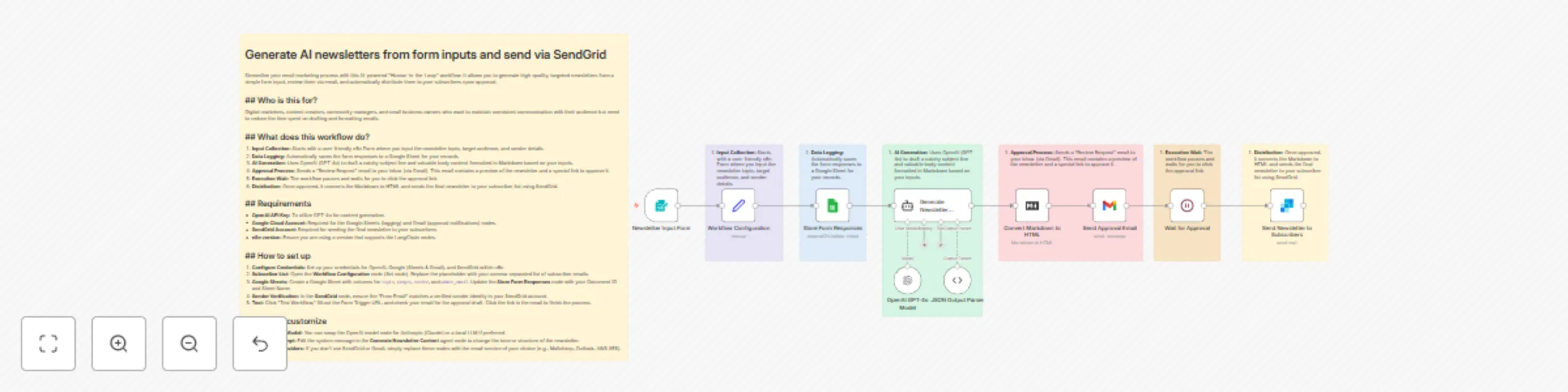
  1. Input Collection: Starts with a user-friendly n8n Form where you input the newsletter topic, target audience, and sender details.
  2. Data Logging: Automatically saves the form responses to a Google Sheet for your records.
  3. AI Generation: Uses OpenAI (GPT-4o) to draft a catchy subject line and valuable body content formatted in Markdown based on your inputs.
  4. Approval Process: Sends a "Review Request" email to your inbox (via Gmail). This email contains a preview of the newsletter and a special link to approve it.
  5. Execution Wait: The workflow pauses and waits for you to click the approval link.
  6. Distribution: Once approved, it converts the Markdown to HTML and sends the final newsletter to your subscriber list using SendGrid.

## Requirements

  • OpenAI API Key: To utilize GPT-4o for content generation.
  • Google Cloud Account: Required for the Google Sheets (logging) and Gmail (approval notifications) nodes.
  • SendGrid Account: Required for sending the final newsletter to your subscribers.
  • n8n version: Ensure you are using a version that supports the LangChain nodes.

## How to set up

  1. Configure Credentials: Set up your credentials for OpenAI, Google (Sheets & Gmail), and SendGrid within n8n.
  2. Subscriber List: Open the Workflow Configuration node (Set node). Replace the placeholder with your comma-separated list of subscriber emails.
  3. Google Sheets: Create a Google Sheet with columns for topic, target, sender, and admin_email. Update the Store Form Responses node with your Document ID and Sheet Name.
  4. Sender Verification: In the SendGrid node, ensure the "From Email" matches a verified sender identity in your SendGrid account.
  5. Test: Click "Test Workflow," fill out the Form Trigger URL, and check your email for the approval draft. Click the link in the email to finish the process.

## How to customize

  • Change the AI Model: You can swap the OpenAI model node for Anthropic (Claude) or a local LLM if preferred.
  • Adjust the Prompt: Edit the system message in the Generate Newsletter Content agent node to change the tone or structure of the newsletter.
  • Swap Email Providers: If you don't use SendGrid or Gmail, simply replace these nodes with the email service of your choice (e.g., Mailchimp, Outlook, AWS SES).

1.2 Logical Blocks

This catalog entry is organized from the workflow JSON. The node-level section below shows the executable blocks available for review before importing the template.

2. Block-by-Block Analysis

Block 1 - Newsletter Input Form

Type / Role
n8n-nodes-base.formTrigger - formTrigger
Config choices
Version 2.3

Block 2 - Workflow Configuration

Type / Role
n8n-nodes-base.set - set
Config choices
Version 3.4

Block 3 - Store Form Responses

Type / Role
n8n-nodes-base.googleSheets - googleSheets
Config choices
Version 4.7

Block 4 - Generate Newsletter Content

Type / Role
@n8n/n8n-nodes-langchain.agent - agent
Config choices
Version 3

Block 5 - OpenAI GPT-4o Model

Type / Role
@n8n/n8n-nodes-langchain.lmChatOpenAi - lmChatOpenAi
Config choices
Version 1.3

Block 6 - JSON Output Parser

Type / Role
@n8n/n8n-nodes-langchain.outputParserStructured - outputParserStructured
Config choices
Version 1.3

Block 7 - Convert Markdown to HTML

Type / Role
n8n-nodes-base.markdown - markdown
Config choices
Version 1

Block 8 - Send Approval Email

Type / Role
n8n-nodes-base.gmail - gmail
Config choices
Version 2.1

Block 9 - Wait for Approval

Type / Role
n8n-nodes-base.wait - wait
Config choices
Version 1.1

Block 10 - Send Newsletter to Subscribers

Type / Role
n8n-nodes-base.sendGrid - sendGrid
Config choices
Version 1

Block 11 - Sticky Note

Type / Role
n8n-nodes-base.stickyNote - stickyNote
Config choices
Version 1

Block 12 - Sticky Note1

Type / Role
n8n-nodes-base.stickyNote - stickyNote
Config choices
Version 1

Block 13 - Sticky Note2

Type / Role
n8n-nodes-base.stickyNote - stickyNote
Config choices
Version 1

Block 14 - Sticky Note3

Type / Role
n8n-nodes-base.stickyNote - stickyNote
Config choices
Version 1

Block 15 - Sticky Note4

Type / Role
n8n-nodes-base.stickyNote - stickyNote
Config choices
Version 1

Block 16 - Sticky Note5

Type / Role
n8n-nodes-base.stickyNote - stickyNote
Config choices
Version 1

Block 17 - Sticky Note6

Type / Role
n8n-nodes-base.stickyNote - stickyNote
Config choices
Version 1

3. Summary Table

Workflow Create AI newsletters with GPT-4o, human approval workflow, and SendGrid
Complexity advanced
Nodes 17
Categories Social Media, Multimodal AI
Author 小林幸一
Published 20 Nov 2025

4. Reproducing the Workflow from Scratch

  1. 1. Download the workflow JSON

    Use the JSON export at /data/workflows/11032/11032.json as the source template for this automation.

  2. 2. Import the template into n8n

    Open n8n, import the downloaded JSON, and review each node before activating the workflow.

  3. 3. Configure credentials and variables

    Replace placeholder credentials, API keys, webhook URLs, account IDs, and environment-specific values with your own settings.

  4. 4. Test with sample data

    Run the workflow manually or in a staging workspace, inspect node output, and confirm downstream systems receive the expected data.

  5. 5. Activate and monitor

    Enable the workflow only after testing, then monitor executions, errors, and rate limits during the first production runs.

5. General Notes & Resources

Review imported nodes carefully before activation. This catalog entry is intended to help you inspect the workflow structure, understand required services, and find related templates faster.

Node names, credentials, schedules, webhook paths, and external service limits may need adjustment for your workspace.

Frequently asked questions

What does Create AI newsletters with GPT-4o, human approval workflow, and SendGrid do?

Generate AI newsletters from form inputs and send via SendGrid Streamline your email marketing process with this AI powered "Human in the Loop" workflow. It allows you to generate high quality, tar...

What do I need before importing this workflow?

Review the workflow JSON, configure any required credentials in n8n, and test the automation in a safe workspace before using it in production.

Can I customize this workflow?

Yes. Use the block-by-block analysis and the downloadable JSON to inspect each node, then adjust credentials, prompts, schedules, filters, or destinations for your Social Media, Multimodal AI use case.



