Build a multi-site content aggregator with Google Sheets & custom extraction logic
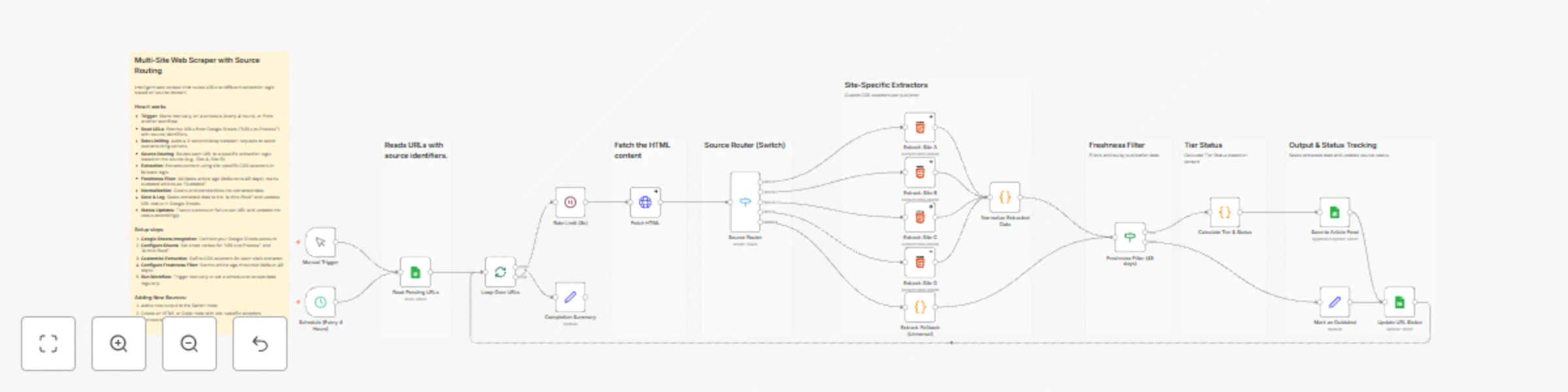
Workflow preview


 Early Deal
DISCOUNT 20%

Important notice
This workflow is provided as-is. Please review and test before using in production.
Overview
An intelligent web scraping workflow that automatically routes URLs to site-specific extraction logic, normalizes data across multiple sources, and filters content by freshness to build a unified article feed.
What Makes This Different:
- Intelligent Source Routing - Uses a Switch node to route URLs to specialized extractors based on source identifier, enabling custom CSS selectors per publisher for maximum accuracy
- Universal Fallback Parser - Advanced regex-based extractor handles unknown sources automatically, extracting title, description, author, date, and images from meta tags and HTML patterns
- Freshness Filtering - Built-in 45-day freshness threshold filters outdated content before saving, with configurable date validation logic
- Tier-Based Classification - Automatically categorizes articles into Tier 1 (0-7 days), Tier 2 (8-14 days), Tier 3 (15-30 days), or Archive based on publication date
- Rate Limiting & Error Handling - Built-in 3-second delays between requests prevents server overload, with comprehensive error handling that continues processing even if individual URLs fail
- Status Tracking - Updates source spreadsheet with processing status, enabling easy monitoring and retry logic for failed extractions
Key Benefits of Multi-Source Content Aggregation:
- Scalable Architecture - Easily add new sources by adding a Switch rule and extraction node, no code changes needed for most sites
- Data Normalization - Standardizes extracted data across all sources into a consistent format (title, description, author, date, image, canonical URL)
- Automated Processing - Schedule-based execution (every 4 hours) or manual triggers keep your feed updated without manual intervention
- Quality Control - Freshness filtering ensures only recent, relevant content enters your feed, reducing noise from outdated articles
- Flexible Input - Reads from Google Sheets, making it easy to add URLs in bulk or integrate with other systems
- Comprehensive Metadata - Captures full article metadata including canonical URLs, publication dates, author information, and featured images
Who's it for
This template is designed for content aggregators, news monitoring services, content marketers, SEO professionals, researchers, and anyone who needs to collect and normalize articles from multiple websites. It's perfect for organizations that need to monitor competitor content, aggregate industry news, build content databases, track publication trends, or create unified article feeds without manually scraping each site or writing custom scrapers for every source.
How it works / What it does
This workflow creates a unified article aggregation system that reads URLs from Google Sheets, routes them to site-specific extractors, normalizes the data, filters by freshness, and saves results to a feed. The system:
- Reads Pending URLs - Fetches URLs with source identifiers from Google Sheets, filtering for entries with "Pending" status
- Processes with Rate Limiting - Loops through URLs one at a time with a 3-second delay between requests to respect server resources
- Fetches HTML Content - Downloads page HTML with proper browser headers (User-Agent, Accept, Accept-Language) to avoid blocking
- Routes by Source - Switch node directs URLs to specialized extractors (Site A, B, C, D) or universal fallback parser based on Source field
- Extracts Article Data - Site-specific HTML nodes use custom CSS selectors, while fallback uses regex patterns to extract title, description, author, date, image, and canonical URL
- Normalizes Data - Standardizes all extracted fields into consistent format, handling missing values and trimming whitespace
- Filters by Freshness - Validates publication dates and filters out articles older than 45 days (configurable threshold)
- Calculates Tier & Status - Assigns tier classification and freshness status based on article age
- Saves to Feed - Appends normalized articles to Article Feed sheet with all metadata
- Updates Status - Marks processed URLs as complete in source sheet for tracking
Key Innovation: Source-Based Routing - Unlike generic scrapers that use one-size-fits-all extraction, this workflow uses intelligent routing to apply site-specific CSS selectors. This dramatically improves extraction accuracy while maintaining a universal fallback for unknown sources, making it both precise and extensible.
How to set up
1. Prepare Google Sheets
- Create a Google Sheet with two tabs: "URLs to Process" and "Article Feed"
- In "URLs to Process" sheet, create columns:
URL,Source,Status - Add sample data: URLs in
URLcolumn, source identifiers (e.g., "Site A", "Site B") inSourcecolumn, and "Pending" inStatuscolumn - In "Article Feed" sheet, the workflow will automatically create columns:
Title,Description,Author,datePublished,imageUrl,canonicalUrl,source,sourceUrl,tier,freshnessStatus,extractedAt - Verify your Google Sheets credentials are set up in n8n (OAuth2 recommended)
2. Configure Google Sheets Nodes
- Open the "Read Pending URLs" node and select your spreadsheet from the document dropdown
- Set sheet name to "URLs to Process"
- Configure the "Save to Article Feed" node: select same spreadsheet, set sheet name to "Article Feed", operation should be "Append or Update"
- Configure the "Update URL Status" node: same spreadsheet, "URLs to Process" sheet, operation "Update"
- Test connection by running the "Read Pending URLs" node manually to verify it can access your sheet
3. Customize Source Routing
- Open the "Source Router" (Switch node) to see current routing rules for Site A, B, C, D, and fallback
- To add a new source: Click "Add Rule", set condition:
{{ $('Loop Over URLs').item.json.Source }}equals your source name - Create a new HTML extraction node for your source with appropriate CSS selectors
- Connect the new extractor to the "Normalize Extracted Data" node
- Update the Switch node to route to your new extractor
- Example CSS selectors for common sites:
// WordPress sites
title: "h1.entry-title, .post-title"
author: ".author-name, .byline a"
date: "time.entry-date, time[datetime]"

// Modern CMS
title: "h1.article__title, article h1"
author: ".article__byline a, a[rel='author']"
date: "time[datetime], meta[property='article:published_time']"
4. Configure Freshness Threshold
- Open the "Freshness Filter (45 days)" IF node
- The current threshold is 45 days (configurable in the condition expression)
- To change threshold: Modify the expression
cutoffDate.setDate(cutoffDate.getDate() - 45)to your desired number of days - The filter marks articles as "Fresh" (within threshold) or routes to "Outdated" handler
- Test with sample URLs to verify date parsing works correctly for your sources
5. Set Up Scheduling & Test
- The workflow includes both Manual Trigger (for testing) and Schedule Trigger (runs every 4 hours)
- To customize schedule: Open "Schedule (Every 4 Hours)" node and adjust interval
- For initial testing: Use Manual Trigger, add 2-3 test URLs to your sheet with Status="Pending"
- Verify execution: Check that URLs are fetched, routed correctly, extracted, and saved to Article Feed
- Monitor the "Completion Summary" node output to see processing statistics
- Check execution logs for any errors in HTML extraction or date parsing
- Common issues: Missing CSS selectors (update extractor), date format mismatches (adjust date parsing), or rate limiting (increase wait time if needed)
Requirements
- Google Sheets Account - Active Google account with OAuth2 credentials configured in n8n for reading and writing spreadsheet data
- Source Spreadsheet - Google Sheet with "URLs to Process" and "Article Feed" tabs, properly formatted with required columns
- n8n Instance - Self-hosted or cloud n8n instance with access to external websites (HTTP Request node needs internet connectivity)
- Source Knowledge - Understanding of target website HTML structure to configure CSS selectors for site-specific extractors (or use fallback parser for unknown sources)