Back up Instagram videos to Google Drive with JSON metadata catalog
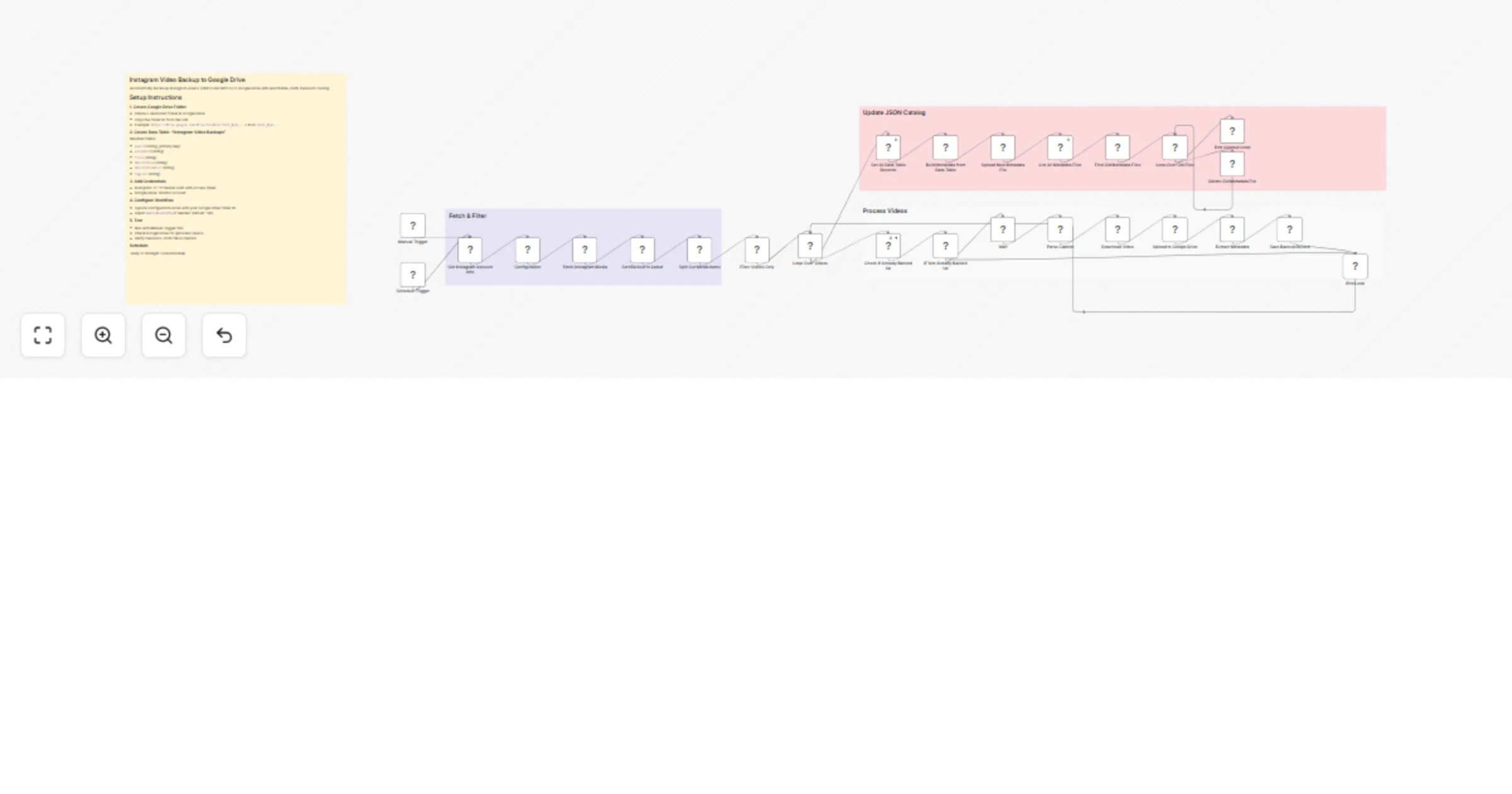
Workflow preview


 Early Deal
DISCOUNT 20%

Overview
Instagram Video Backup to Google Drive
Automatically backup all your Instagram videos to Google Drive with a searchable metadata catalog in JSON format.
What It Does
This workflow provides a complete backup solution for your Instagram video content with intelligent caption parsing:
- Fetches your Instagram account ID and videos (VIDEO and REELS types)
- Parses captions into structured fields:
- Title: Everything before the first hashtag
- Description: Everything after the first hashtag (includes all tags)
- Tag List: All hashtags extracted as an array
- Description Full: Complete original caption text
- Downloads videos in maximum available quality from Instagram
- Uploads videos to a designated Google Drive folder
- Creates/updates a JSON metadata file with all video details
- Prevents duplicates using n8n Data Tables with account-level filtering
Key Features
Account-Level Tracking: The Data Table includes accountId so you can use the same table across multiple Instagram accounts. Each account's videos are tracked separately.
Smart Caption Parsing: Automatically splits Instagram captions into title (before first #) and description (all hashtags and text after), with full text preserved in descriptionFull.
Portable Catalog: The JSON file is stored in Google Drive alongside your videos, making it accessible anywhere without needing n8n.
Maximum Quality: Uses Instagram Graph API's media_url field for highest available quality.
Hashtag Extraction: Automatically extracts all hashtags into an array for easy filtering and analysis.
Workflow Architecture
Section 1: Fetch & Filter
Get Instagram Account Info → Configuration → Fetch Media → Split Out Items → Filter Videos Only
- Get Instagram Account Info: Fetches your Instagram account ID and username
- Configuration: Stores account ID, Google Drive folder ID, and settings
- Fetch Media: Gets up to 100 media items from Instagram
- Split Out Items: Separates each media item for individual processing
- Filter Videos Only: Keeps only VIDEO and REELS types (skips images)
Section 2: Process Videos
Check If Backed Up → IF Not Backed Up → Wait → Parse Caption → Download → Upload → Extract Metadata → Save Record → Aggregate
For each video:
- Check If Already Backed Up: Queries Data Table by
postIdto avoid duplicates - IF Not Already Backed Up: Skips if video already exists
- Wait: 5-second delay between downloads (prevents API rate limits)
- Parse Caption: Splits caption into title, description, tagList, descriptionFull
- Download Video: Downloads video file from Instagram to memory
- Upload to Google Drive: Uploads video to configured folder
- Extract Metadata: Creates structured metadata object with all fields
- Save Backup Record: Stores
accountId,postId,googleDriveFileId,backedUpAtin Data Table - Aggregate: Collects all new video metadata for JSON update
Section 3: Update JSON Catalog
End Loop → Download Existing JSON → Update JSON → Upload Updated JSON
After all videos processed:
- Download Existing Metadata JSON: Gets current JSON file from Google Drive (if exists)
- Update Metadata JSON: Appends new video metadata to existing catalog
- Upload Updated Metadata JSON: Saves updated JSON back to Google Drive
Setup Steps
1. Create Google Drive Folder
- Go to Google Drive
- Create a new folder named
Instagram Video Backups(or any name you prefer) - Open the folder and copy the Folder ID from the URL:
https://drive.google.com/drive/folders/1ABC123xyz...
^^^^^^^^^^^
This is your Folder ID
2. Create n8n Data Table
Create a Data Table for deduplication tracking with account-level support:
Table Name: Instagram Video Backups
Schema:
| Field Name | Type | Description |
|---|---|---|
accountId |
string | Instagram account ID (allows multi-account use) |
postId |
string (Primary Key) | Instagram post ID |
googleDriveFileId |
string | Google Drive file ID for the video |
backedUpAt |
string | ISO timestamp of backup |
Why accountId? This allows you to use the same Data Table for multiple Instagram accounts. Each account's videos are tracked separately, preventing conflicts.
3. Configure Credentials
You'll need two credential sets:
Instagram Graph API (HTTP Bearer Auth)
- In n8n, create new credential: HTTP Bearer Auth
- Set header name:
Authorization - Set header value:
Bearer YOUR_INSTAGRAM_ACCESS_TOKEN - Name it:
Instagram Graph API
Getting Instagram Access Token:
- Follow Meta's Business Account setup guide
- Required permissions:
instagram_graph_user_media - Tokens expire after 60 days (requires manual refresh)
Google Drive OAuth2
- In n8n, create new credential: Google Drive OAuth2 API
- Follow OAuth flow to authorize your Google account
- Name it:
Google Drive Account
4. Update Configuration Node
In the workflow, open the Configuration node and update:
{
 "googleDriveFolderId": "PASTE_YOUR_FOLDER_ID_HERE",
 "maxVideosPerRun": 100,
 "waitBetweenDownloads": 5,
 "metadataFileName": "instagram-backup-metadata.json"
}
Settings Explained:
googleDriveFolderId: The folder ID you copied in step 1maxVideosPerRun: Max videos to process per run (100 is safe for API limits)waitBetweenDownloads: Seconds to wait between downloads (prevents rate limits)metadataFileName: Name of the JSON catalog file in Google Drive
Note: accountId and accountUsername are automatically populated from Instagram API.
5. Test & Activate
- Click Manual Trigger to test the workflow
- Check Google Drive folder for:
- Video files named
instagram_{postId}.mp4 - JSON file named
instagram-backup-metadata.json
- Verify Data Table has records with
accountIdandpostId - Activate the Schedule Trigger for daily automatic backups
Metadata JSON Structure
The JSON file stored in Google Drive has this structure:
{
 "lastUpdated": "2026-02-01T10:00:00Z",
 "totalVideos": 42,
 "videos": [
 {
 "accountId": "17841400123456789",
 "instagramId": "123456789",
 "permalink": "https://instagram.com/p/ABC123",
 "title": "Amazing sunset at the beach!",
 "description": "#travel #nature #sunset",
 "tagList": ["travel", "nature", "sunset"],
 "descriptionFull": "Amazing sunset at the beach! #travel #nature #sunset",
 "timestamp": "2026-01-15T08:30:00Z",
 "mediaType": "VIDEO",
 "googleDriveFileId": "1ABC123xyz...",
 "googleDriveFileName": "instagram_123456789.mp4",
 "backedUpAt": "2026-02-01T10:00:00Z"
 }
 ]
}
Field Descriptions
- accountId: Instagram account ID (from Graph API
/meendpoint) - instagramId: Instagram post ID (unique identifier)
- permalink: Direct link to Instagram post
- title: Caption text before the first hashtag
- description: Caption text from first hashtag onward (includes all tags)
- tagList: Array of hashtags without the
#symbol - descriptionFull: Complete original caption (preserves full text)
- timestamp: When the video was originally posted to Instagram
- mediaType:
VIDEOorREELS - googleDriveFileId: Google Drive file ID (use to access file via Drive API)
- googleDriveFileName: Filename in Google Drive (
instagram_{postId}.mp4) - backedUpAt: When the video was backed up (ISO timestamp)
Caption Parsing Logic
The Parse Caption Code node splits Instagram captions intelligently:
Example Caption:
"Amazing sunset at the beach! 🌅 #travel #nature #sunset"
Parsed Fields:
- title:
"Amazing sunset at the beach! 🌅" - description:
"#travel #nature #sunset" - tagList:
["travel", "nature", "sunset"] - descriptionFull:
"Amazing sunset at the beach! 🌅 #travel #nature #sunset"
Edge Cases:
- No hashtags: Entire caption becomes
title,descriptionis empty - Hashtag at start:
titleis empty, entire caption becomesdescription - Multiple lines: Preserves all line breaks in
descriptionFull
Multi-Account Usage
Using the same Data Table for multiple accounts:
- Import this workflow multiple times (once per Instagram account)
- Configure each workflow with different Instagram credentials
- Use the same Data Table name in all workflows:
Instagram Video Backups - Each workflow automatically filters by its own
accountId
Benefits:
- Single deduplication table for all accounts
- Easy to query all backups across accounts
- Prevents conflicts between accounts with same post IDs
Querying specific account backups:
// In Data Table or external script
const accountBackups = allBackups.filter(
 backup => backup.accountId === "17841400123456789"
);
API Quotas & Limits
Instagram Graph API
- Rate Limits: 200 calls/hour per user token (standard)
- This Workflow: 2 calls total (1 for account info, 1 for media fetch)
- Impact: Can run safely within free tier limits
Google Drive API
- Rate Limits: 1,000 requests per 100 seconds per user
- This Workflow: 2 calls per video (upload video + final JSON update)
- Impact: 100 videos = ~200 calls, well within limits
Recommended Schedule
- Daily (midnight): Default, safe for most accounts
- Weekly: Good for accounts with infrequent posting
- Manual: On-demand backups when needed
Troubleshooting
No videos are being backed up
Check Instagram credentials:
- Open "Get Instagram Account Info" node
- Click "Execute Node"
- Look for error messages about authentication
Verify account has videos:
- Instagram Graph API only returns VIDEO and REELS
- Won't backup images or carousels (by design)
accountId is empty in Data Table
Account info fetch failed:
- Check Instagram credentials have correct permissions
- Verify token hasn't expired (60-day limit)
- Test "Get Instagram Account Info" node separately
JSON file has wrong title/description
Caption parsing issue:
- Open "Parse Caption" Code node
- Check the output to see parsed fields
- Verify caption has hashtags (if no hashtags, entire caption becomes title)
Custom parsing logic: Edit the "Parse Caption" Code node to adjust splitting logic:
// Current: splits at FIRST hashtag
const firstHashtagIndex = caption.indexOf('#');

// Alternative: split at specific word
const splitWord = 'DESCRIPTION:';
const splitIndex = caption.indexOf(splitWord);
Duplicate videos in Google Drive
Data Table issues:
- Verify table name is exactly:
Instagram Video Backups - Check table has
postIdas primary key - Verify
accountIdfield exists
Workflow execution failed mid-run:
- If workflow fails after upload but before saving to Data Table, video won't be tracked
- Safe to delete duplicate video in Google Drive and re-run
Rate limit errors
Instagram rate limits:
- Reduce
maxVideosPerRunto 50 or 25 - Increase
waitBetweenDownloadsto 10 seconds
Google Drive rate limits:
- Unlikely with default settings
- If occurs, reduce
maxVideosPerRun
Caption has special characters (emojis, line breaks)
Emojis preserved:
- All emojis are preserved in
descriptionFull - May appear in
titleordescriptiondepending on position
Line breaks:
- Line breaks are preserved in
descriptionFull - May affect title/description split if hashtags are on new lines
Advanced Customization
Change Backup Folder
Update googleDriveFolderId in Configuration node to any Google Drive folder ID.
Change Schedule
Edit the Schedule Trigger node:
- Daily midnight:
0 0 * * *(default) - Every 12 hours:
0 */12 * * * - Weekly Sunday:
0 0 * * 0 - Custom: Use crontab.guru to generate expression
Organize Videos by Date
To create monthly subfolders (e.g., 2026-02/video.mp4):
- Before "Upload to Google Drive" node, add "Google Drive - Create Folder" node
- Folder name:
={{ $now.format('yyyy-MM') }} - Parent folder:
={{ $('Configuration').item.json.googleDriveFolderId }} - Update upload node to use created folder ID
Download Videos Locally Too
To keep local copies in addition to Google Drive:
- After "Download Video" node, add Write Binary File node
- File path:
/path/to/backup/{{ $('Extract Metadata').item.json.googleDriveFileName }} - Connect in parallel with "Upload to Google Drive"
Custom Caption Parsing
To use different title/description split logic:
Option 1: Split at specific keyword
const splitKeyword = 'DESCRIPTION:';
const splitIndex = caption.indexOf(splitKeyword);

if (splitIndex === -1) {
 title = caption.trim();
 description = '';
} else {
 title = caption.substring(0, splitIndex).trim();
 description = caption.substring(splitIndex + splitKeyword.length).trim();
}
Option 2: Use first sentence as title
const sentenceEnd = caption.match(/[.!?]/);
const endIndex = sentenceEnd ? caption.indexOf(sentenceEnd[0]) + 1 : -1;

if (endIndex === -1) {
 title = caption.trim();
 description = '';
} else {
 title = caption.substring(0, endIndex).trim();
 description = caption.substring(endIndex).trim();
}
Filter by Account in JSON
To create separate JSON files per account:
- Update "Update Metadata JSON" Code node to filter by
accountId - Change
metadataFileNameto include account username:
instagram-backup-{{ $('Configuration').item.json.accountUsername }}.json
Use Cases
Search Videos by Hashtag
Download the JSON file from Google Drive, then:
// Load JSON
const metadata = require('./instagram-backup-metadata.json');

// Find all #travel videos
const travelVideos = metadata.videos.filter(v =>
 v.tagList.includes('travel')
);

console.log(`Found ${travelVideos.length} travel videos`);
Find Videos by Date Range
const startDate = new Date('2026-01-01');
const endDate = new Date('2026-01-31');

const videosInRange = metadata.videos.filter(v => {
 const videoDate = new Date(v.timestamp);
 return videoDate >= startDate && videoDate <= endDate;
});
Generate Reports
Import JSON into Google Sheets or Excel to analyze:
- Most used hashtags
- Videos per month
- Backup coverage percentage
- Videos by account (if using multi-account setup)
Migrate to Another Platform
The JSON catalog includes permalinks and timestamps, making it easy to:
- Re-upload to YouTube, TikTok, etc.
- Generate video sitemap for website
- Create video archive with searchable metadata
Known Limitations
- Only videos: Doesn't backup images or carousel posts (by design)
- Token expiration: Instagram tokens expire after 60 days, requires manual refresh
- Storage limits: Google Drive free tier is 15GB
- No analytics: Doesn't track views, likes, or comments
- Single folder: All videos in one folder (can be customized, see Advanced Customization)
- Caption parsing: Assumes first hashtag splits title/description (customizable)
Data Privacy
- Videos are downloaded to n8n temporarily, then uploaded to Google Drive
- n8n doesn't permanently store video files
- Metadata JSON contains only public Instagram data
- Google Drive files are private to your account
- Instagram access token is encrypted by n8n credentials system
- Account ID is public data from Instagram Graph API
Version History
- v1.0 (2026-02-01): Initial release
- Daily automatic backups
- Google Drive storage
- JSON metadata catalog with smart caption parsing
- Multi-account support via accountId
- Deduplication via Data Tables
- Title/description/tagList extraction
Related Workflows
- Upload from Instagram to YouTube: Cross-post videos to YouTube with metadata
- Instagram to X: Share posts to Twitter/X
- Instagram Account Information Tracker: Track follower metrics and insights over time
Additional Resources
- Instagram Graph API Documentation
- Google Drive API Documentation
- n8n Data Tables Guide
- Instagram Access Token Setup
Support
If you encounter issues:
- Check Troubleshooting section above
- Review n8n execution logs for error details
- Verify all credentials are active and have required permissions
- Test with Manual Trigger before relying on Schedule Trigger
- Check "Parse Caption" node output if title/description is incorrect