Avoid Asking Redundant Questions with Dynamically Generated Forms using OpenAI
Workflow preview


 Early Deal
DISCOUNT 20%

Important notice
This workflow is provided as-is. Please review and test before using in production.
Overview
Avoid Asking Redundant Questions with Dynamically Generated Forms using OpenAI
Target Audience
This workflow has been built for those who require a form to capture as much data as possible as well as the answers to predefined questions, whilst optimising the user experience by avoiding asking redundant questions.
Use Case
When creating a form to capture information, it can be useful to give the user an opportunity to input a long answer to a large, open-ended question. We then want to drill down to answer specific questions that we require the answer to. When doing this, we don't want to ask duplicate questions. This particular scenario imagines an AI consultancy capturing leads.
What it Does
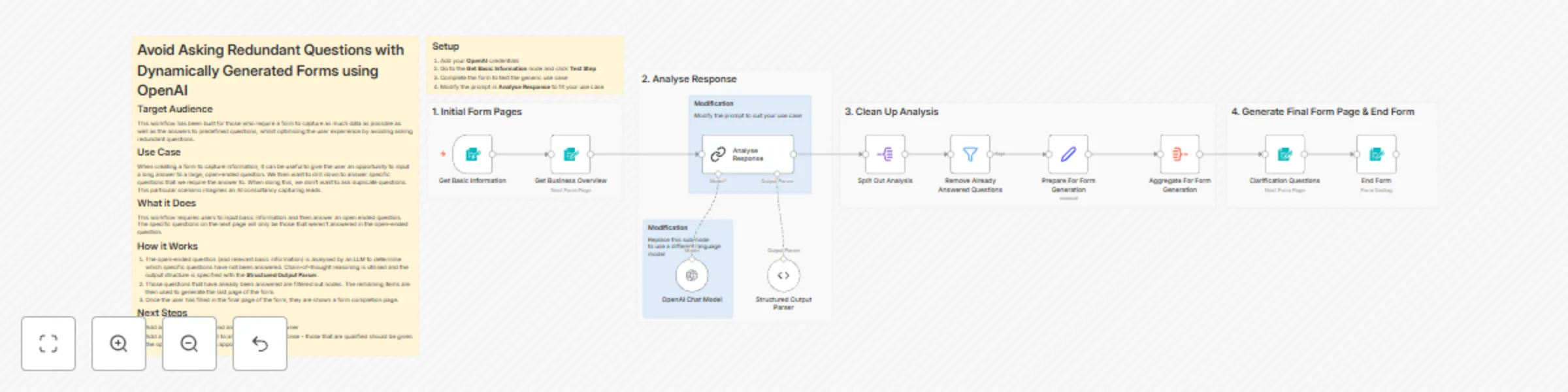
This workflow requires users to input basic information and then answer an open ended question. The specific questions on the next page will only be those that weren't answered in the open-ended question.
How it Works
- The open-ended question (and relevant basic information) is analysed by an LLM to determine which specific questions have not been answered. Chain-of-thought reasoning is utilised and the output structure is specified with the Structured Output Parser.
- Those questions that have already been answered are filtered out nodes. The remaining items are then used to generate the last page of the form.
- Once the user has filled in the final page of the form, they are shown a form completion page.
Setup
- Add your OpenAI credentials
- Go to the Get Basic Information node and click Test Step
- Complete the form to test the generic use case
- Modify the prompt in Analyse Response to fit your use case
Next Steps
- Add additional nodes to send an email to the form owner
- Add a subsequent LLM call to analyse the form response - those that are qualified should be given the opportunity to book an appointment