
Automated CVE scanning of Bug Bounty programs with Nuclei and Project Discovery

Workflow preview
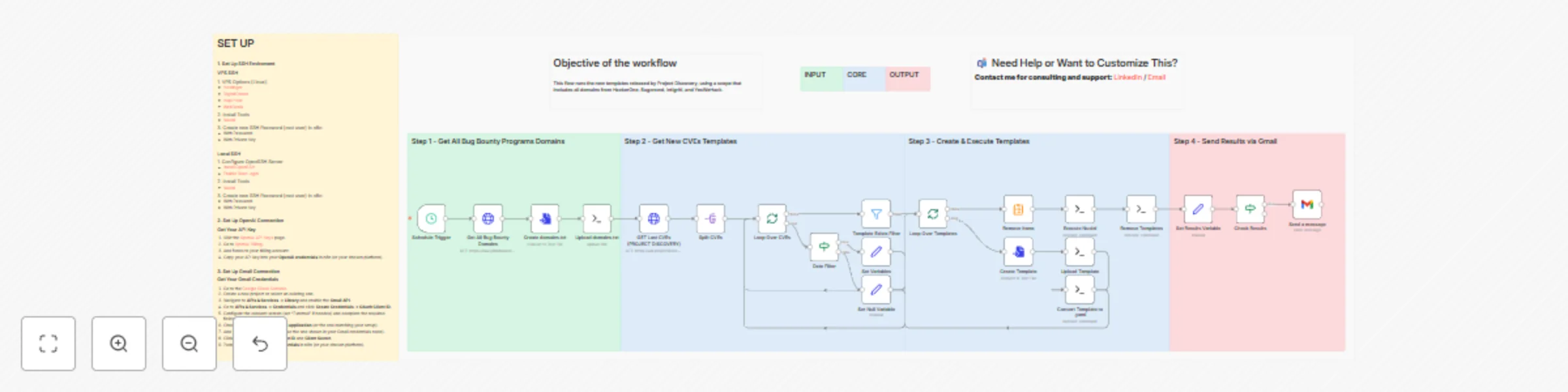
Workflow preview
100%
Automated CVE scanning of Bug Bounty programs with Nuclei and Project Discovery preview
Open on n8n.io

Important notice

This workflow is provided as-is. Please review and test before using in production.

1. Workflow Overview

Description Automates daily CVE driven scanning against bug bounty scopes. It fetches bug bounty domains, pulls newly published Project Discovery templates, converts them to Nuclei rules, runs targ...

Best for

  • SecOps automation workflows
  • advanced n8n builders looking for reusable templates

Tools used

n8n-nodes-base.scheduletrigger, n8n-nodes-base.httprequest, n8n-nodes-base.converttofile, n8n-nodes-base.ssh, n8n-nodes-base.splitinbatches, n8n-nodes-base.splitout, n8n-nodes-base.filter, n8n-nodes-base.if

Source and attribution

This workflow is cataloged by N8N Workflows and links back to its original n8n.io source page by Javier Rieiro.

Original n8n.io source

1.1 Workflow description

Title
Automated CVE scanning of Bug Bounty programs with Nuclei and Project Discovery
Workflow name
Automated CVE scanning of Bug Bounty programs with Nuclei and Project Discovery

Description

Automates daily CVE-driven scanning against bug bounty scopes. It fetches bug-bounty domains, pulls newly published Project Discovery templates, converts them to Nuclei rules, runs targeted scans, and emails findings.

Objective

Help security researchers and bug bounty hunters discover exploitable instances quickly by automatically running the latest public templates from Project Discovery against a consolidated bug-bounty scope. Reduce manual steps and maintain continuous reconnaissance.

How it works

  1. The workflow accepts or fetches a domain list that covers HackerOne, Bugcrowd, Intigriti, and YesWeHack.
  2. It downloads the latest public templates from Project Discovery.
  3. For each new template published since the last run it: creates a file, uploads it to a remote host, and converts it to a Nuclei-compatible YAML.
  4. It uploads a consolidated domains wordlist to the remote host.
  5. It executes Nuclei with the new templates against the domains list using configured flags (concurrency, rate limits, severity tags).
  6. It collects and deduplicates Nuclei output.
  7. If results exist, it sends the findings via Gmail.

Requirements

• SSH access (root or equivalent) to a VPS or host. • Nuclei installed on the remote host. • Gmail OAuth2 credentials for sending notifications. • Recommended: VPS with enough CPU and network capacity for concurrent scanning when scope is large.

1.2 Logical Blocks

This catalog entry is organized from the workflow JSON. The node-level section below shows the executable blocks available for review before importing the template.

2. Block-by-Block Analysis

Block 1 - Schedule Trigger

Type / Role
n8n-nodes-base.scheduleTrigger - scheduleTrigger
Config choices
Version 1.2

Block 2 - Get All Bug Bounty Domains

Type / Role
n8n-nodes-base.httpRequest - httpRequest
Config choices
Version 4.2

Block 3 - Create domains.txt

Type / Role
n8n-nodes-base.convertToFile - convertToFile
Config choices
Version 1.1

Block 4 - Upload domains.txt

Type / Role
n8n-nodes-base.ssh - ssh
Config choices
Version 1

Block 5 - Loop Over CVEs

Type / Role
n8n-nodes-base.splitInBatches - splitInBatches
Config choices
Version 3

Block 6 - Split CVEs

Type / Role
n8n-nodes-base.splitOut - splitOut
Config choices
Version 1

Block 7 - GET Last CVEs (PROJECT DISCOVERY)

Type / Role
n8n-nodes-base.httpRequest - httpRequest
Config choices
Version 4.2

Block 8 - Template Exists Filter

Type / Role
n8n-nodes-base.filter - filter
Config choices
Version 2.2

Block 9 - Date Filter

Type / Role
n8n-nodes-base.if - if
Config choices
Version 2.2

Block 10 - Set Variables

Type / Role
n8n-nodes-base.set - set
Config choices
Version 3.4

Block 11 - Set Null Variable

Type / Role
n8n-nodes-base.set - set
Config choices
Version 3.4

Block 12 - Loop Over Templates

Type / Role
n8n-nodes-base.splitInBatches - splitInBatches
Config choices
Version 3

Block 13 - Create Template

Type / Role
n8n-nodes-base.convertToFile - convertToFile
Config choices
Version 1.1

Block 14 - Upload Template

Type / Role
n8n-nodes-base.ssh - ssh
Config choices
Version 1

Block 15 - Convert Template to .yaml

Type / Role
n8n-nodes-base.ssh - ssh
Config choices
Version 1

Block 16 - Execute Nuclei

Type / Role
n8n-nodes-base.ssh - ssh
Config choices
Version 1

Block 17 - Remove Templates

Type / Role
n8n-nodes-base.ssh - ssh
Config choices
Version 1

Block 18 - Set Results Variable

Type / Role
n8n-nodes-base.set - set
Config choices
Version 3.4

Block 19 - Check Results

Type / Role
n8n-nodes-base.if - if
Config choices
Version 2.2

Block 20 - Send a message

Type / Role
n8n-nodes-base.gmail - gmail
Config choices
Version 2.1

Block 21 - Remove Items

Type / Role
n8n-nodes-base.summarize - summarize
Config choices
Version 1.1

Block 22 - Sticky Note

Type / Role
n8n-nodes-base.stickyNote - stickyNote
Config choices
Version 1

Block 23 - Sticky Note1

Type / Role
n8n-nodes-base.stickyNote - stickyNote
Config choices
Version 1

Block 24 - Sticky Note2

Type / Role
n8n-nodes-base.stickyNote - stickyNote
Config choices
Version 1

Showing the first 24 of 32 workflow blocks. Download the JSON for the full node graph.

3. Summary Table

Workflow Automated CVE scanning of Bug Bounty programs with Nuclei and Project Discovery
Complexity advanced
Nodes 32
Categories SecOps
Author Javier Rieiro
Published 22 Oct 2025

4. Reproducing the Workflow from Scratch

  1. 1. Download the workflow JSON

    Use the JSON export at /data/workflows/10054/10054.json as the source template for this automation.

  2. 2. Import the template into n8n

    Open n8n, import the downloaded JSON, and review each node before activating the workflow.

  3. 3. Configure credentials and variables

    Replace placeholder credentials, API keys, webhook URLs, account IDs, and environment-specific values with your own settings.

  4. 4. Test with sample data

    Run the workflow manually or in a staging workspace, inspect node output, and confirm downstream systems receive the expected data.

  5. 5. Activate and monitor

    Enable the workflow only after testing, then monitor executions, errors, and rate limits during the first production runs.

5. General Notes & Resources

Review imported nodes carefully before activation. This catalog entry is intended to help you inspect the workflow structure, understand required services, and find related templates faster.

Node names, credentials, schedules, webhook paths, and external service limits may need adjustment for your workspace.

Frequently asked questions

What does Automated CVE scanning of Bug Bounty programs with Nuclei and Project Discovery do?

Description Automates daily CVE driven scanning against bug bounty scopes. It fetches bug bounty domains, pulls newly published Project Discovery templates, converts them to Nuclei rules, runs targ...

What do I need before importing this workflow?

Review the workflow JSON, configure any required credentials in n8n, and test the automation in a safe workspace before using it in production.

Can I customize this workflow?

Yes. Use the block-by-block analysis and the downloadable JSON to inspect each node, then adjust credentials, prompts, schedules, filters, or destinations for your SecOps use case.



