Automated blog content tracking with RSS feeds and time-based filtering
Workflow preview


 Early Deal
DISCOUNT 20%

Important notice
This workflow is provided as-is. Please review and test before using in production.
Overview
Automated Blog Monitoring System with RSS Feeds and Time-Based Filtering
Overview
This workflow provides a powerful yet simple foundation for monitoring blogs using RSS feeds. It automatically fetches articles from a list of your favorite blogs and filters them based on their publication date, separating new content from old. It is the perfect starting point for anyone looking to build a custom content aggregation or notification system without needing any API keys.
This template is designed for developers, hobbyists, and marketers who want a reliable way to track new blog posts and then decide what to do with them. Instead of including a specific final step, this workflow intentionally ends with a filter, giving you complete freedom to add your own integrations.
Use Cases
Why would you need to monitor and filter blog posts?
- Build a Custom News Feed: Send new articles that match your interests directly to a Discord channel, Slack, or Telegram chat.
- Power a Newsletter: Automatically collect links and summaries from industry blogs to curate your weekly newsletter content.
- Create a Social Media Queue: Add new, relevant blog posts to a content calendar or social media scheduling tool like Buffer or Hootsuite.
- Archive Content: Save new articles to a personal database like Airtable, Notion, or Google Sheets to build a searchable knowledge base.
How It Works
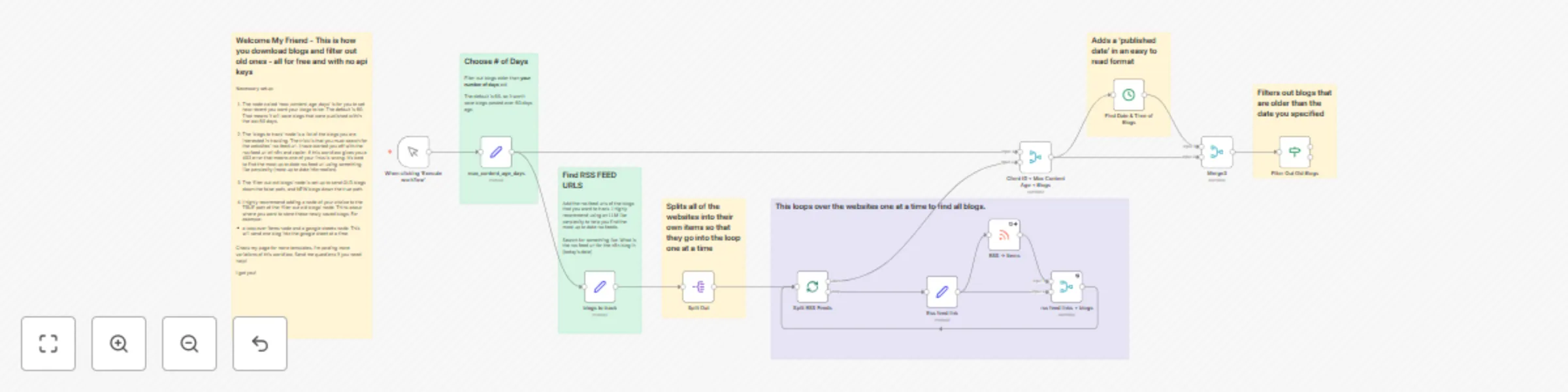
- Manual Trigger: The workflow starts when you click "Execute Workflow". You can easily swap this for a Schedule Trigger to run it automatically.
- Fetch RSS Feeds: It reads a list of RSS feed URLs that you provide in the "blogs to track" node.
- Process Each Feed: The workflow loops through each RSS feed individually.
- Filter by Date: It checks the publication date of every article and compares it to a timeframe you set (default is 60 days).
- Split New from Old:
- New articles are sent down the
truepath of the "Filter Out Old Blogs" node. - Old articles are sent down the
falsepath. - This workflow leaves the
truepath empty so you can add your desired next steps.
- New articles are sent down the
Setup and Customization
This workflow requires minimal setup and is designed for easy customization.
Add Your Blog Feeds:
- Find the "blogs to track" node.
- In the
source_identifierfield, replace the example URLs with the RSS feeds you want to monitor.
// Add your target RSS feed URLs in this array
['https://blog.n8n.io/rss', 'https://zapier.com/blog/feeds/latest/']
Set the Time Filter:
- Go to the "max_content_age_days" node.
- Change the value from the default
60to your desired number of days. For example, use7to only get articles published in the last week.
Customize Your Output (Required Next Step):
- This is the most important part! Drag a new node and connect it to the
trueoutput of the "Filter Out Old Blogs" node. - Example Idea: To save new articles to a Google Sheet, add a Split In Batches node followed by a Google Sheets node to append each new article as a new row.
- This is the most important part! Drag a new node and connect it to the