
Automate your UTM campaign tracking: Shopify, n8n to Baserow

Workflow preview
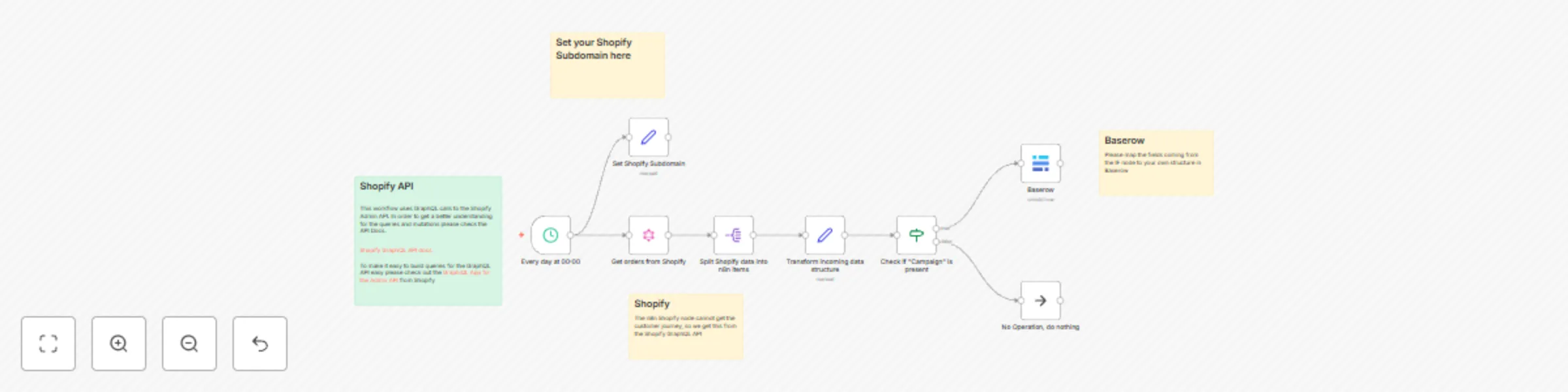
Workflow preview
100%
Automate your UTM campaign tracking: Shopify, n8n to Baserow preview
Open on n8n.io

Important notice

This workflow is provided as-is. Please review and test before using in production.

1. Workflow Overview

Campaign tracking is pivotal; it enables marketers to evaluate the efficacy of various strategies and channels. UTM parameters are particularly essential as they provide granular details about the ...

Best for

  • Market Research automation workflows
  • intermediate n8n builders looking for reusable templates

Tools used

n8n-nodes-base.baserow, n8n-nodes-base.noop, n8n-nodes-base.set, n8n-nodes-base.graphql, n8n-nodes-base.scheduletrigger, n8n-nodes-base.splitout, n8n-nodes-base.if, n8n-nodes-base.stickynote

Source and attribution

This workflow is cataloged by N8N Workflows and links back to its original n8n.io source page by Sascha.

Original n8n.io source

1.1 Workflow description

Title
Automate your UTM campaign tracking: Shopify, n8n to Baserow
Workflow name
Automate your UTM campaign tracking: Shopify, n8n to Baserow

Campaign tracking is pivotal; it enables marketers to evaluate the efficacy of various strategies and channels. UTM parameters are particularly essential as they provide granular details about the source, medium, and campaign effectiveness. However, when this data is not automatically integrated into a centralized system, it can become a tedious and error-prone process to manually collate and analyze it.

Retrieving UTM data from Shopify and storing it in Baserow enables oy to do more with this data. For example you could build a campaign database in Baserow and automatically add campaign revenue to it using this workflow template.

This template will help you:

  1. Automatically retrieve UTM parameters from Shopify orders using the Shopify Admin API
  2. Process marketing data through n8n
  3. Store this data into Baserow, providing you with a dynamic, responsive base for campaign tracking and decision-making

This template will demonstrate the follwing concepts in n8n:

  • use the Schedule trigger node
  • use the GraphQL node to call the Shopify Admin API
  • split larger incoming datasets into n8n items with the Split node
  • transform the data structure with the Set node
  • control flow with the If node
  • store data in Baserow with the Baserow node

How to get started?

  1. Create a custom app in Shopify get the credentials needed to connect n8n to Shopify This is needed for the Shopify Trigger
  2. Create Shopify Acces Token API credentials n n8n for the Shopify trigger node
  3. Create Header Auth credentials: Use X-Shopify-Access-Token as the name and the Acces-Token from the Shopify App you created as the value. The Header Auth is neccessary for the GraphQL nodes.
  4. You will need a running Baserow instance for this. You can also sign up for a free account at https://baserow.io/

Please make sure to read the notes in the template.

For a detailed explanation please check the corresponding video: https://youtu.be/VBeN-3129RM

1.2 Logical Blocks

This catalog entry is organized from the workflow JSON. The node-level section below shows the executable blocks available for review before importing the template.

2. Block-by-Block Analysis

Block 1 - Baserow

Type / Role
n8n-nodes-base.baserow - baserow
Config choices
Version 1

Block 2 - No Operation, do nothing

Type / Role
n8n-nodes-base.noOp - noOp
Config choices
Version 1

Block 3 - Set Shopify Subdomain

Type / Role
n8n-nodes-base.set - set
Config choices
Version 3.2

Block 4 - Get orders from Shopify

Type / Role
n8n-nodes-base.graphql - graphql
Config choices
Version 1

Block 5 - Every day at 00:00

Type / Role
n8n-nodes-base.scheduleTrigger - scheduleTrigger
Config choices
Version 1.1

Block 6 - Split Shopify data into n8n items

Type / Role
n8n-nodes-base.splitOut - splitOut
Config choices
Version 1

Block 7 - Transform incoming data structure

Type / Role
n8n-nodes-base.set - set
Config choices
Version 3.2

Block 8 - Check if "Campaign" is present

Type / Role
n8n-nodes-base.if - if
Config choices
Version 2

Block 9 - Sticky Note4

Type / Role
n8n-nodes-base.stickyNote - stickyNote
Config choices
Version 1

Block 10 - Sticky Note3

Type / Role
n8n-nodes-base.stickyNote - stickyNote
Config choices
Version 1

Block 11 - Sticky Note

Type / Role
n8n-nodes-base.stickyNote - stickyNote
Config choices
Version 1

Block 12 - Sticky Note2

Type / Role
n8n-nodes-base.stickyNote - stickyNote
Config choices
Version 1

3. Summary Table

Workflow Automate your UTM campaign tracking: Shopify, n8n to Baserow
Complexity intermediate
Nodes 12
Categories Market Research
Author Sascha
Published 23 Feb 2024

4. Reproducing the Workflow from Scratch

  1. 1. Download the workflow JSON

    Use the JSON export at /data/workflows/2126/2126.json as the source template for this automation.

  2. 2. Import the template into n8n

    Open n8n, import the downloaded JSON, and review each node before activating the workflow.

  3. 3. Configure credentials and variables

    Replace placeholder credentials, API keys, webhook URLs, account IDs, and environment-specific values with your own settings.

  4. 4. Test with sample data

    Run the workflow manually or in a staging workspace, inspect node output, and confirm downstream systems receive the expected data.

  5. 5. Activate and monitor

    Enable the workflow only after testing, then monitor executions, errors, and rate limits during the first production runs.

5. General Notes & Resources

Review imported nodes carefully before activation. This catalog entry is intended to help you inspect the workflow structure, understand required services, and find related templates faster.

Node names, credentials, schedules, webhook paths, and external service limits may need adjustment for your workspace.

Frequently asked questions

What does Automate your UTM campaign tracking: Shopify, n8n to Baserow do?

Campaign tracking is pivotal; it enables marketers to evaluate the efficacy of various strategies and channels. UTM parameters are particularly essential as they provide granular details about the ...

What do I need before importing this workflow?

Review the workflow JSON, configure any required credentials in n8n, and test the automation in a safe workspace before using it in production.

Can I customize this workflow?

Yes. Use the block-by-block analysis and the downloadable JSON to inspect each node, then adjust credentials, prompts, schedules, filters, or destinations for your Market Research use case.



